

More news on this day
FS Italiane Group is accelerating its push to become a central player in European rail by combining a new high-speed maintenance hub in France with an expanded network of cross-border routes connecting major capitals and regional cities.
Get the latest news straight to your inbox!
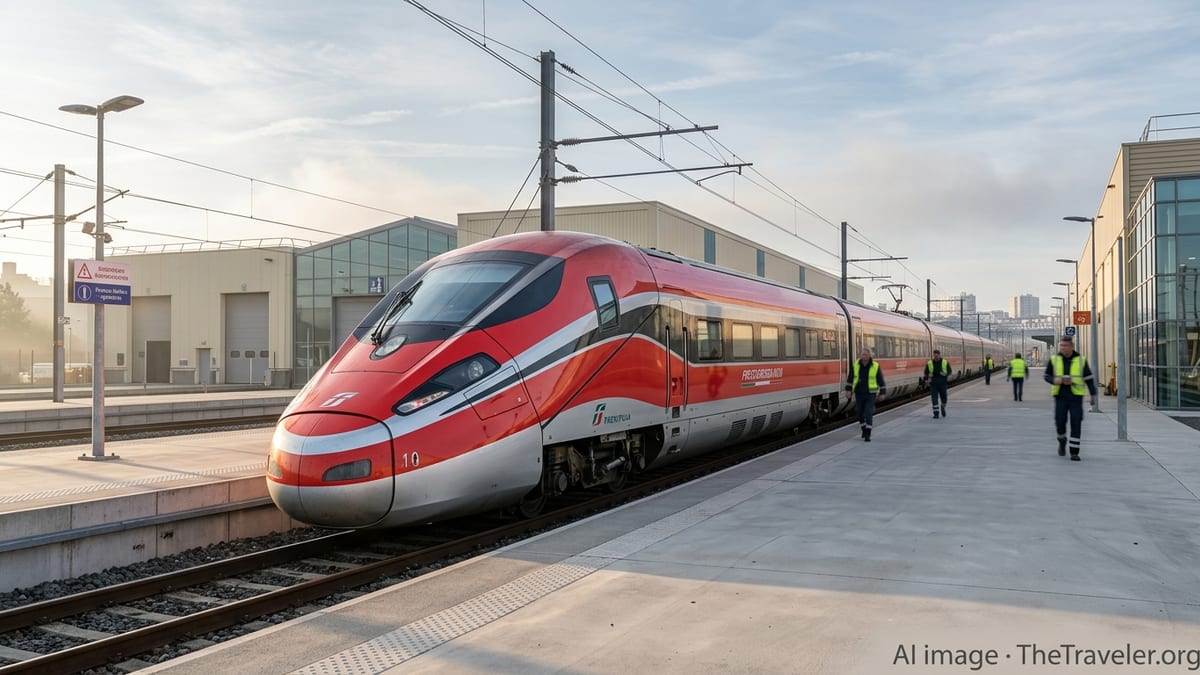
Strategic Hub Anchors FS Italiane’s Growth in France
The new maintenance hub in France is emerging as a cornerstone of FS Italiane Group’s European strategy, providing the technical backbone for a growing fleet of high-speed trains on some of the continent’s busiest corridors. Publicly available information indicates that the facility is designed to support Frecciarossa 1000 trainsets operating under the Trenitalia France brand, which already runs high-speed services on the Paris to Lyon and Paris to Marseille routes, as well as cross-border links between Paris and Milan.
The hub is intended to consolidate servicing activities that were previously dependent on external depots, a shift that is expected to improve train availability, shorten turnaround times and give the Italian operator greater control over maintenance planning. Industry coverage suggests that securing independent maintenance capacity in France has become a key competitive factor for new entrants in the liberalised high-speed market, where access to incumbent-owned depots can be constrained.
According to FS Italiane Group’s strategic planning documents, the emphasis on state-of-the-art maintenance aligns with a wider push to digitise operations and introduce predictive technologies across the fleet. The French hub is expected to integrate advanced diagnostics, condition-based monitoring and optimised workflows aimed at reducing unplanned downtime and supporting higher utilisation of rolling stock.
By situating this facility close to its main French high-speed axes, FS Italiane is positioning itself to sustain higher frequencies and more complex service patterns, while also preparing for future expansions into new routes and markets.
High-Speed Network Extends Across Key European Corridors
The French hub arrives as FS Italiane scales up its international high-speed portfolio, with services now spanning Italy, France and Spain and plans progressing for further cross-border links. Company information on European high-speed operations shows that Trenitalia France has expanded its domestic French network and strengthened connections to northern Italy, while the Iryo brand, backed by FS in Spain, operates on core Spanish high-speed routes and offers multimodal combinations via its Iryo-Conecta platform.
FS Italiane’s 2025 to 2029 Strategic Plan highlights France, Spain, Germany and cross-border projects as priority markets, describing Europe as the group’s natural home base. The strategy calls for increased high-speed capacity and new international routes that connect major economic centres and tourist destinations, complemented by digital platforms that simplify ticketing and intermodal journeys across borders.
Reports on the group’s financial performance indicate that international revenues have risen sharply in recent years, driven in part by the launch of high-speed services in France and Spain and by logistics growth in Central Europe. This momentum is shaping FS Italiane’s approach to future projects, including additional long-distance connections that link Italy with neighbouring countries, using both dedicated high-speed lines and upgraded conventional corridors.
The growing network is intended to feed into the European Union’s broader objective of shifting journeys from road and air to rail, particularly on dense short-haul corridors. By scaling up services across multiple countries, FS Italiane is aligning its business ambitions with this policy trend, while using its French maintenance capacity to underpin reliability on international routes.
Paris–London Vision and New Cross-Border Links
FS Italiane’s expansion plans go beyond existing French and Spanish operations to include a proposed high-speed link between Paris and London by the end of the decade. Company announcements outline an intention to introduce a new competitor on the heavily trafficked corridor through the Channel Tunnel, subject to technical, regulatory and commercial assessments that are currently under way. The service would draw on the group’s experience running Frecciarossa trains on international routes and on its strengthened presence in both France and the United Kingdom.
A strategic partnership between FS Group and investment firm Certares, focused initially on Trenitalia France, is expected to support this cross-Channel ambition. Publicly available information on the agreement describes a planned investment of around 1 billion euros in France and the United Kingdom, including the purchase of new high-speed trainsets and marketing initiatives designed to position rail as a viable alternative to short-haul flights for business and leisure travellers.
Beyond the Paris to London project, FS Italiane has signalled interest in additional cross-border corridors that would link northern Italy with Germany and other parts of Central Europe. Sector commentary points to potential routes between Milan and Munich, with extensions further into Germany under evaluation. These concepts build on the group’s existing cross-border passenger and freight services, including links through Switzerland and Austria, and anticipate a more integrated north-south high-speed spine.
In parallel, the group continues to run the Paris to Milan connection, positioning it as an example of how open-access competition can broaden choices for passengers and encourage innovation in onboard services. The new French maintenance hub is expected to support this and future cross-border trains by providing dedicated facilities for inspections, repairs and upgrades close to key junctions.
Maintenance Innovation Underpins Reliability and Passenger Experience
The emphasis on a state-of-the-art hub reflects a wider shift in European rail operations toward data-driven maintenance and lifecycle management. FS Italiane documentation on its transformation programme highlights connectivity, safety and network digitisation as central elements, with maintenance processes increasingly supported by real-time diagnostics and centralised control systems.
Within this context, the French hub is expected to function as both a workshop and a data centre for rolling stock performance, feeding information to engineers and planners across the group. By pairing physical infrastructure with digital tools, FS Italiane aims to anticipate component wear, optimise spare parts logistics and schedule interventions during off-peak windows, minimising disruption for passengers.
These practices are particularly significant for high-speed operations, where tight headways and long-distance services leave little margin for unplanned incidents. Reliability is a key differentiator in competitive markets such as France and Spain, and reports from operators across Europe indicate that maintenance access has become a determining factor in timetable planning, rolling stock rotation and customer satisfaction scores.
As FS Italiane brings more trainsets into service for international routes, the French hub is expected to play a growing role in ensuring that increased capacity does not come at the expense of punctuality or comfort. Investments in interiors, onboard connectivity and energy efficiency are closely tied to maintenance capabilities, which allow the company to keep trains in optimal condition over their service life.
Europe-Wide Ambitions Aligned with Sustainability Goals
The expansion of FS Italiane’s high-speed and cross-border services is occurring against the backdrop of European policies that prioritise rail as a low-carbon transport mode. Financing initiatives such as green bonds arranged with European institutions for new high-speed trains in Italy and Spain underscore the link between fleet renewal and decarbonisation objectives across the Trans-European Transport Network.
Public information on FS Italiane’s investment pipeline shows a strong focus on infrastructure and rolling stock projects that support a shift from private cars and short-haul aviation to rail, particularly on routes under roughly 800 kilometres. By enhancing cross-border connectivity and improving service quality, the group aims to attract both frequent business travellers and occasional tourists who may previously have opted for flights.
Industry observers note that these trends are reshaping competition in European rail, with new entrants challenging long-established incumbents on key corridors. FS Italiane’s French maintenance hub and its network of high-speed services position the company as one of the most prominent cross-border players, working alongside other operators within a more open and interconnected market framework.
For travellers, the combination of new maintenance capacity, modern rolling stock and a denser map of international routes promises shorter journey times and more direct city centre connections. As additional projects such as the proposed Paris to London link and further German extensions advance, FS Italiane’s evolving footprint illustrates how strategic investment in hubs and cross-border corridors can accelerate the transformation of rail travel across Europe.