

More news on this day
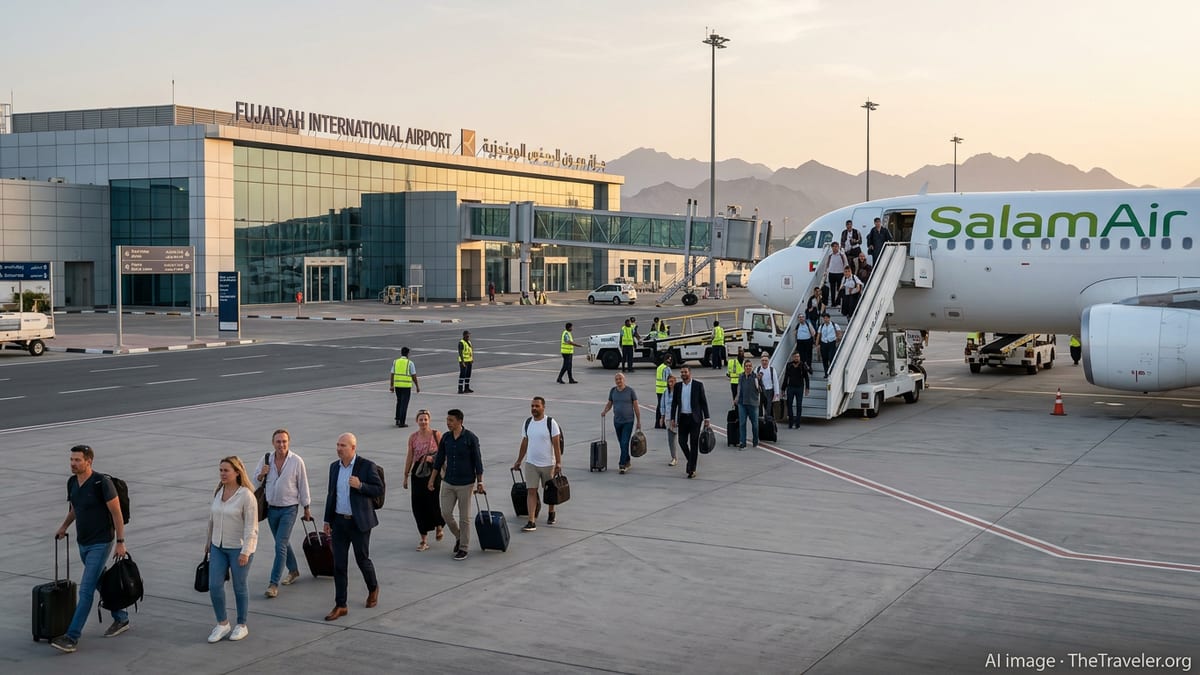
Fujairah International Airport in the United Arab Emirates has opened its doors to tourists and stranded travelers as a temporary charter hub, launching special flights via Muscat to keep people moving amid a fast‑evolving regional crisis that has disrupted normal air routes across the Middle East.
New Charter Corridor Links Fujairah to Five Key Destinations
Airport authorities in Fujairah have confirmed a series of special charter services in partnership with Oman-based carrier SalamAir, positioning the east coast emirate as an alternative gateway for travelers affected by widespread flight cancellations and diversions in the region. The limited-time operation is being promoted as both a humanitarian corridor and a practical option for tourists and residents seeking a way out of the current congestion at larger Gulf hubs.
The charter flights, operating on March 4 and 5 via Muscat, connect Fujairah with five major international destinations: Calicut, Hyderabad and Lucknow in India, as well as Istanbul in Turkey and Karachi in Pakistan. By routing passengers through the Omani capital, the airport and airline are effectively stitching together a temporary bridge between the UAE and some of the markets most affected by the recent wave of disrupted itineraries.
Bookings for the services are being handled through SalamAir’s regular commercial channels, but officials stress that the operation is distinct from normal scheduled traffic. The airport describes the initiative as a focused response to an extraordinary situation, with teams on the ground working extended hours to process travelers who have been rerouted from other UAE airports or have arrived in Fujairah by road from neighboring emirates.
For leisure and business travelers alike, the move offers a crucial alternative at a time when many are facing long delays, complex rebookings and limited capacity on remaining flights out of the Gulf. Travel agents in the UAE and in key origin markets have begun steering clients toward Fujairah as news of the new corridor filters through.
Humanitarian Focus as Regional Tensions Disrupt Air Travel
The charter program has been framed by officials as a humanitarian effort first and foremost, aimed at helping travelers return to their home countries amid a period of elevated tension and shifting airspace restrictions across parts of the Middle East. In recent days, a number of international airlines have suspended or adjusted services to major regional hubs, triggering a knock-on effect that left many passengers stranded far from home.
By stepping in with dedicated charter flights, Fujairah International Airport is seeking to ease pressure on the region’s busier gateways while providing a controlled and secure environment for transit. Airport management has highlighted its coordination with UAE and Omani authorities, as well as with airline and ground handling partners, to keep the operation aligned with evolving safety and overflight guidance.
The focus on repatriation and essential travel does not exclude tourists. Many of those now transiting Fujairah are visitors who began their journeys as holidaymakers in the UAE or wider Gulf, only to see their return flights disrupted as airlines adjusted routes. For them, the airport’s new role is a lifeline that turns what could have been an open-ended stay into a managed and relatively predictable journey home.
Industry observers note that the move also underscores how secondary airports can play a stabilizing role when regional networks are strained. With sufficient runway capacity, modern facilities and close proximity to major road links, Fujairah is well placed to absorb a surge of traffic in a way that remains manageable for staff and passengers.
Operational Readiness Showcases Fujairah’s Growing Ambitions
Although the current charter operation is time-limited, it has drawn attention to Fujairah International Airport’s broader ambitions in the aviation and tourism sectors. Historically overshadowed by the UAE’s larger hubs, the airport has invested in infrastructure and services aimed at attracting more passenger and cargo traffic over the long term. The rapid deployment of a complex charter program in partnership with SalamAir is being seen locally as a test of those capabilities under pressure.
Officials say the airport has activated contingency plans designed for crisis scenarios, ramping up staff across check-in, security, immigration and ground handling. Special assistance desks have been set up to guide passengers whose travel plans have been disrupted, while coordination centers inside the terminal link airport teams with airline control rooms and government agencies monitoring the wider regional picture.
For Fujairah itself, the sudden influx of travelers presents both logistical challenges and an unexpected showcase. Hotels along the emirate’s coastline and in the city center are receiving short-notice bookings from passengers facing layovers or missed connections, while local transport providers are seeing increased demand for transfers to and from other UAE cities. Tourism officials are quietly hopeful that some of these travelers will return under calmer circumstances, having had a first glimpse of Fujairah’s beaches and mountain landscapes while in transit.
Aviation analysts suggest that the performance of the airport during this period could strengthen its case for additional scheduled services in the future. Demonstrating that it can handle a surge of international charter movements while maintaining service standards and safety compliance may help attract both regional carriers and niche long-haul operators once the current crisis eases.
Passenger Experience: From Stranded to Supported
On the ground, the immediate priority is passenger experience. Many travelers arriving in Fujairah have already endured hours of uncertainty and complex overland journeys after flights were rerouted or canceled at short notice. In response, the airport has bolstered frontline teams tasked with managing queues, assisting with rebookings and providing clear information in multiple languages throughout the terminal.
Temporary signage and dedicated charter check-in zones have been introduced to streamline flows for SalamAir services, while additional security and immigration counters are being opened as required to reduce waiting times. Airport staff are also working closely with tour operators and group coordinators to keep families and tour parties together through each stage of the process.
Food and beverage outlets at the airport have reportedly been asked to extend operating hours to cater to late-night and early-morning departures. Prayer rooms and quiet areas are being used by passengers with longer waits between arrival and onward connection, and airport medical teams remain on standby to support travelers who may be experiencing stress or fatigue.
Travelers who spoke to regional media described a sense of relief at having a clear pathway home after days of uncertainty. For many, the combination of structured charter services and visible on-the-ground support has turned Fujairah from a little-known name on the map into a reassuring waypoint in an otherwise disjointed journey.
Implications for Future Regional Connectivity
While the current charter schedule is fixed for March 4 and 5, the airport has left the door open to further operations if conditions require. That flexibility is being closely watched by regional planners, who see in Fujairah’s rapid pivot a template for how smaller airports might be mobilized when major hubs are disrupted by geopolitical events, weather or other shocks to the system.
The collaboration with SalamAir may also point to deeper cross-border partnerships in Gulf aviation, particularly around crisis planning and shared contingency networks. By using Muscat as a central switching point for flights originating in Fujairah and continuing to key markets in South Asia and Europe, the current operation illustrates how multiple gateways can be woven together to preserve essential connectivity even as standard schedules are upended.
For tourists and residents weighing travel decisions in the coming days, the Fujairah initiative adds a measure of resilience to a fragile situation. Although it does not replace the scale and frequency of regular services into the region’s largest airports, it offers a clear example of how targeted charter links can fill critical gaps and keep itineraries viable when broader networks come under strain.
As the regional picture continues to evolve, the experience of Fujairah International Airport is likely to feed into future planning across the Gulf. Whether or not it leads directly to new long-term routes, the episode has thrust the airport into the spotlight as both a humanitarian gateway in a moment of crisis and an emerging player in the wider tourism and aviation landscape of the United Arab Emirates.