

More news on this day
Galveston Wharves has adopted an updated 20-year strategic master plan that charts ambitious growth in cruise tourism, cargo throughput and commercial development, positioning the Texas Gulf port for significantly expanded economic impact over the next two decades.
Get the latest news straight to your inbox!
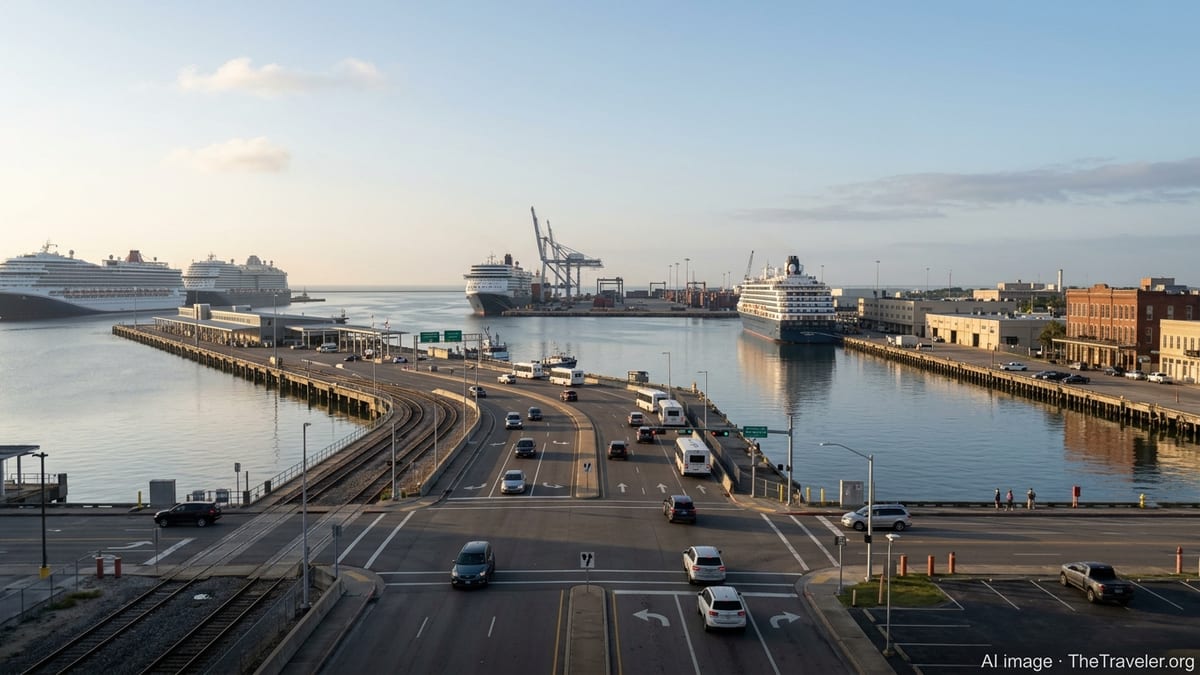
Updated Master Plan Adopted After Years of Rapid Growth
Publicly available information shows that the Galveston Wharves Board of Trustees unanimously adopted the updated 20-Year Strategic Master Plan on February 11, 2026, following several years of faster than expected growth across its main business lines. The port’s first master plan, adopted in 2019, guided a period of substantial expansion that included two new cruise terminals, an internal roadway and new or expanded cargo facilities.
Port publications indicate that gross revenues rose from about 59 million dollars in 2019 to more than 87 million dollars in 2025, while operating expenses remained close to 40 million dollars during that period. Reports characterize this performance as evidence that the original long-range roadmap delivered both traffic growth and stronger financial reserves, giving the port greater capacity to tackle long-deferred infrastructure work.
After delivering several flagship projects ahead of schedule, the board elected in 2025 to commission an update to the plan. International consultancy Bermello Ajamil and Partners, which developed the original framework, was retained to refresh the document using new market forecasts, technical studies and community feedback. The adopted update extends the planning horizon to roughly 2045 and resets project priorities in light of booming cruise demand and renewed industrial interest along the Gulf Coast.
According to port communications, the updated plan is designed as a flexible roadmap rather than a fixed construction schedule, with projects to be phased in line with market conditions, financing capacity and stakeholder input.
Cruise Sector: New Terminals and Traffic Management Focus
Galveston has emerged in recent years as the fourth-ranked cruise homeport in the United States, handling about 3.4 million passenger movements through three terminals in 2024, according to industry coverage. Forecasts cited in the master plan update point to continued growth, with Galveston expected to increase its share of the North American cruise market and add more homeported vessels over the 20-year horizon.
Reports indicate that the strategy centers on a fourth cruise terminal opening in November 2025, developed under a long-term agreement with MSC Cruises and positioned to also serve Norwegian Cruise Line. The new facility, at Pier 16, is expected to generate an additional 10 million to 14 million dollars in annual revenue and support hundreds of jobs once fully operational, according to published coverage of port financial projections.
The updated master plan outlines further potential cruise infrastructure beyond this fourth terminal, including additional berths, expanded on-site parking garages and extended internal roadways to move vehicles away from city streets. Planning documents emphasize traffic management on and around Harborside Drive as a critical issue, with additional cueing lanes, grade improvements and roadway connections intended to relieve congestion as sailings increase.
Industry reports note that the plan also calls for continued upgrades to the port’s legacy Cruise Terminals 25 and 28 to maintain competitiveness, with improvements to passenger facilities, baggage handling, security areas and shore power readiness evaluated as part of the long-term vision.
Cargo Expansion at West Port and Pelican Island
Cargo remains a central pillar of the updated strategy, with the plan seeking to increase annual cargo volumes from roughly 3 million tons to more than 5 million tons within the next 5 to 10 years. Port documents outline a substantial build-out of the West Port Cargo Complex, where the board previously approved a nearly 30 million dollar construction contract as the first phase of a projected 90 million dollar expansion program.
According to published information, this work includes rebuilding and strengthening waterfront structures, replacing aging piers, and ultimately creating a 1,426-foot-long continuous berth to accommodate larger and more diverse cargo vessels. Subsequent phases are expected to add new paving, laydown areas, rail connections and utilities, backed in part by state grants and port-generated reserves.
The updated master plan also looks across the channel to Pelican Island as a major long-term growth front. Planning materials highlight opportunities for new industrial and maritime-related developments supported by improved bridge and rail infrastructure. Publicly available summaries of the plan describe Pelican Island as a key location for future heavy-lift, project cargo and potential wind energy components, aligning with trends in Gulf Coast energy and manufacturing sectors.
According to state and regional planning documents, Galveston’s cargo growth strategy is closely linked to its cruise revenues: surpluses from the booming passenger business are being used to reinvest in working docks and terminals, with the aim of diversifying income streams and reinforcing the port’s role as a logistics hub for Texas and the wider central United States.
Commercial Waterfront Vision and Tourism Development
Beyond core maritime operations, the updated 20-year roadmap sets out an expansive commercial vision along the eastern side of the port, adjacent to Galveston’s historic Strand district and downtown. Summaries of the plan describe a new commercial and recreational district featuring a maritime park, mixed-use developments and enhanced public access to the waterfront.
Planning materials reference a concept that would integrate the preserved battleship USS Texas as a major visitor attraction at the port, alongside a hotel, retail spaces and residential units. The aim, according to port communications, is to leverage growing cruise traffic and regional tourism to support year-round activity along the harbor, extending the existing visitor footprint and connecting it more directly with the working waterfront.
The master plan update also calls for a new public boardwalk and improved pedestrian connections between cruise terminals, the commercial waterfront and downtown Galveston. These elements are framed as a way to balance operational efficiency with community access, seeking to maintain the port’s industrial role while opening more areas for recreation, heritage interpretation and tourism-oriented businesses.
Local economic development reports suggest that such commercial projects are expected to catalyze private investment in adjacent neighborhoods, further knitting together the city’s beach, historic and harbor-front attractions into a unified visitor offering.
Community Input, Financing and Long-Term Outlook
In conjunction with adoption of the updated plan, Galveston Wharves has launched a new round of public outreach. Port announcements describe an open-house format at Cruise Terminal 16 and opportunities to review plan highlights online, with comments invited from residents, businesses and industry stakeholders. The process builds on earlier community engagement that informed the 2019 master plan and its first set of revisions.
From a financing standpoint, publicly available information indicates that the port is relying on a mix of bond sales, state infrastructure grants and internally generated cash flow to fund the plan’s early phases. A notable recent move was a 157 million dollar bond issuance tied to cruise terminal development that reportedly attracted strong investor interest, reflecting confidence in Galveston’s position in the North American cruise market.
Over the full 20-year horizon, the updated strategic master plan projects robust growth in both cruise and cargo revenues, alongside expanded commercial leases and tourism activity along the waterfront. Regional planning documents and industry analyses point to expectations that Galveston’s gross revenues could continue to rise sharply as new terminals, berths and commercial spaces come online.
While specific project timelines remain subject to market conditions and regulatory approvals, the adoption of the updated master plan in February 2026 marks a significant milestone. It provides a consolidated vision for how Galveston Wharves aims to manage rapid cruise expansion, modernize cargo infrastructure and reshape its commercial waterfront, reinforcing the port’s role as a major economic engine for the city, the Houston-Galveston region and the wider Texas Gulf Coast.