

More news on this day
Mounting airport delays, growing staffing shortfalls at Transportation Security Administration checkpoints and escalating concerns from the travel industry have prompted the Global Business Travel Association to again urge the U.S. Congress to end the ongoing partial government shutdown.
Get the latest news straight to your inbox!
Business Travel Sector Sounds Alarm Over Airport Disruptions
The Global Business Travel Association, representing a wide cross section of corporate travel buyers and suppliers, has renewed its warnings that the shutdown is undermining the reliability of the U.S. air travel system. Publicly available statements from the association emphasize that extended disruption at security checkpoints and in air traffic control threatens both traveler confidence and the broader business travel economy.
Industry data from trade groups and financial analysts covering the shutdown period indicate that longer queues at security, missed connections and schedule disruptions are becoming increasingly common at major hubs. Reports highlight pressure points at airports such as Hartsfield Jackson Atlanta, Chicago O Hare, New York LaGuardia and other high volume facilities, where thin staffing levels are amplifying normal peak time congestion.
According to coverage by national business outlets, airlines and airports are already recording softer demand on some routes as corporate travel managers weigh the risk of delays and consider deferring nonessential trips. The GBTA has framed these developments as a direct threat to productivity, noting that lost time in transit quickly translates into higher costs for companies that depend on frequent face to face meetings.
The association s renewed appeal to Congress follows earlier warnings issued during past shutdowns, when TSA absenteeism and air traffic controller staffing problems contributed to ground stops and checkpoint closures. Current conditions, many observers note, are tracking similar patterns, with signs that front line federal workers are facing mounting financial and operational strain.
TSA Staffing Shortages Translate Into Long Lines and Checkpoint Closures
Publicly available data from the TSA and aviation industry reports show that unscheduled absences among security screeners have risen notably as the shutdown drags on and paychecks are delayed. Previous shutdowns saw unscheduled absence rates rise well above the agency s typical baseline, triggering lane closures at several large airports; this year, airport and airline briefings suggest that comparable trends are again emerging.
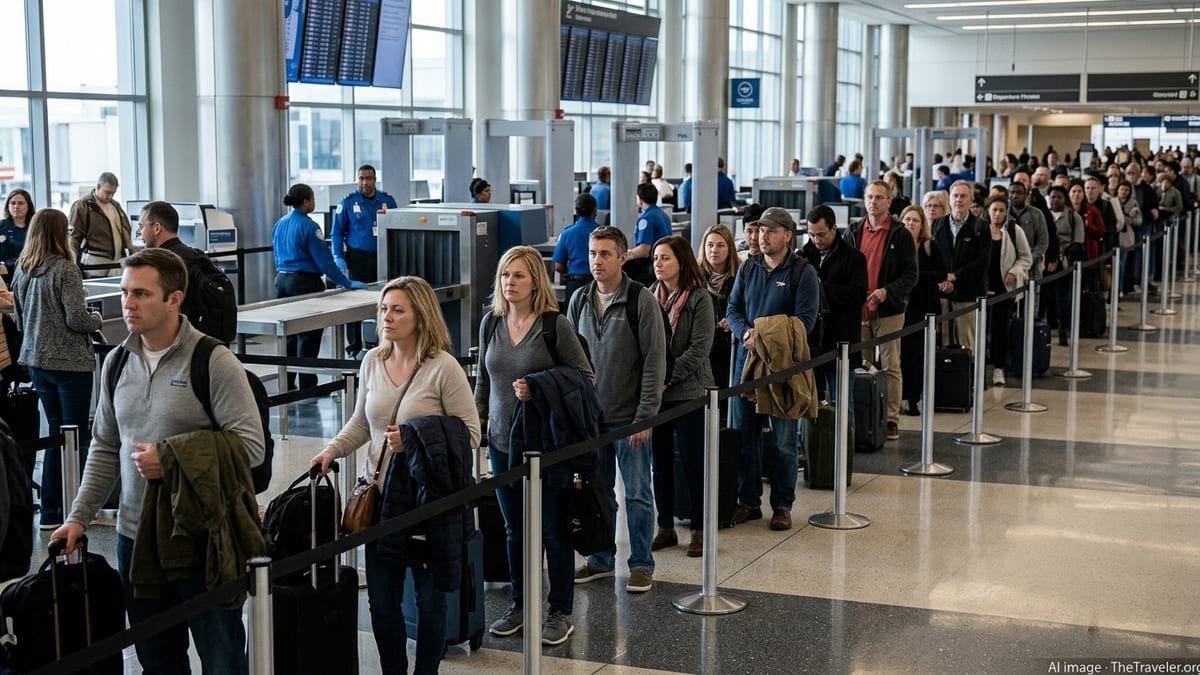
Coverage from national news organizations describes security lines stretching for hundreds of meters at peak times, particularly at busy connecting hubs and in key East Coast markets. Some airports have consolidated checkpoints in order to cope with thinner staffing, a step that can keep operations functioning but often pushes wait times past the 45 minute mark and, in extreme cases, over 90 minutes.
Analyses from business publications have also pointed out that TSA has limited ability to rapidly bring in new personnel or trainees during a funding lapse. Training pipelines and background checks are slower under constrained budgets, which means that resignations or extended absences among experienced screeners have an outsized impact on daily throughput. This structural vulnerability is part of the reason trade groups argue that shutdowns pose a systemic risk for aviation rather than a short term inconvenience.
Airport executives quoted in industry coverage have warned that if staffing metrics deteriorate further, some smaller or mid sized airports could face partial terminal shutdowns or time limited closures of security lanes. That scenario would likely funnel even more passengers into already strained hubs, compounding the very delays that GBTA and other travel stakeholders are flagging for lawmakers.
Ripple Effects for Airlines, Airports and Regional Economies
The strain on TSA staffing is only one piece of a broader aviation disruption picture that concerns the business travel community. Reports from airline earnings calls and airport authority updates indicate that the shutdown is delaying certain regulatory approvals, complicating route planning and slowing infrastructure related decision making, all of which add uncertainty to carriers medium term strategies.
In major metropolitan areas, travel and tourism bodies are tracking potential losses in visitor spending and meeting bookings. When corporate buyers adjust travel policies in response to perceived reliability risks, high value sectors such as financial services, technology and professional consulting can quickly scale back trips, with downstream impacts on hotels, convention centers, restaurants and ground transportation providers.
Analysts looking back at earlier shutdown periods have documented reduced passenger throughput and an uptick in delays and cancellations, particularly when air traffic control centers also struggle with staffing. Business travel observers note that if the current impasse extends much longer, similar patterns could emerge again, affecting not only coast to coast routes but also regional connections that rely heavily on timely security processing.
Local economies with airports that serve as business travel gateways are especially exposed. Cities positioning themselves as conference hubs or headquarters locations depend on predictable air service and efficient security screening as part of their value proposition. GBTA s latest call for congressional action reflects concerns that prolonged uncertainty could cause companies to reconsider where and how they hold meetings and invest in future projects.
Traveler Experience Deteriorates as Wait Times Climb
For individual travelers, the most visible impact of TSA workforce strain is at the checkpoint. Passenger accounts compiled in news coverage describe early morning crowds forming before lanes open, sporadic closure of PreCheck lines in order to redirect staff and a general shift toward more conservative arrival times at the airport.
Travel advisors and corporate travel managers are increasingly recommending that passengers arrive well ahead of their scheduled departures, sometimes by as much as three hours for domestic flights at the busiest airports. This precaution can help reduce the risk of missed flights, but it also lengthens door to door journey times and affects traveler satisfaction scores that many companies use to gauge the performance of their travel programs.
Airlines and airports have tried to offset some of the disruption by increasing communication on social channels and airport displays about checkpoint conditions. However, without full control over federal staffing, their ability to guarantee consistent wait times remains limited during a funding lapse. GBTA and other industry groups argue that the most effective way to stabilize the passenger experience is to restore normal pay and support for TSA personnel through prompt legislative action.
As the shutdown continues, the contrast between airports with relatively stable staffing and those heavily affected by absenteeism is becoming more pronounced. This uneven experience makes it harder for companies to standardize travel policies across networks and adds another layer of complexity for travel planners working to keep employees moving safely and efficiently.