

More news on this day
Gulf aviation hubs are at the heart of the world’s worst air travel disruption since the pandemic, with more than 23,000 flights reportedly cancelled across GCC carriers in recent days and hundreds of thousands of passengers stranded from Dubai to Doha as war and airspace closures reshape global routes.
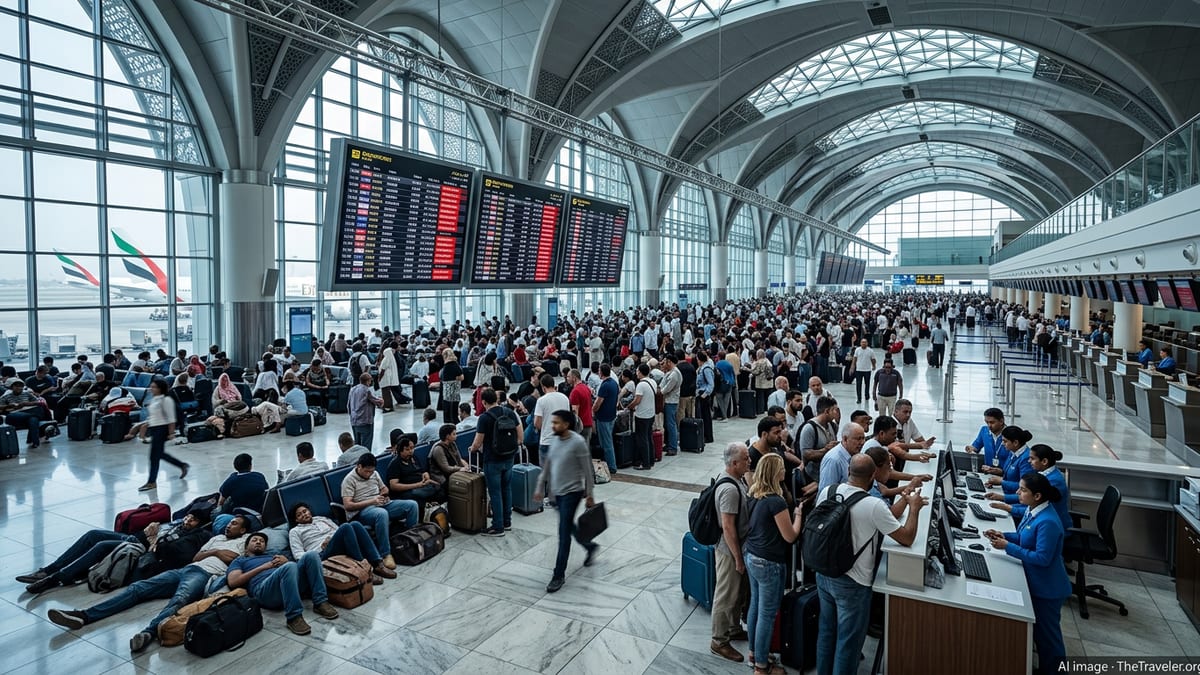
Conflict, Closures and the Scale of the GCC Flight Meltdown
The rapid escalation of conflict involving Iran and Western allies has triggered rolling airspace closures across the Gulf, shutting down or sharply curtailing operations at key hubs in the United Arab Emirates, Qatar, Bahrain and beyond. Airports in Dubai, Abu Dhabi and Doha, normally among the busiest transit points on earth, have seen days of suspended or severely reduced schedules as authorities keep skies closed or tightly restricted for security reasons.
Industry data suggests that more than 23,000 flights touching GCC states have been cancelled since the latest phase of the crisis intensified, with knock-on disruption rippling into Europe, Africa and Asia. Analysts estimate that on a normal day, Emirates, Qatar Airways and Etihad alone handle close to a quarter of a million passengers through their hubs. Today, much of that traffic is either grounded, rerouted via longer polar or African paths, or left in limbo as carriers wait for clearer safety assessments.
While some airlines, particularly in the UAE, have begun operating limited “special” or diversionary services, many scheduled passenger flights remain off the boards. Qatar Airways has been hit especially hard because its Doha hub is surrounded by restricted airspace, leaving the carrier with few viable alternatives that do not traverse contested skies. That reality is central to what travelers can realistically expect in terms of refunds, rebooking and cash compensation.
For passengers, the result is a patchwork of airport shutdowns, last-minute cancellations and rolling delays that often change by the hour. Official travel advisories from governments in Europe, Asia and North America now warn against nonessential travel through the Gulf, and aviation regulators in several countries have issued emergency notices that effectively lock in the disruption for at least the short term.
Refunds: When You Can Get Your Money Back in Cash
Across the Gulf, one critical point cuts through the noise: if your flight is cancelled by the airline, you are usually entitled to a refund of the unused portion of your ticket, regardless of the reason for the disruption. That principle is reflected in the conditions of carriage of major GCC airlines and, in some cases, strengthened by international regulations when flights touch certain jurisdictions.
For itineraries departing the European Union or United Kingdom, or operated by EU or UK carriers, the EU261 and UK261 regimes give passengers a clear legal right to choose between a refund and rerouting when a flight is cancelled. Under these rules, the choice belongs to the traveler, not the airline. If you no longer wish to travel because the disruption makes the trip pointless or unsafe, you can demand a cash refund instead of accepting a voucher or distant rebooking date.
By contrast, on many purely Gulf or Asia–Gulf routes operated by regional carriers, passenger rights are governed by local contract terms and national regulations. Emirates, Qatar Airways and Etihad have all activated temporary waiver policies during the crisis, generally offering full refunds for cancelled flights or for customers directly covered by their travel alerts. However, where cancellations are explicitly linked to airspace closures or security decisions, airlines are framing refunds as a goodwill or policy-based gesture rather than a legal obligation to pay extra compensation.
Travelers should be wary of defaulting to vouchers unless they are certain they will return to the same airline. In most cases, it is possible to insist on a refund in the original form of payment for a cancelled flight, especially where a carrier’s own public waiver statements refer to “full refunds” or “ticket refunds on request.” Screenshots of those statements and booking confirmations showing the cancellation are vital evidence if there is later a dispute with the airline or a credit card company.
Rebooking in a Moving Target: Getting Home or Rerouted
For many stranded passengers, the more urgent priority is not a refund but a way home. GCC and foreign airlines are juggling complex operational constraints, including rerouting around closed skies and managing fuel and crew duty limits on significantly longer flights. This means that even when rebooking is offered, options can be limited and travel times dramatically extended.
Major Gulf carriers have published temporary “commercial waivers” that allow at least one free change of date and, in some cases, rerouting via alternative hubs. Emirates and Etihad have begun operating a smaller number of flights using circuitous routes that add several hours per sector, while foreign airlines are pushing more traffic through Istanbul and European hubs instead of the Gulf. These waivers often cover travel over a specific time window and require rebooking in the same cabin, though fare differences may be waived for nearby dates.
Qatar Airways’ situation is more constrained, with large parts of its usual airspace effectively off-limits. The airline is prioritising essential freight, rescue and repatriation sectors, and is rebooking disrupted passengers into the “next available” seats when routes reopen. In practice, that may mean long waits and multi-stop journeys via third countries, particularly for travelers headed between Europe and Asia who would normally enjoy single-stop transits in Doha.
Passengers willing to be flexible on dates, routing and even nearby destination airports tend to secure seats more quickly. Experts recommend asking agents to search regional alternatives such as Muscat, Riyadh or Jeddah, as well as European or Turkish hubs, and to check alliance and codeshare partners that may have spare capacity outside the core Gulf corridor. Where airlines are overwhelmed, many travelers are turning to local travel agencies or online booking platforms once refunds are confirmed, using fresh tickets to bypass congested call centers.
Compensation, Duty of Care and What You Are Unlikely to Get
The most misunderstood part of the current crisis is financial compensation beyond a ticket refund. Under EU261 and similar frameworks, passengers on many flights to and from Europe are normally entitled to fixed cash payouts for cancellations and long delays that are within an airline’s control. However, those regulations explicitly exclude “extraordinary circumstances” such as war, security emergencies and air traffic control shutdowns.
Regulators and Gulf-based carriers are making it clear that the present wave of cancellations falls squarely into that extraordinary category. That means passengers should not expect the usual compensation sums, even on routes that start or end in the EU or UK. GCC airlines are instead emphasizing their duty of care obligations, such as providing meals, basic refreshments, hotel accommodation where available and assistance with communications for those stranded away from home.
The extent of that duty of care varies by jurisdiction and airline policy. Some carriers are paying for hotels and meals only when passengers are stuck overnight at their hub airports, while others are offering meal vouchers or partial reimbursements capped at a daily limit. In heavily affected cities where rooms are scarce, airlines are also encouraging passengers to arrange their own accommodation and claim back costs later, subject to receipts and policy caps. This creates a practical gap between theoretical rights and what disrupted travelers can realistically secure on the ground.
Insurance has become another flashpoint. Standard travel policies frequently exclude conflict-related events or classify them as “known risks” once government advisories are issued. That leaves many passengers discovering that they are not covered for cancellation or curtailment simply because they are now uncomfortable transiting the region. Only those with policies that specifically include war or advisory-triggered cancellation, or who bought coverage before the crisis escalated, are likely to see claims approved for nonrefundable costs such as hotels and tours.
Act Now: Practical Steps to Secure Your Entitlements
With call centers jammed and websites overloaded, timing and documentation are crucial for passengers trying to salvage value from disrupted GCC flights. Consumer advocates stress that travelers should avoid cancelling bookings of their own accord before an airline officially cancels or changes the flight. Voluntary cancellations often convert a potentially refundable ticket into a voucher or fee-heavy change, weakening the traveler’s legal position.
Instead, experts advise monitoring your booking through the airline app or website, enrolling in flight-status text alerts and watching for travel waivers tied to specific dates and routes. Once your flight is formally flagged as cancelled or significantly changed, you can request either a refund or rebooking according to the most favorable policy that applies, whether under regional law or the airline’s published waiver. Keeping detailed records of every communication, from confirmation emails to chat transcripts, can prove decisive in any later dispute with the airline, regulator or credit card issuer.
Passengers who face stonewalling or slow responses from GCC carriers have several escalation routes. Those departing from the EU or UK can file complaints with national enforcement bodies responsible for air passenger rights, while customers who paid by credit card may pursue chargebacks if services are not delivered. In major Gulf markets, civil aviation authorities also accept complaints against airlines, though processing times can be long during a mass disruption.
For now, the broader picture remains highly fluid. Airspace restrictions can tighten or ease with little warning, and airlines are constantly recalibrating schedules and waiver policies in response. Travelers with upcoming trips through the Gulf are being urged to build in maximum flexibility, review their insurance coverage line by line and be prepared to choose quickly between refund and rerouting as their flights are updated. In a crisis where geopolitics is driving aviation decisions, knowing your rights and acting fast may be the only leverage passengers can realistically exercise.