

From the Blue Ridge Mountains to the Atlantic coast, Georgia delivers an impressive range of scenery, culture, and unforgettable travel moments. This bucket list brings together the state’s must-see places and signature experiences, from Savannah’s cobblestone streets and Atlanta’s skyline to quiet blackwater swamps and windswept barrier islands. Whether you are planning your first visit or returning to dig deeper, these highlights capture the essence of the Peach State at its most memorable.
Savannah’s Historic Charm and Coastal Breezes
Savannah is often the first stop on any Georgia bucket list, and with good reason. The city’s historic district unfolds in a walkable grid of leafy squares framed by live oaks draped in Spanish moss, Gothic churches, and stately 19th century townhouses. Strolling Bull Street or the lanes around Chippewa and Madison squares, you can easily spend a day ducking into art galleries, historic homes, and shaded parks that feel a world away from modern life.
Down by the water, River Street runs along old cotton warehouses that now house restaurants, shops, and galleries. Cobblestone ramps descend toward the Savannah River, where cargo ships glide past at nearly eye level. Evenings are especially atmospheric, with brick facades glowing in lamplight and the scent of Lowcountry cooking in the air. Many visitors pair a riverfront walk with a harbor cruise or simple people watching from one of the broad riverside benches.
Just outside downtown, Bonaventure Cemetery has become one of Savannah’s signature sights. Winding dirt paths lead past elaborate Victorian funerary sculptures and crumbling family plots shaded by endless rows of live oaks. While it is a working cemetery and deserves quiet respect, it is also a remarkable outdoor museum that tells the story of Savannah’s families, from Civil War soldiers to modern-day locals.
For a change of scene, make time for the Victorian-era neighborhoods and the arts district that radiate south of Forsyth Park. This broad green space, anchored by its famous white fountain, functions as Savannah’s communal living room, with joggers, dog walkers, and families gathering beneath the trees. Cafes and bakeries ring the park, making it an ideal place to start or end a full day of exploration.
Tybee Island and the Atlantic Coast
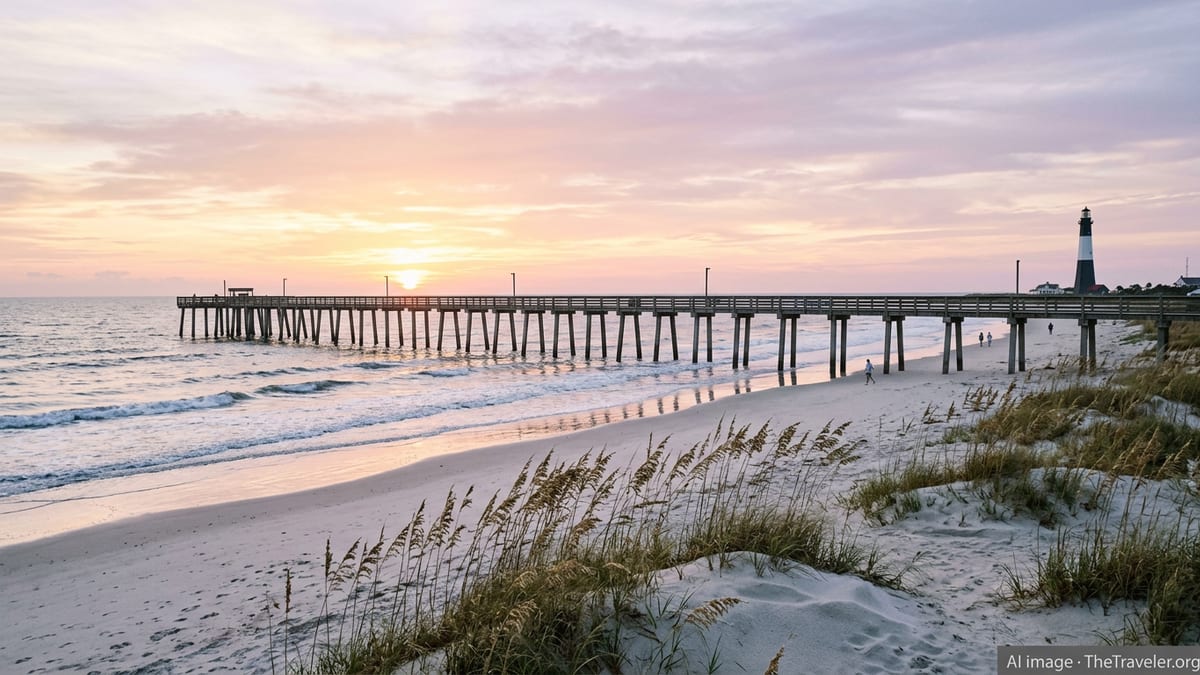
Less than a half-hour’s drive from downtown Savannah, Tybee Island offers a classic Georgia beach experience. The island combines broad, sandy shoreline with a distinctly laid-back, small-town atmosphere, making it one of the state’s most accessible coastal escapes. Families spread out near the centrally located Tybee Pier and Pavilion, where fishermen cast lines, musicians often perform, and sunrise or sunset walks become a daily ritual for many visitors.
On the quieter north end of Tybee, the Tybee Island Light Station rises above a cluster of historic keeper’s cottages. Considered the oldest and tallest lighthouse in Georgia, the tower’s 170-plus steps reward climbers with sweeping views of the Atlantic, Savannah River channel, and low-lying marshes that define Georgia’s coast. Nearby, the former Fort Screven military complex and the Tybee Island Museum help fill in the island’s layered history, from early colonial defenses to 20th century seaside resort days.
Nature lovers can explore nearby salt marshes and tidal creeks by kayak or paddleboard, looking for dolphin pods, wading birds, and the subtle shifts of the tidal ecosystem. Outfitters on the island arrange guided paddles that introduce first-time visitors to the rhythms of the marsh. For a more remote experience, Little Tybee Island, an undeveloped barrier island just to the south, lures experienced paddlers and boaters with primitive camping, wide empty beaches, and star-filled night skies.
Tybee’s growing profile as a beach destination also reflects its role in statewide tourism promotion. The Tybee Island pier has appeared as a cover image for the official Georgia state travel guide, highlighting the island’s status as one of the state’s signature coastal scenes. Today, Tybee blends classic beach-town pleasures with conservation-focused experiences such as marine science programs and sea turtle education, making it an appealing stop for both relaxation and learning.
Atlanta: Urban Energy and Cultural Icons
No Georgia bucket list is complete without time in Atlanta, the state’s sprawling and fast-evolving capital. Often described as the commercial and transportation engine of the Southeast, Atlanta balances glass-and-steel skyscrapers with leafy historic neighborhoods and an increasingly vibrant street-level culture. Visitors usually begin downtown or in adjacent Midtown, where major cultural venues and attractions sit within a short ride of each other.
The Martin Luther King Jr. National Historical Park anchors Atlanta’s powerful civil rights story. The district includes King’s birth home, Ebenezer Baptist Church, and the King Center, where exhibits and memorials explore the legacy of the civil rights movement. A short distance away, the National Center for Civil and Human Rights connects that history to ongoing global struggles, giving visitors context that resonates long after they leave the galleries.
For a lighter change of pace, the Atlanta BeltLine has transformed former rail corridors into a string of multiuse trails lined with public art, parks, and adaptive reuse developments. The Eastside Trail, in particular, winds through neighborhoods filled with restaurants, loft spaces, and breweries, making it a favorite among locals for weekend strolls and bike rides. Nearby, Ponce City Market and Krog Street Market have become food hall landmarks, bringing together local chefs, small retailers, and rooftop entertainment.
Families and first-time visitors often gravitate toward Centennial Olympic Park, the Georgia Aquarium, and nearby attractions. The aquarium, frequently ranked among the largest of its kind, showcases everything from whale sharks and manta rays to local river species. Just next door, World of Coca Cola explores the story of the iconic Atlanta-born brand through interactive exhibits, while the park itself offers green space for festivals, splash fountains, and skyline views that frame the city’s contemporary identity.
Blue Ridge Mountains and North Georgia High Country
North Georgia’s mountains provide a dramatic contrast to the low country and coast, earning a place on many bucket lists for their hiking, waterfalls, and small-town charm. Centered around communities like Blue Ridge, Dahlonega, and Helen, the region delivers four distinct seasons, from spring wildflowers to winter mist hugging the ridgelines. For travelers driving up from Atlanta, the mountains feel surprisingly close yet entirely different in pace and atmosphere.
The town of Blue Ridge has emerged as one of the region’s standout destinations, celebrated by regional travel magazines for its blend of outdoor access and polished amenities. Surrounded by Chattahoochee National Forest, the area boasts hundreds of miles of hiking trails, including access to segments of the Appalachian Trail, as well as numerous trout streams and mountain lakes. Many visitors ride the Blue Ridge Scenic Railway along the Toccoa River, watching wooded hills roll by from vintage railcars.
Further east, mountain roads lead to popular waterfall hikes and scenic overlooks that are especially photogenic in autumn when hardwood forests turn shades of red, gold, and orange. State parks in the region protect deep gorges, high-elevation balds, and panoramic vistas. Cabins tucked into the hills range from rustic to luxury, allowing travelers to choose between unplugged retreats and modern comforts with hot tubs and fireplaces.
The high country is also wine country. Vineyards have taken advantage of the area’s rolling hills and cooler temperatures to produce regional wines that can be sampled in tasting rooms with mountain views. Small downtowns offer another kind of reward, with galleries focused on local crafts, live-music venues, and farm-to-table restaurants that highlight north Georgia’s agricultural bounty.
Okefenokee Swamp and Georgia’s Wild Side
In the southeast corner of the state, the Okefenokee Swamp offers one of Georgia’s most distinctive natural experiences. Sprawling over hundreds of thousands of acres, it is recognized as one of North America’s most extensive blackwater wetlands. The swamp’s tannin-rich waters, floating islands of vegetation, and cypress forests create a hauntingly beautiful landscape that feels far removed from urban life.
Several access points allow visitors to explore different facets of the Okefenokee. Near Waycross, an established park entrance provides boardwalks, boat tours, and wildlife exhibits that make the ecosystem accessible to first-time visitors. From there, guided boat trips slide along historic Native American waterways and past stands of cypress draped in Spanish moss, offering chances to spot alligators, turtles, and an array of birdlife. Elevated observation towers reveal the mosaic of open prairie, forested islands, and dark channels that define the swamp.
On the western side of the refuge, Stephen C. Foster State Park serves as a smaller, more remote gateway deep within the wetland. Here, the focus is on quiet paddling routes, fishing, and unspoiled night skies. The park has been recognized as an official dark sky site, making it one of Georgia’s premier locations for stargazing. On clear nights, the Milky Way arches overhead, and the only sounds may be frogs, owls, and the quiet splash of a paddle in the distance.
Because the Okefenokee is a sensitive environment, visitor services emphasize education and low-impact exploration. Outfitters and refuge staff help visitors understand water levels, seasonal wildlife patterns, and safety considerations before setting out. That thoughtful approach helps ensure that the swamp remains a sanctuary for both wildlife and those seeking a glimpse of wild Georgia at its most elemental.
Historic Heartland: Athens, Macon, and Small-Town Georgia
Between Atlanta and the coast lies a belt of college towns, music hubs, and small communities that capture another side of the Georgia story. Athens, home to the University of Georgia, blends neoclassical campus buildings with a vibrant downtown anchored by music clubs, coffeehouses, and creative boutiques. Long known as the launchpad for influential bands, Athens maintains an energetic live-music scene that thrives alongside its football culture and youthful student spirit.
Southwest of Athens, Macon sits along the Ocmulgee River and has increasingly highlighted its musical and Native American heritage. Historic neighborhoods showcase grand antebellum homes and early 20th century architecture, while museums and venues trace the city’s connections to artists ranging from soul and rock icons to contemporary performers. Natural and cultural sites along the river corridor, including a recently designated national historical park, add layers of history that reach back thousands of years.
Scattered across the region, smaller towns offer slower-paced detours that reward curious travelers with courthouse squares, locally owned diners, and seasonal festivals. Places like Madison, with its well-preserved antebellum streetscape, or Thomasville, known for its historic downtown and quail-hunting traditions, provide compelling reasons to leave the interstate. These communities often serve as gateways to lakes, state parks, and scenic byways that rarely make national headlines but add richness to any Georgia itinerary.
Exploring Georgia’s heartland encourages a different style of travel. Instead of checking off a single marquee attraction, visitors are invited to linger in locally owned shops, chat with residents, and absorb the particular cadence of small-town life. In many ways, it is here, in corner cafes and brick-lined main streets, that the state’s famed hospitality feels most tangible.
Barrier Islands and Coastal Wilderness Beyond Tybee
While Tybee Island is the most accessible beach for many visitors, Georgia’s coast stretches south in a string of barrier islands that combine resort amenities with large tracts of protected wilderness. Islands like St. Simons and Jekyll offer a mix of hotels, historic sites, golf courses, and wide beaches where tide patterns create shifting sandbars and tidal pools. Live oaks and Spanish moss line bike paths and island lanes, providing shade and a sense of timeless Southern character.
Jekyll Island, managed with a strong conservation focus, limits development and maintains long stretches of undeveloped shoreline. Driftwood-strewn beaches, maritime forests, and marsh viewpoints invite exploration on foot or by bicycle. Historic districts recall the Gilded Age, when industrial titans used the island as a seasonal retreat, while modern facilities host conferences, family vacations, and nature programs.
Farther off the grid, islands accessible only by boat, such as Cumberland, protect some of the most pristine beaches and maritime forests on the Eastern Seaboard. Wild horses grazing in dune meadows, loggerhead sea turtle nesting sites, and undeveloped backcountry campsites make these places feel remote even though they sit relatively close to the mainland. Permits, ferry reservations, and careful planning are essential, which in turn helps limit impact and preserve the islands’ sense of solitude.
Collectively, Georgia’s barrier islands underscore the state’s commitment to balancing tourism and conservation. Visitors willing to navigate ferry schedules or kayak routes are rewarded with quiet beaches where the loudest sounds are waves and shorebirds, and where sunrise and sunset frame some of the most photogenic scenes in the state.
The Takeaway
Georgia’s appeal lies in its diversity. Within a single state, travelers can wander through moss-draped squares in Savannah, hike mountain trails in the north, experience big-city culture and civil rights history in Atlanta, and drift by alligators in a blackwater swamp. Layered atop those landscapes are vibrant music scenes, inventive food, deep-rooted traditions, and countless stories of resilience and creativity.
Building a Georgia bucket list is less about checking off a rigid set of sights and more about choosing a mix of experiences that reflect your interests. One trip might focus on hiking and waterfalls in the Blue Ridge region, another on coastal islands and Lowcountry cuisine, and yet another on civil rights landmarks and college-town music venues. Regardless of the route, you are likely to encounter the state’s trademark hospitality and a sense of place strong enough to inspire return visits.
As you plan, leave room in your schedule for detours. Some of Georgia’s most memorable moments happen in unscheduled conversations on a town square, quiet sunsets on a little-known beach, or roadside produce stands on a back highway. Those unscripted experiences, combined with the marquee destinations highlighted here, are what transform a standard vacation into a personal connection with the Peach State.
FAQ
Q1. When is the best time of year to visit Georgia for this bucket list?
Spring and fall are generally ideal, with mild temperatures, blooming azaleas in March and April, and colorful mountain foliage from late October into early November.
Q2. How many days should I plan for a first-time Georgia trip?
A week allows you to sample Atlanta, Savannah, and at least one additional region such as the mountains or coast, though shorter three to four day trips can focus on a single area.
Q3. Do I need a car to explore these destinations?
A car offers the most flexibility, especially for the mountains, small towns, and the Okefenokee. Major cities like Atlanta and Savannah have rideshares and limited transit, but rural areas do not.
Q4. Is Georgia’s summer heat difficult for outdoor activities?
Summer can be hot and humid, especially in the south and along the coast, so plan early-morning or evening activities, stay hydrated, and build in breaks in air-conditioned spaces.
Q5. Are Georgia’s beaches suitable for families?
Yes, islands such as Tybee, Jekyll, and St. Simons are popular with families, offering gentle surf, lifeguards in season at main beaches, and a range of kid-friendly activities.
Q6. How accessible are the Okefenokee Swamp and dark sky areas?
Designated park entrances have paved roads, parking, and visitor centers, but some experiences require boat tours or canoe rentals. Dark sky recognition sites usually offer basic facilities and limited ambient light.
Q7. What should I pack for a trip that includes both mountains and coast?
Plan layers for cooler mountain evenings, lightweight clothing for coastal humidity, comfortable walking shoes, rain protection, insect repellent, and sun protection including a hat and reef-safe sunscreen.
Q8. Is it possible to visit civil rights sites and relax at the beach on the same trip?
Yes, many travelers spend a few days in Atlanta for museums and historic sites, then continue to Savannah and Tybee Island or another coastal destination for a change of pace.
Q9. Are reservations necessary for popular parks and islands?
For cabins, campgrounds, and limited-access islands, advance reservations are strongly recommended, particularly during school holidays, long weekends, and spring and fall peak seasons.
Q10. How can I travel responsibly while exploring Georgia?
Respect posted guidelines in parks and wildlife areas, support locally owned businesses, reduce waste by carrying reusable bottles and bags, and stay on marked trails to help protect sensitive ecosystems.