

More news on this day
German travelers are leaning into summer 2026 with their wallets pointed firmly toward Türkiye, as strong early bookings, competitive prices, and well-developed resort infrastructure keep the country near the top of Germany’s preferred holiday destinations despite ongoing geopolitical tensions and domestic political frictions in both Ankara and Berlin.
Get the latest news straight to your inbox!
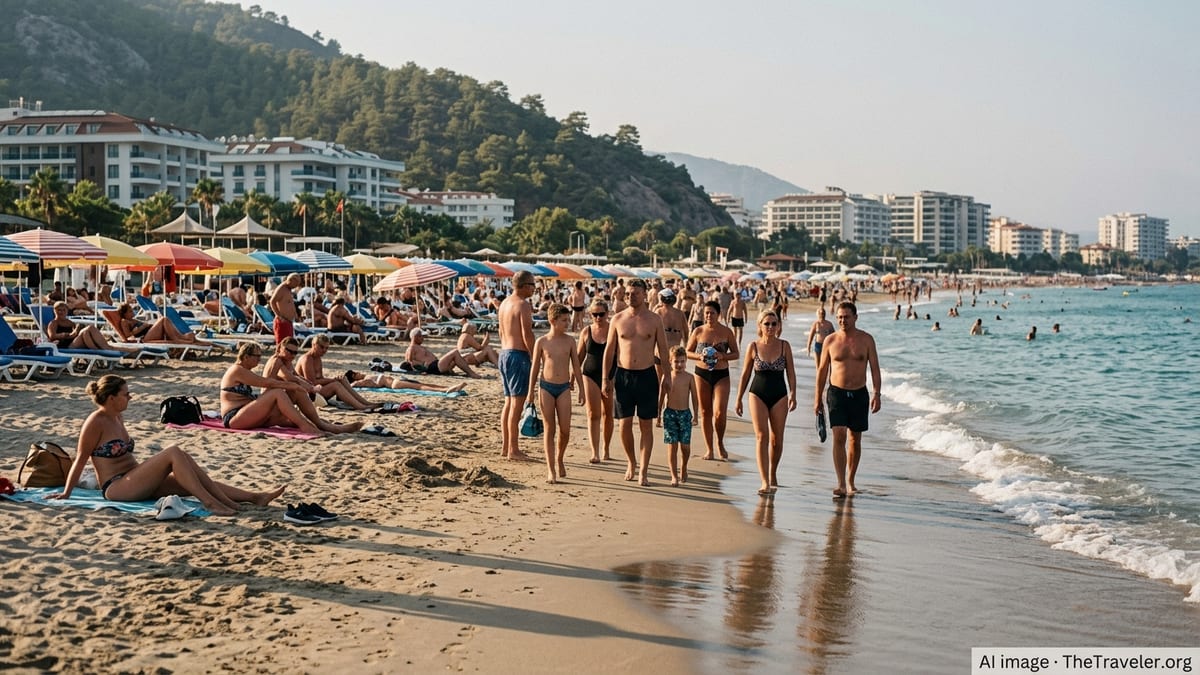
Record Tourism Revenues Underscore Türkiye’s Pull
Recent tourism data highlight how firmly Türkiye has reestablished itself among Europe’s heavyweight destinations, providing crucial context for the latest wave of German demand. Publicly available figures from Turkish authorities show that tourism revenue reached about 61 billion dollars in 2024, setting a new record as international arrivals climbed above 52 million and continued to trend upward into 2025. Those numbers placed Türkiye among the leading earners globally from inbound travel, even as parts of its economy grappled with inflation and currency volatility.
Within that overall surge, Germany has emerged as a pivotal source market. Ministry data and trade reports for 2024 and 2025 indicate that Germans consistently rank among the top foreign nationalities visiting Türkiye, with more than 6 million arrivals recorded in the first ten months of 2024 and over 1 million Germans leading monthly arrival tallies during peak season in some 2024 and 2025 reporting periods. For the crucial shoulder and summer months, Germans have frequently been either the largest or one of the largest visitor groups.
By spring 2025, provisional figures showed that German travelers were again at the front of the pack. Data released for April 2025 indicated that foreign arrivals to Türkiye grew around 8 percent year on year, with Germany providing more than half a million visitors that month alone and recording growth of over 30 percent compared with the previous year. Analysts reading the ministry figures pointed to this as an early signal that demand from Germany was not only resilient, but accelerating into the 2025 and 2026 summer seasons.
Private-sector assessments have reinforced that picture. International tourism and investment reports published in late 2025 describe Türkiye as one of the eastern Mediterranean’s most dynamic destinations, with coastal hubs such as Antalya and the Aegean resorts absorbing large volumes of package travelers from Central Europe. For Germany’s outbound market, this has translated into a reliable mix of sun, sea, and value at a moment when many households are still price-sensitive.
Early Bookings Point to Robust Summer 2026 Demand
The clearest indications of how Germans are planning for summer 2026 come from booking trends recorded by major tour operators and travel associations. Reports on the German package holiday market show that early reservations for classic sun-and-beach destinations have shifted away from the last-minute habits of the past decade and toward “super early” booking patterns. Travel trade coverage citing the German Travel Association noted that advance bookings for mainstream holiday packages were already several percentage points higher than the previous year, with Türkiye among the key beneficiaries.
Dedicated analyses of Germany’s outbound bookings for 2026 further underline this shift. A recent report focusing on German travel patterns into summer 2026 highlighted Greece, Spain, and Türkiye as the three main destinations shaping early reservations, with tourism giant TUI identifying all three as focal points for its capacity planning. Official data from Germany’s Federal Statistical Office, referenced in the same coverage, showed that 7.7 million travelers from Germany flew to Türkiye in summer 2025, compared with 10.5 million who went to Spain, placing Türkiye firmly among the country’s core foreign holiday markets ahead of the 2026 season.
Travel-industry analyses suggest that this base of nearly eight million German visitors in the previous summer provides strong momentum for 2026, particularly as airlines and tour operators add or restore capacity into Turkish coastal airports. German holiday carriers have already expanded overall leisure capacity beyond pre-pandemic levels, with eastern Mediterranean routes singled out as key growth segments. Industry briefings in early 2025 noted that late and last-minute bookings were rising again for Turkey, Egypt, and parts of southern Europe, indicating that initial early-booking strength was being topped up by short-notice demand.
For Türkiye, this combination of early commitments and flexible, close-in bookings points to another solid high season in 2026. Analysts tracking cross-border tourism spending argue that German households continue to prioritise holiday travel even in the face of higher living costs, and that they are reallocating budgets toward destinations that can offer predictable sunshine and relatively affordable packages. On that measure, Türkiye remains well positioned.
Value for Money and All-Inclusive Resorts Drive Choice
Beneath the headline numbers, value for money remains one of the strongest drivers pulling German tourists toward Türkiye. The depreciation of the Turkish lira in recent years has made on-the-ground costs comparatively lower for visitors paying in euros, even as domestic inflation has pushed up prices in local terms. Package deals sold in Germany bundle flights, accommodation, and often all-inclusive catering in a way that shields travelers from some day-to-day price uncertainty, while still appearing more affordable than equivalent offers in parts of the eurozone.
Travel trend reports for 2024 and 2025 describe a German market that is highly cost-conscious yet unwilling to sacrifice the main elements of a beach holiday. Türkiye’s large inventory of resort hotels along the Mediterranean and Aegean coasts, many of them purpose-built for family and couples’ packages, allows tour operators to offer competitive per-night rates even during school holidays. Industry observers note that high-capacity properties in Antalya, Side, Alanya, Bodrum, and Marmaris, paired with charter and scheduled flights from multiple German cities, underpin some of Europe’s most aggressively priced all-inclusive options.
For German travelers, this translates into familiar products at a time when overtourism concerns and accommodation shortages are pushing up prices in parts of Spain, Italy, and other traditional hotspots. Coverage of broader European tourism trends in 2025 has highlighted how surging visitor numbers are straining infrastructure in several destinations, and how some cities are introducing new taxes or restrictions. In contrast, Türkiye’s coastal resort zones still offer a sense of space and purpose-built tourism infrastructure, while secondary cities and inland regions provide scope for cultural extensions without the crowding seen in some western Mediterranean hubs.
German spending power abroad also plays a role. European tourism statistics released in late 2025 show that German residents collectively spend more on foreign trips than any other nationality on the continent. Travel analysts argue that this deep pool of purchasing power reinforces demand for destinations capable of absorbing large volumes at scale, and that Türkiye, with its mix of high-capacity resorts, heritage sites, and domestic transport links, remains exceptionally well suited to that role.
Traveling in a World of Tensions
The renewed appetite for Turkish holidays comes against a backdrop of elevated geopolitical strain and domestic political tension. In 2025, Türkiye experienced large-scale protests following the arrest of prominent opposition figures, while relations between Ankara and several European capitals were periodically tested by disagreements over migration, security cooperation, and regional conflicts. Separately, wider global concerns, from energy security to Middle East flashpoints, have kept Turkey at the center of several diplomatic debates.
Yet tourism statistics and travel trade reports indicate that these political developments have not significantly dampened German demand. Analysts point out that the European tourism rebound has continued even during periods of heightened geopolitical anxiety, with United Nations tourism barometers for 2024 and 2025 recording strong growth in international arrivals across the continent. Commentators attribute this resilience to pent-up demand after the pandemic, stable employment in many source markets, and a cultural prioritisation of holidays among German households.
Published coverage of 2025 tourism flows also notes that safety perceptions are being shaped less by day-to-day political headlines and more by practical factors such as airport operations, local security in resort areas, and the responsiveness of tour operators. In Türkiye’s main coastal destinations, large hotel groups and well-established package providers are seen as offering a level of predictability that reassures risk-aware travelers. German package tourists, in particular, often book with companies that provide clear contingency policies and on-the-ground representation, making them more comfortable travelling to destinations that feature frequently in foreign-policy news.
This does not mean that political events are irrelevant. Travel experts caution that sudden escalations or domestic disruptions can still produce short-lived dips in bookings, as some of Türkiye’s monthly arrival figures in 2025 have shown. However, the broader pattern suggests that German travelers are distinguishing between strategic-level diplomatic disagreements and the reality of a week at a beach resort. So far, the latter appears to be winning out.
Infrastructure, Connectivity, and Evolving Experiences
Another reason Türkiye continues to attract German visitors is the steady improvement of its tourism infrastructure and air connectivity. Major airports such as Istanbul and Antalya handle large volumes of point-to-point and connecting traffic from German cities, with both full-service and low-cost carriers operating dense seasonal schedules. Aviation and tourism briefings in 2025 describe how German leisure airlines have expanded capacity on eastern Mediterranean routes, including Türkiye, ahead of the 2025 and 2026 high seasons.
On the ground, investments in hotel stock, roads, and urban public transport in key tourism centers have made it easier for German tourists to combine traditional resort stays with city breaks or cultural tours. Istanbul continues to function as a gateway for travelers who want to pair coastal relaxation with sightseeing in one of Europe’s largest metropolises, while smaller cities along the Aegean and Mediterranean coasts are promoting local gastronomy, hiking, and heritage attractions. Sectoral reports from Turkish and international agencies describe a diversification push that aims to balance mass-market all-inclusive products with higher-value cultural and nature-based experiences.
Regional climate patterns are also influencing German travel choices. Hotter summers and longer shoulder seasons across the Mediterranean have extended the viable holiday window for beach and pool tourism into late spring and early autumn. Travel trend studies for 2024 and 2025 record growing interest in May, September, and October travel, as Europeans look to avoid the peak of summer heat while still enjoying warm seas and lower prices. Türkiye’s southern coasts, with sea temperatures that remain relatively high well into autumn, are well placed to benefit from this shift.
As German travelers look ahead to summer 2026, the combination of proven infrastructure, competitive pricing, and an expanding range of experiences is keeping Türkiye firmly on the radar. While geopolitical storylines and domestic debates will continue to shape perceptions from afar, the hard numbers from recent seasons suggest that for many Germans, the promise of reliable sunshine, generous buffet tables, and a favorable exchange rate is more than enough to justify another flight to the Turkish coast.