

More news on this day
British travellers eyeing an Easter escape to Europe are being urged to prepare for longer queues and new biometric checks, as Germany joins a growing list of EU countries highlighted in UK travel advice for stricter border controls linked to the bloc’s new Entry/Exit System.
Get the latest news straight to your inbox!
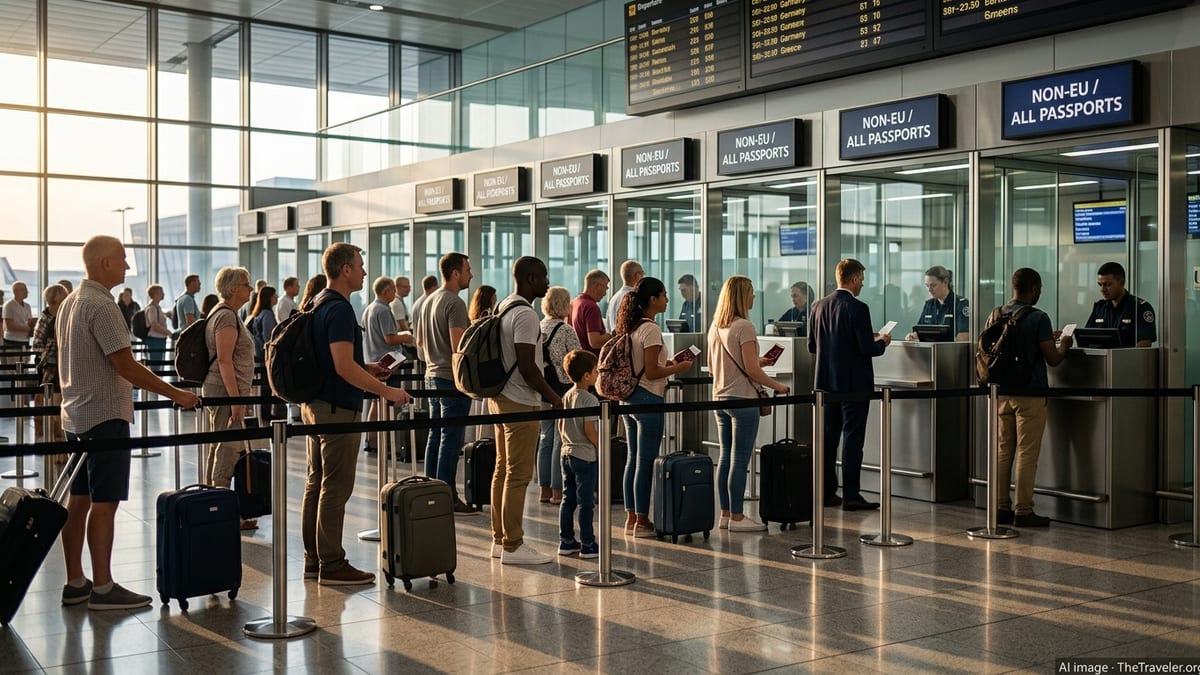
New EU Entry/Exit Rules Take Shape Ahead of Peak Travel
Across the Schengen Area, border police are gradually relying on the EU’s digital Entry/Exit System to log non-EU visitors, replacing the familiar ink passport stamps with electronic records. Publicly available EU documents indicate that the system began a phased roll-out in late 2025, with a goal of covering all external Schengen border points by April 2026. As the technology is expanded, non-EU nationals, including UK citizens, are facing additional identity and biometric checks when entering or leaving Europe.
The Entry/Exit System records a traveller’s name, passport details, facial image, fingerprints and the time and place of crossing. The information is then used to calculate stays under the 90‑days‑in‑180‑days rule that governs short visits to the Schengen zone. For most holidaymakers this removes the need for passport stamps, but it can add time at the first point of entry while details are captured for the first time.
Industry briefings and airport guidance point to a period of adjustment as border staff and travellers adapt to new equipment. During the initial months of deployment, several airports and land crossings have reported longer processing times at busy periods, particularly where infrastructure or staffing has not yet fully caught up with demand.
For UK travellers planning Easter trips, the key message emerging from transport operators and tourism bodies is to expect the new system to be in active use at many Schengen entry points. That means allowing more time for border checks and being ready to follow instructions for facial scans or fingerprint collection on arrival.
Germany Joins List of Countries Under Enhanced Scrutiny
Recent updates to the UK government’s foreign travel advice draw particular attention to Germany, now listed alongside Greece, Austria, Belgium, Denmark, Estonia, Finland and several other Schengen members where systematic checks on non-EU nationals are being reinforced. The change reflects Germany’s decision to extend and expand internal and external border controls, including at land frontiers and major airports, while it integrates the new digital systems.
Publicly available immigration notices from Germany describe additional checks on travellers arriving from neighbouring states, on top of the standard Schengen external border screening. Although these measures are officially framed around security and irregular migration, they also affect ordinary visitors, including British holidaymakers connecting via hubs such as Frankfurt, Munich, Berlin and Düsseldorf.
Travel industry assessments suggest that the impact will be most visible at peak holiday times, when flights from the UK arrive in concentrated waves and queues can build quickly at passport control. Germany’s major airports are introducing more e-gates and dedicated lanes for biometric enrolment, but the overall time taken to process first-time Entry/Exit registrations remains higher than for a simple passport stamp.
For passengers using overland routes, including rail and road trips across Germany’s borders with Austria, the Czech Republic or Poland, spot checks and systematic inspections are likely to be more common than before. While many crossings will still feel routine, travellers are being advised to carry all required documentation and to factor possible delays into onward connections.
What UK Holidaymakers Can Expect This Easter
For Easter 2026, the main change most British tourists will notice is the increased formality of border checks on arrival in the Schengen Area. Instead of a quick stamp, travellers may be asked to pause at a kiosk, remove hats or glasses for a facial image capture, and place fingers on a scanner. Families and groups might be processed together but each non-EU adult and child will need to be enrolled individually.
Reports from early adopter airports across Europe describe first-time enrolment as taking several minutes per person, compared with under a minute for a manual stamp, although repeat visits are generally faster once biometric data is stored. At busy Easter weekends, that difference can translate into significantly longer queues at certain entry points, particularly where many UK flights arrive close together.
The system does not change the underlying rules on how long UK citizens can stay in the Schengen zone: the 90‑days‑in‑180‑days limit still applies to holidays and short business trips. However, the electronic record removes much of the discretion that once existed around faint or missing passport stamps. Travellers who frequently visit multiple EU countries may find their movements are tracked more precisely, reducing the scope for honest mistakes about days spent in the zone.
For those connecting through Germany or other highlighted countries on their way to final destinations such as Greece, Spain or Italy, the first Schengen entry point remains where checks are carried out. That means a connection in Frankfurt en route to Athens, for example, will involve completing Entry/Exit formalities in Germany, not in Greece, and any delay there could affect onward flights.
Knock-On Effects for Flights, Ferries and Channel Crossings
Aviation and transport analysts have been warning of potential bottlenecks at certain ports and airports where large volumes of British travellers pass through a limited number of control booths. Short-haul leisure routes between the UK and Spain, Greece and Portugal, as well as city breaks to Belgium, the Netherlands and Germany, are expected to see the greatest pressure.
Operators of Channel ferry routes and the Channel Tunnel are also adjusting to the new reality. Because Entry/Exit checks must often be completed before boarding, particularly where juxtaposed controls operate on UK soil, any slowdown at the border can back up into vehicle lanes and departure halls. Trial runs in recent months have shown that processing coach groups and car passengers under the new rules is especially time‑consuming.
In response, several ports have added more kiosks, reconfigured queuing areas and altered boarding procedures in an attempt to smooth the flow for Easter and the summer season. Nonetheless, contingency planning documents circulated within the transport sector anticipate periods of disruption, particularly during bank holiday getaways or when staffing levels are reduced.
Rail passengers using high-speed services between London and cities such as Paris, Brussels and Amsterdam have been advised in operator communications to arrive earlier than before departure. While not all terminals will have the Entry/Exit technology fully in place at the same time, any station where the system is live is likely to require additional time at security and passport control.
How to Prepare Your Easter Trip Under the New Regime
For travellers, preparation begins well before reaching the airport or port. UK government guidance continues to stress the importance of checking passport validity for Schengen travel, ensuring that documents are less than ten years old on the date of entry and have at least three months’ validity beyond the intended departure. The Entry/Exit databases draw directly from passport data, so any discrepancy or damage can lead to secondary checks.
Experts in travel planning recommend allowing extra time at departure points where juxtaposed EU controls operate, such as certain ferry ports, rail terminals and UK airports with pre‑clearance facilities. Booking earlier travel slots, avoiding the busiest departure hours where possible and building in longer connection times can all reduce the stress of potential delays.
Looking ahead, travellers are also being reminded that the EU’s separate travel authorisation scheme, known as ETIAS, is scheduled to come into force after the Entry/Exit System is fully operational. Current EU communications indicate that ETIAS is expected to launch in the latter part of 2026, meaning it is not yet required for this Easter, but will eventually add an additional online step for visa‑exempt visitors such as UK citizens.
For now, the most immediate impact for Easter holidaymakers will be at the border itself. With Germany now among the countries singled out in UK advice for more intensive checks, and popular destinations across Greece, Austria, Belgium, Denmark, Estonia and Finland also adapting to the new technology, British travellers heading for spring sunshine or city breaks are being cautioned to treat border control as a central part of their journey planning.