

More news on this day
Germany is rapidly emerging as the anchor of Europe’s rail revival, pairing aggressive climate-focused ticketing reforms with a new wave of cross-border daytime and night-train services that promise a seamless, low-carbon way to travel between France, Austria and Switzerland.
Get the latest news straight to your inbox!
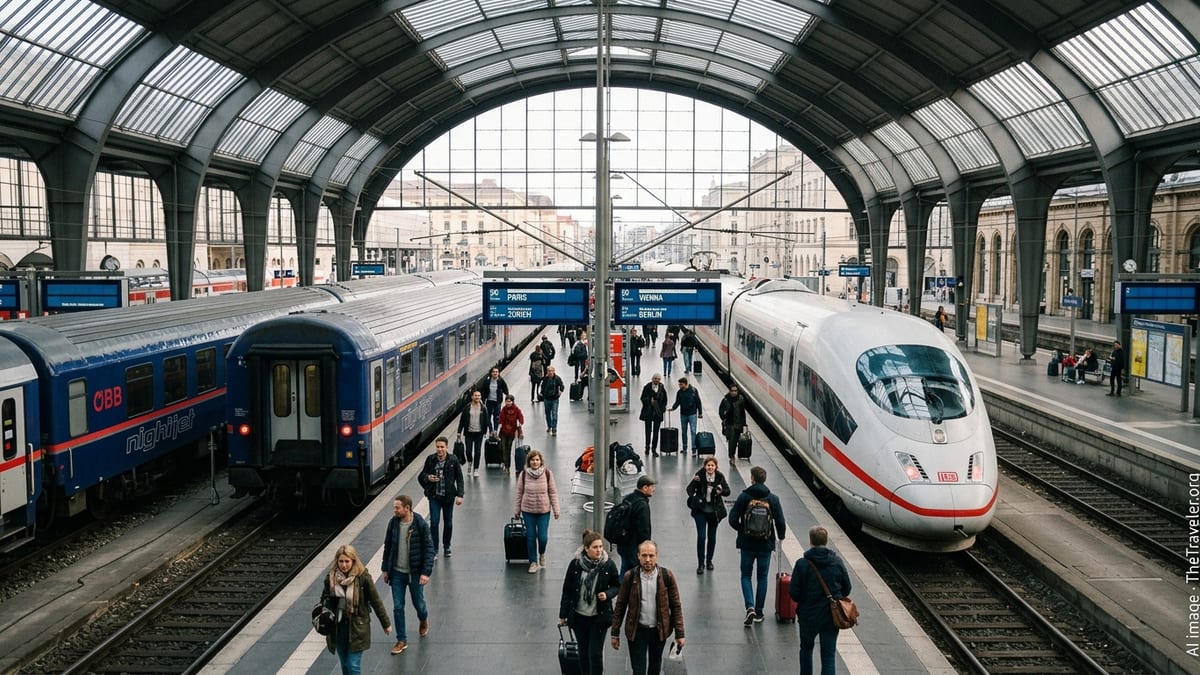
Germany’s Climate Ticket Sets the Pace for Greener Mobility
Germany’s nationwide Deutschlandticket has become a reference point for climate-friendly mobility policy in Europe. Introduced in May 2023 as a flat-rate monthly pass for local and regional public transport, it dramatically simplified fares and made rail and buses significantly more attractive for everyday and leisure travel. Publicly available research by climate institutes and transport economists indicates that the ticket has triggered a substantial shift from private cars to public transport, especially on medium-distance journeys.
National rail usage data show that regional train travel increased by close to a third in the first year of the scheme compared with pre-ticket levels. Analysts describe the Deutschlandticket as a “booster” for regional rail, with many passengers reporting that they now choose trains for trips they previously made by car. This scale of behavioral change is seen by transport researchers as critical if Germany is to meet its emissions targets in the transport sector, one of the country’s most challenging climate frontiers.
Although the price of the Deutschlandticket has risen from its original 49 euros to a higher monthly fee, governments have chosen to maintain the core model into 2026. Debates continue over long-term funding, but policymakers across Europe are closely watching the German experiment as they explore their own climate-ticket concepts. Advocacy groups argue that the German pass demonstrates how straightforward, affordable pricing can make rail the default choice for both commuters and domestic tourists.
The ripple effects extend beyond national borders. With more Germans using regional trains to reach hubs such as Munich, Frankfurt and Hamburg, international long-distance services into neighboring France, Austria and Switzerland are benefitting from stronger feeder traffic. Rail operators and planners increasingly view Germany’s dense, integrated network as the backbone of a broader European rail ecosystem.
New Night Trains Link Germany With France and Austria
Alongside domestic reforms, Germany’s role in Europe’s night train renaissance is expanding. Over the past three years, joint operations between Austria’s ÖBB, Germany’s Deutsche Bahn and partner railways have rebuilt a network of Nightjet sleeper services connecting German cities with Austria and beyond. Routes such as Vienna to Hamburg, Innsbruck to Cologne and services via Munich now offer overnight alternatives to short-haul flights, with modern rolling stock featuring private cabins, family compartments and upgraded couchettes.
Reports on the latest timetable changes indicate that the Nightjet product continues to evolve, even as some French-supported services are restructured. Subsidy cuts in France led to the discontinuation of certain Paris-linked Nightjet routes in late 2025, but operators and new entrants have moved to preserve and expand key corridors through Germany. The strategy increasingly focuses on high-demand city pairs and efficient cross-border paths, often routed through German hubs where connections to domestic high-speed and regional lines are strongest.
Independent operators are now using Germany’s network to plug gaps left by legacy services. The Belgian-Dutch cooperative European Sleeper has stepped in to revive the Paris to Berlin overnight link after its withdrawal by the French rail operator. According to published coverage, the relaunched service in 2026 uses a route via Belgium and northern Germany, relying on leased German-built sleeping cars that offer a mix of seats, couchettes and classic sleeper compartments.
These developments position Germany as a central platform for night trains moving across the continent. Passengers from France can travel overnight to Berlin and change onto established Nightjet services to Vienna or southern Germany. Similarly, travelers from Austria can use overnight services through Munich or Hamburg to reach onward day trains for Paris. The result is a more flexible, mesh-like network, with Germany’s railways providing the core north-south and east-west axes.
Cross-Border High-Speed Links Reinforce Daytime Eco Travel
While night trains capture the imagination, daytime cross-border services are also expanding and modernizing, making low-carbon rail increasingly competitive with short-haul flights between Germany, France, Austria and Switzerland. New infrastructure projects in Austria, including the Koralm Railway between Graz and Klagenfurt, are set to shorten travel times on routes linking Vienna with both Germany and Italy. This, in turn, improves onward connectivity for passengers heading toward German cities by way of Salzburg and Munich.
Across the wider European Union, the European Commission has launched initiatives to accelerate high-speed rail and remove technical obstacles that complicate cross-border operation. Planned regulatory changes include simplified driver certification and harmonized technical standards, which are expected to make it easier for trains to run seamlessly from Germany into neighboring countries. Officials in Brussels have framed these reforms as essential to shifting more intercity journeys from air to rail by the mid-2030s.
Rolling stock investments support this vision. Major operators have ordered new high-speed trainsets specifically designed to operate in multiple European countries, including Germany, France, Belgium, the Netherlands and Switzerland. These trains are being built to cope with differing signaling systems, power supplies and safety rules, allowing direct services across borders with fewer technical constraints.
For travelers, the impact is likely to be felt in more frequent and faster direct trains linking key city pairs such as Frankfurt to Paris, Munich to Vienna and German hubs to Swiss cities including Zurich and Basel. Combined with integrated ticketing tools and increasingly competitive fares, these links strengthen the case for choosing rail as the primary mode for trips of up to 6 or 7 hours, a range that covers much of western and central Europe.
Switzerland and Austria Team Up With Germany on Night and Scenic Routes
Switzerland and Austria, both long-time champions of rail, are reinforcing Germany’s central role in an emerging transalpine eco-corridor. The Swiss national operator and ÖBB have jointly expanded Nightjet connections from Zurich, including routes toward northern Germany. Recent timetable updates highlight new overnight services designed to tie Swiss cities into the growing lattice of sleeper trains serving Hamburg, Berlin and other German hubs.
These partnerships complement Switzerland’s established daytime Eurocity and InterCity links into Germany, which carry high volumes of both business and leisure travelers. Even as certain older cross-border services are phased out or replaced, new patterns are emerging, with emphasis on faster connections and better use of upgraded infrastructure north of Basel. Travelers can now combine panoramic daytime journeys through the Alps with overnight segments across Germany, structuring multi-country itineraries that remain entirely rail-based.
Austria, meanwhile, has gained international visibility for the Nightjet brand and its new generation of sleeper trains, introduced from 2023 onward. These trains, which serve routes into Germany and beyond, feature modern pods and family mini-cabins aimed at attracting younger and more comfort-conscious travelers. Travel media and rail specialists describe Nightjet as a key driver of Europe’s sleeper-train comeback, often highlighting Germany’s cities as both origins and transfer points.
Together, the Swiss and Austrian strategies underscore the importance of Germany’s geographically central position. For a traveler leaving Paris or Strasbourg by day to reach Zurich, then boarding an overnight train north through Germany, or departing Vienna on a Nightjet that traverses Bavaria to reach the Rhineland, Germany functions as a connective tissue for eco-friendly journeys that cross several borders in a single itinerary.
A Growing Network for Flight-Free Journeys Across Western Europe
The cumulative effect of Germany’s ticketing reforms, cross-border infrastructure upgrades and new night-train initiatives is a rapidly thickening web of rail options for travelers who want to avoid flying. A passenger can now move from France through Germany to Austria or Switzerland using a mix of high-speed, regional and overnight services that are increasingly coordinated in terms of timing and fares. Travel media coverage notes a rising interest in curated “flight-free” itineraries that use Germany as a central hinge between western and central Europe.
Environmental groups and transport researchers view this shift as significant for climate policy because aviation remains one of the fastest-growing sources of emissions. Rail, by contrast, benefits from Europe’s decarbonizing electricity mix and offers substantial per-passenger emission reductions compared with short-haul flights. The more compelling and convenient the rail alternative becomes, the easier it is for governments to argue for measures that limit aviation growth on routes where strong train options exist.
Challenges remain, including capacity constraints on busy main lines, the need for further station upgrades and the complexity of coordinating timetables and ticketing across multiple national systems. However, ongoing EU-level initiatives and new investment commitments suggest that political momentum is now behind rail in a way not seen for decades.
For travelers planning journeys from Paris to Vienna, Munich to Geneva or Berlin to the French Riviera, Germany’s evolving rail system sits at the heart of a new, practical vision of low-carbon mobility. With more night trains, faster cross-border links and climate tickets nudging people out of cars and planes, the country is quietly helping to redefine how Europeans move between France, Austria, Switzerland and beyond.