

More news on this day
Germany is bracing for severe travel disruption as a 48-hour nationwide walkout of local public transport staff threatens to grind buses, trams and metro systems to a halt in major cities from Friday, leaving commuters and international visitors scrambling for alternatives.
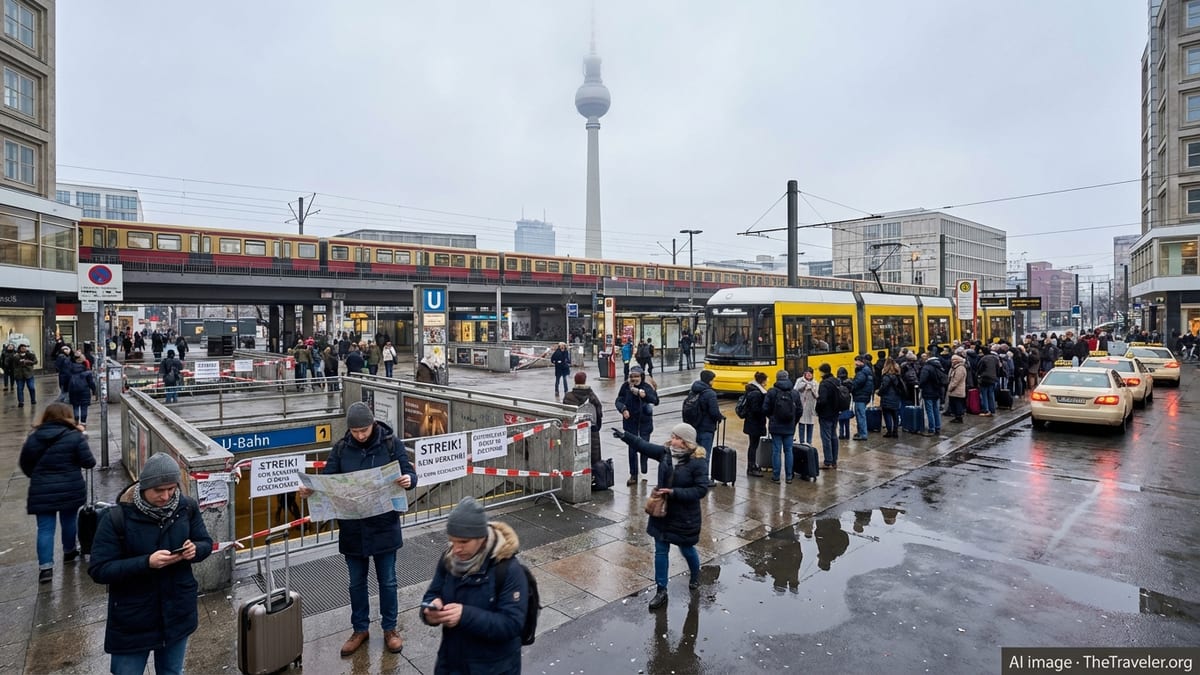
Nationwide Walkout to Hit Cities From Berlin to Cologne
The Verdi trade union has called on around 100,000 employees at roughly 150 municipal transport operators to down tools for 48 hours on Friday and Saturday, escalating an already tense pay and conditions dispute. The action will hit local buses, trams and underground networks in all 16 federal states, with dense urban regions warned to expect near-total shutdowns of regular services.
Berlin’s BVG, one of Europe’s largest urban transit operators, has confirmed that U-Bahn trains, most trams and the majority of city buses will stop running from 3:00 a.m. on Friday until the early hours of Sunday. Similar stoppages are planned in Hamburg, Munich, Frankfurt and Stuttgart, while authorities in North Rhine-Westphalia say almost all major cities in the region, including Cologne, Düsseldorf, Dortmund, Essen and Bonn, will see services heavily curtailed or suspended.
Although Germany’s national rail operator Deutsche Bahn is not part of the strike, officials caution that S-Bahn, regional and long distance trains that do run are likely to be crowded as passengers shift from local networks to rail corridors that remain open. Some cities are preparing limited emergency timetables on key bus or tram routes, but these will fall far short of normal capacity.
The walkout follows a series of one day warning strikes earlier this month that already brought many networks to a standstill. Verdi says employers left the negotiating table without making sufficient concessions, prompting the union to move to a longer, nationwide stoppage in an effort to increase pressure.
Tourists Warned of Disruption to City Breaks and Airport Access
The strike is a particular blow for city break tourists and business travellers who rely on Germany’s normally robust public transport to connect airports, main stations and hotels. Travel advisers are warning visitors to Berlin, Munich and Frankfurt this weekend that conventional metro-based itineraries will no longer work, forcing them to rethink how they move around the city.
In Berlin, where the U-Bahn forms the backbone of urban mobility, visitors arriving at the main station or either of the city’s airports will be funnelled onto S-Bahn and regional trains, which are expected to bear the brunt of redirected demand. Travel specialists note that airport transfers which typically take under 40 minutes by metro and bus could stretch considerably as passengers queue for alternative services or turn to taxis and ride hailing apps.
Similar patterns are expected in other hubs. Frankfurt’s compact centre is usually easily navigable by tram and U-Bahn, but with these modes disrupted, travellers may find themselves walking further or relying on already busy regional trains that skirt the city core. In Cologne and Düsseldorf, suspension of local tram and bus lines will complicate journeys to their international trade fairs and riverfront tourist areas.
Tourism bodies are urging visitors who cannot reschedule trips to factor in longer transfer times, check hotel locations against S-Bahn and regional rail lines rather than metro routes, and be prepared for crowded platforms, especially during Friday evening and Saturday midday peaks.
Union Push for Better Hours and Rest Breaks Behind Strike
At the heart of the confrontation is a nationwide push by Verdi to improve working conditions for municipal transport staff, many of whom say they are stretched by chronic staff shortages, irregular shift patterns and weekend work. The union is seeking shorter weekly working hours, longer rest periods between shifts and higher supplements for night and weekend duty, arguing that these steps are essential to make the profession sustainable.
Union officials contend that without better conditions, operators will struggle to recruit and retain enough drivers and dispatchers to support the expansion of climate friendly urban transport that German cities are counting on to meet emissions targets. They argue that improving schedules and rest times is as important as wage increases in preventing burnout and absenteeism in a sector that runs early mornings, late nights and holidays.
Municipal employers say they recognise the pressure staff are under but warn that the scale of Verdi’s demands would place a heavy burden on local budgets, particularly in smaller cities still recovering from pandemic era revenue losses. They argue that any agreement must remain affordable for public finances while preserving room for investment in vehicles and infrastructure.
The latest round of collective bargaining talks is due to resume after the strike, with both sides under pressure from passengers, city governments and business groups to reach a compromise quickly. Observers say the breadth and duration of this weekend’s action could prove decisive in shaping the final settlement.
Roads, Taxis and Micromobility Braced for Surge
With metros, trams and buses largely off the streets, Germany’s road networks are expected to absorb a sharp rise in traffic as commuters and visitors turn to private cars, taxis and car sharing schemes. City authorities have warned of congestion around key radial routes leading into central business districts, particularly in Berlin, Munich and Cologne, and are advising drivers to avoid peak hour travel where possible.
Taxi operators and ride hailing platforms anticipate strong demand from passengers who are unable to walk longer distances or who need door to door service for early morning flights and late evening events. Some local councils have relaxed certain restrictions on taxi ranks and pick up zones for the weekend in an attempt to keep flows moving.
Micromobility providers are also preparing for a spike in usage. Rental bike and e scooter fleets in major cities typically see higher ridership on strike days, as residents and tourists opt for short hops that bypass congested roads entirely. However, cycling advocates caution that increased numbers of inexperienced riders on busy routes, coupled with heavier car traffic, could heighten safety risks at intersections and along narrow streets.
City planners and transport researchers will be watching closely to see how travellers adapt, viewing the strike as an unplanned stress test of alternative networks. Some believe the disruption could spur renewed debate about resilience in urban mobility systems and the balance between local and national transport provision.
Travellers Scramble to Rebook and Reroute
In the days leading up to the walkout, airlines, rail operators and travel agents have experienced a surge in enquiries from passengers seeking to adjust plans. While flights are not directly affected by the strike, carriers report higher than usual requests to change departure times so that travellers can arrive at airports before the worst of the local disruption.
Deutsche Bahn has reiterated that its long distance and regional services will operate according to the published timetable, although it acknowledges that certain trains may be busier than normal on routes linking suburbs to city centres. The company is advising passengers to travel outside rush hours where possible and to reserve seats on intercity services, particularly on Friday afternoon.
Hotels in well connected neighbourhoods near mainline stations in Berlin, Frankfurt and Munich have seen an uptick in last minute bookings from travellers seeking to minimise reliance on closed metro lines. Some conference organisers are shifting sessions online or staggering start times to give attendees more flexibility in reaching venues by foot or rail.
For many residents and visitors, the 48 hour shutdown will mean a patchwork of workarounds, from teleworking and car pooling to longer walks and improvised cycling routes. While German cities are no strangers to industrial action, the breadth of this coordinated stoppage has prompted warnings that the coming weekend could be among the most challenging tests of the country’s urban mobility in recent years.