

More news on this day
Germany has sharply escalated its travel warning for the Middle East as widening airspace closures across the United Arab Emirates, Bahrain, Saudi Arabia, Qatar, Jordan, Kuwait, Iraq and neighboring states leave thousands of travelers stranded and disrupt some of the world’s busiest long-haul corridors.
Get the latest news straight to your inbox!
Germany Urges Citizens to Avoid Conflict Zone as Risks Mount
Berlin’s latest advisory, issued in the wake of US and Israeli strikes on Iran at the end of February and subsequent Iranian missile and drone attacks, urges German citizens to avoid non-essential travel across large parts of the Middle East and to leave high-risk countries as soon as safely possible. The German Foreign Office has warned that sudden airspace closures, the risk of further missile fire, and the potential targeting of civilian infrastructure significantly raise the danger profile for travelers in the region.
Officials in Berlin are also concerned about the cascading impact on passengers who are not headed to the Middle East at all, but whose journeys rely on Gulf transit hubs for connections between Europe, Asia and Africa. With the network of safe routing options shrinking by the day, German consular services have reported a rising number of appeals for help from citizens stuck in airports from Dubai to Doha and Amman.
Lufthansa, Europe’s largest airline group, has described an environment of “heightened uncertainty,” as it contends with the sudden loss or restriction of key overflight corridors and hub airports. The carrier has warned corporate and leisure customers that schedules may change at short notice and that routings which were standard only weeks ago are no longer viable.
German authorities have already begun organizing evacuation and special flights in coordination with partner airlines from selected Gulf and regional capitals, prioritizing vulnerable citizens, business travelers on essential assignments and those transiting through now-disrupted hubs.
Gulf and Levant Airspace Tighten, With UAE Now in the Crosshairs
The United Arab Emirates, traditionally one of the region’s most reliable aviation gateways, has been thrust into the center of the crisis following Iranian strikes that damaged infrastructure in and around Dubai. While limited operations have resumed at Dubai International and Abu Dhabi’s Zayed International, both airports are operating under strict security protocols and reduced capacity, leading to rolling delays, cancellations and diversions.
Across the wider Gulf, Bahrain and Kuwait have imposed full airspace closures, while Saudi Arabia maintains partial restrictions focused on areas bordering Iraq and the Gulf. Qatar, whose Hamad International Airport is a pivotal connection point between Europe and Asia, has similarly had to halt or severely limit operations at various stages as Iranian projectiles and interception efforts forced intermittent shutdowns of its skies.
To the north and west, Iraq’s airspace remains closed to civil aviation, and Jordan has implemented nightly restrictions that further complicate already crowded rerouting options. Airlines are attempting to thread narrow, constantly shifting corridors that keep them clear of active military operations, air defense activity and high-risk zones identified by European and international aviation safety bodies.
Specialist aviation risk monitors note that the crisis has effectively carved a wide no-fly arc across the central Middle East. Operators are being advised to avoid or strictly limit operations over Bahrain, Iran, Iraq, Israel, Jordan, Kuwait, Lebanon, Oman, Qatar, Saudi Arabia, Syria and the UAE, with only carefully controlled exceptions for essential services and relief flights.
Thousands of Travelers Stranded as Hubs Seize Up
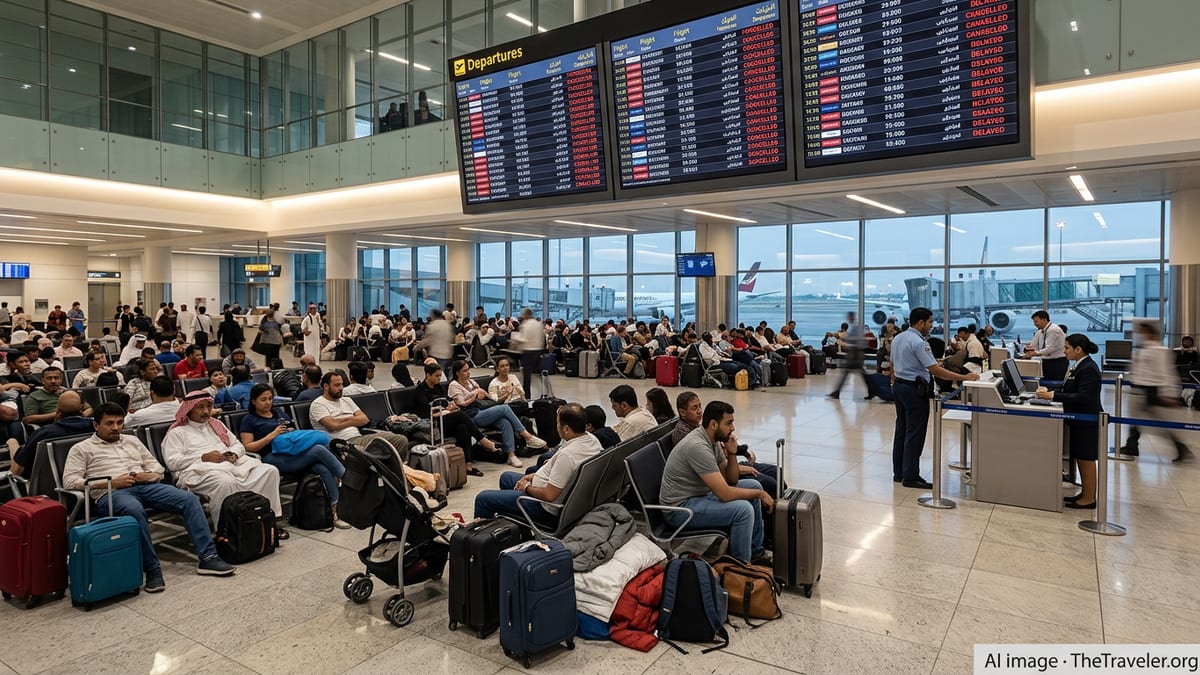
The abrupt loss of multiple regional hubs has left tens of thousands of passengers stranded, including a significant number of German and other European travelers who were caught mid-journey as airspace closures rippled outward. Long queues, packed terminal halls and makeshift sleeping areas have become familiar scenes at Gulf airports as airlines scramble to rebook customers onto the limited flights still operating.
Travelers report repeatedly cancelled or retimed departures, last-minute diversions to secondary airports and prolonged waits for baggage and rebooking assistance. Many whose tickets routed them via Dubai, Doha, Abu Dhabi or Kuwait City have found themselves stuck with no clear timeline for onward travel, as carriers prioritize relief flights, repatriation services and high-priority cargo.
Germany’s warning has been shaped not only by the risk of direct physical harm from missile or drone strikes, but also by the growing likelihood that travelers could become trapped for days in transit. With local authorities in the UAE and Qatar tightly controlling terminal access to prevent overcrowding, only passengers with confirmed, operating flights are being allowed into many airport buildings, further complicating efforts by stranded visitors to secure help.
Some airlines have shifted capacity into European hubs such as Frankfurt and Munich to act as alternative bridges between continents, but those routes are quickly filling, and flight times have lengthened because aircraft must detour around closed skies over Iran, Iraq and parts of the Gulf.
Europe’s Airlines Reroute via Saudi Arabia and Oman
With much of the central corridor effectively off-limits, carriers are increasingly leaning on Saudi and Omani airspace as lifelines for east–west travel. Saudi Arabia has emerged as a critical overland and overflight bridge between Europe and South and East Asia, even as it contends with its own security concerns and isolated strikes linked to the broader conflict.
Oman’s Muscat airport, whose skies remain open, has become a favored waypoint for both commercial airlines and charter operations seeking to bypass heavily militarized zones. Industry analysts say that as traffic funnels into a handful of remaining safe corridors, air traffic control systems are operating near capacity, leaving little buffer for additional disruptions or bad weather.
Rerouted flights are significantly longer and more expensive to operate, pushing up fuel costs at a time when oil markets are already jittery amid the closure of the Strait of Hormuz to much tanker traffic. This combination has led to a jump in fares on many Asia-bound routes, and experts warn that travelers may face sustained high prices and reduced seat availability even once immediate security risks begin to recede.
For business travelers in particular, Germany’s updated advice underscores a shift away from ad hoc last-minute bookings via Gulf hubs toward more carefully planned itineraries through European or southern alternatives, as well as an increased reliance on remote meetings and delayed site visits.
What Germany’s Warning Means for Current and Future Travelers
Germany’s reinforced travel warning sends a clear signal that the Middle East crisis is not a short-lived disruption. Officials stress that rapid changes to airspace status, potential new strikes, and the targeting of economic infrastructure mean that conditions can deteriorate faster than airlines and governments can respond with contingency plans.
Tour operators, corporate travel managers and individual travelers are being advised to reconsider itineraries involving Bahrain, Saudi Arabia, Qatar, Jordan, Kuwait, Iraq, the UAE and neighboring states, even for brief transits. Where travel is unavoidable, German authorities are recommending that citizens register with consular services, maintain flexible tickets, and closely monitor airline and government updates in case sudden evacuations or re-routing become necessary.
Looking ahead, aviation experts say that rebuilding confidence in the Middle East’s air corridors will take time, even if ceasefires hold and some airspace gradually reopens. Safety regulators in Europe and beyond are likely to maintain strict risk assessments for overflight, and airlines may permanently adjust networks to reduce dependency on any single set of hubs in a region so exposed to geopolitical shocks.
For now, Germany’s warning serves as a stark indicator of how quickly a regional security crisis can upend global mobility, leaving travelers, airlines and governments to improvise responses while thousands wait in terminals for the next available seat out.