

More news on this day
Travel across northern Europe is becoming markedly tougher in early 2026 as Germany joins the Netherlands, Sweden and other Schengen states in imposing stricter internal border controls, while Finland escalates its clampdown along the frontier with Russia, including new €500 fines aimed at deterring unauthorized crossings by would-be tourists.
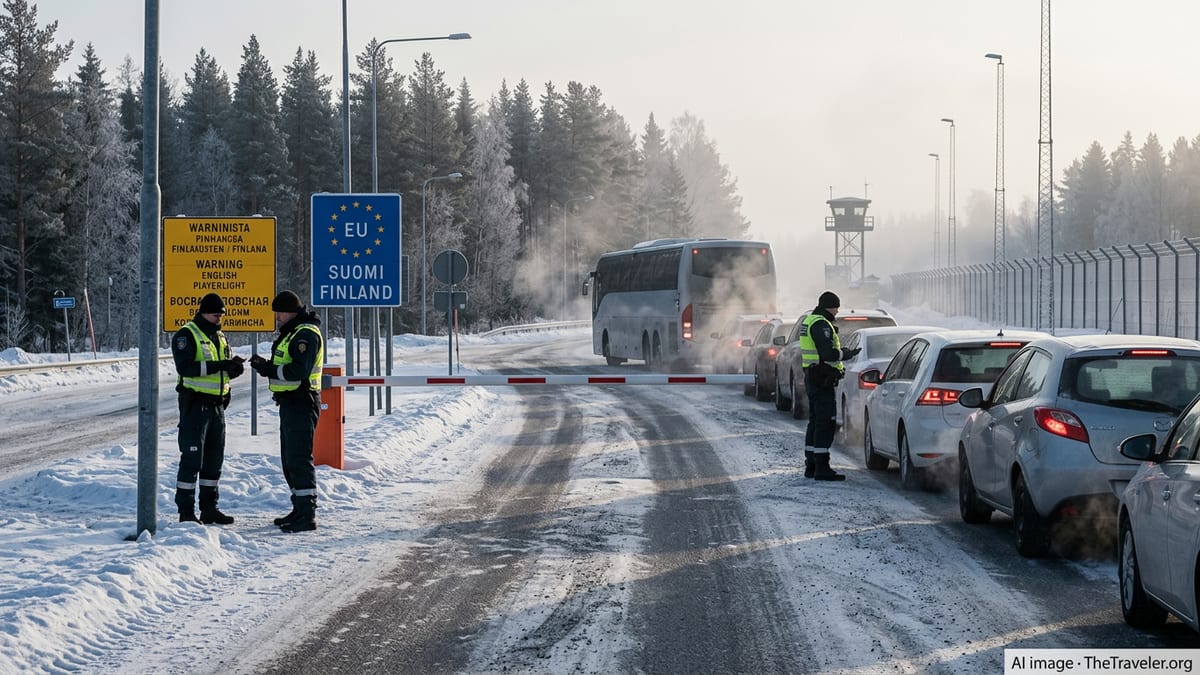
Finland’s Russia Frontier Becomes a Flashpoint
Finland’s 1,340-kilometre border with Russia has emerged as one of Europe’s most heavily controlled frontiers, following a series of closures and emergency measures that began in late 2023. Authorities in Helsinki have framed the tightening as a response to what they describe as “instrumentalised migration,” accusing Russia of facilitating irregular crossings toward the European Union.
In 2023 and 2024, Finland progressively shut land crossings to Russian traffic and sharply limited visa services for Russian citizens. Temporary measures originally introduced as short-term responses have since been extended, and lawmakers have granted wider powers to border guards to turn back third-country nationals arriving via Russia without proper documentation.
As part of this evolving regime, officials have paired physical barriers and enhanced surveillance with financial penalties intended to deter non-compliant travel. Tourists and other non-residents who attempt to bypass official procedures or cross at closed sections of the border now face fines that can reach €500, reinforcing Finland’s message that unauthorized movement will carry a tangible cost.
Rights groups and some EU partners have voiced concern that the hard line risks undermining access to asylum and setting a precedent for broader pushback practices. Finnish leaders counter that the measures are temporary, targeted at specific security risks, and compatible with the country’s international obligations.
Germany Tightens Controls Across All Borders
Further west, Germany has moved to tighten checks at all of its borders, widening a patchwork of temporary controls that originally focused on crossings from Austria. The German government cites a sharp increase in irregular entries, strains on reception systems in several federal states, and mounting political pressure over migration as drivers of the latest crackdown.
Under the new approach, federal police have expanded identity checks on trains, highways and secondary roads connecting Germany with its Schengen neighbors, including Poland, the Czech Republic, the Netherlands and France. While formal border posts remain dismantled for intra-Schengen travel, the stepped-up operations mean more travelers can expect to be stopped, questioned and, in some cases, refused entry or redirected to apply for protection elsewhere.
The measures dovetail with broader EU-level moves to tighten visa policies and external border management, particularly for Russian nationals. Schengen states have already curtailed multiple-entry visas for Russians and narrowed acceptable reasons for travel. Germany has been among the countries pushing for more rigorous screening, arguing that security risks tied to the war in Ukraine and fears of sabotage justify closer scrutiny.
For legitimate tourists, students and business travelers, the impact is most visible in longer queues, more document checks and a higher likelihood of being asked to prove accommodation, financial means and itinerary details at the border, even when traveling within the Schengen Area.
Netherlands and Sweden Extend Internal Schengen Checks
The Netherlands and Sweden, traditionally associated with relatively open travel, have also extended internal border controls well into 2026, citing a mix of security and migration pressures. In both countries, governments have argued that exceptional checks are necessary to combat organized crime, terrorism risks and strains in asylum reception systems.
The Netherlands has reinstated identity checks at land and air borders with neighboring Schengen states, including Germany and Belgium. These controls, while officially temporary, are authorised for several months into mid-2026 and are framed as a response to high numbers of asylum applications and concerns about human smuggling networks using intra-EU routes.
Sweden, for its part, has renewed controls at all internal borders and reinforced checks on the bridge and ferry links to Denmark. Officials in Stockholm point to a series of violent incidents, including explosives attacks and gang-related crime, as justification for exceptional measures. Authorities say the controls are targeted and intelligence-led, but travelers report more frequent passport inspections on routes that were once effectively borderless.
Both governments insist that the reintroduced checks are compatible with Schengen rules, which allow temporary internal controls in the face of serious threats to public order or internal security. Nonetheless, the persistence and geographic spread of these measures have sparked debate over whether “temporary” has quietly become the new normal for travel in parts of northern Europe.
New Reality for Tourists: Fines, Paperwork and Waiting Times
For tourists and other short-stay visitors, the convergence of national crackdowns and EU-wide reforms is reshaping what it means to travel in and around the Schengen Area. Finland’s €500 penalties for unauthorized or off-limits crossings at the Russia border underscore how even seemingly minor deviations from route or paperwork can carry serious consequences in sensitive frontier zones.
At the same time, countries such as Germany, the Netherlands and Sweden are layering additional identity checks on top of existing requirements, from biometric registration at external borders to more detailed questioning at internal ones. Travelers from visa-exempt countries are also preparing for the launch of the European Travel Information and Authorisation System, a pre-travel screening expected to go live in the latter part of 2026, which will add another step before boarding flights to the region.
Industry groups warn that the cumulative effect of national and EU-level measures could dampen tourism recovery, particularly for multi-country itineraries that rely on seamless cross-border movement. Airlines, rail operators and tour companies are urging passengers to arrive earlier, carry printed confirmations of accommodation and onward travel, and remain flexible in case of secondary checks that delay journeys.
Travel advisers now routinely tell clients heading to northern Europe to read consular guidance carefully, check for any temporary border controls on their planned route, and avoid informal crossing points near sensitive borders such as Finland’s frontier with Russia, where enforcement has become both stricter and more punitive.
Balancing Security, Solidarity and Mobility in the Schengen Era
The tightening of controls from the Gulf of Bothnia to the Rhine reflects broader tensions within the Schengen project as governments balance free movement with domestic political demands for tougher migration and security policies. Finland’s aggressive stance on its eastern border, backed by fines and new legal tools for border guards, is one of the clearest illustrations of how frontline states are redefining the limits of openness.
Germany’s comprehensive border checks, combined with stricter visa screening for certain nationalities, show how a core Schengen member can recalibrate its approach without formally abandoning free movement. The Netherlands and Sweden, meanwhile, highlight how temporary internal controls initially introduced in response to specific shocks have become embedded features of the travel landscape.
European officials insist that these steps are calibrated rather than permanent reversals, and that Schengen’s core promise remains intact. Yet for travelers, particularly those from outside the EU or arriving from politically sensitive regions, the experience on the ground increasingly involves a patchwork of checks, potential fines and legal grey zones that were far less visible a decade ago.
As the region moves through 2026, the key question for tourists and policymakers alike is whether these restrictions will gradually recede as security pressures ease, or whether the current moment marks the start of a more controlled, enforcement-driven era of European travel in which the open-border ideal is tempered by a far more muscular approach at the edges and seams of the Schengen Area.