

More news on this day
Germany’s Meyer Werft shipyard has reached a new construction milestone on Carnival Festivale, as key engine and LNG system components move into place ahead of the vessel’s spring 2027 debut.
Get the latest news straight to your inbox!
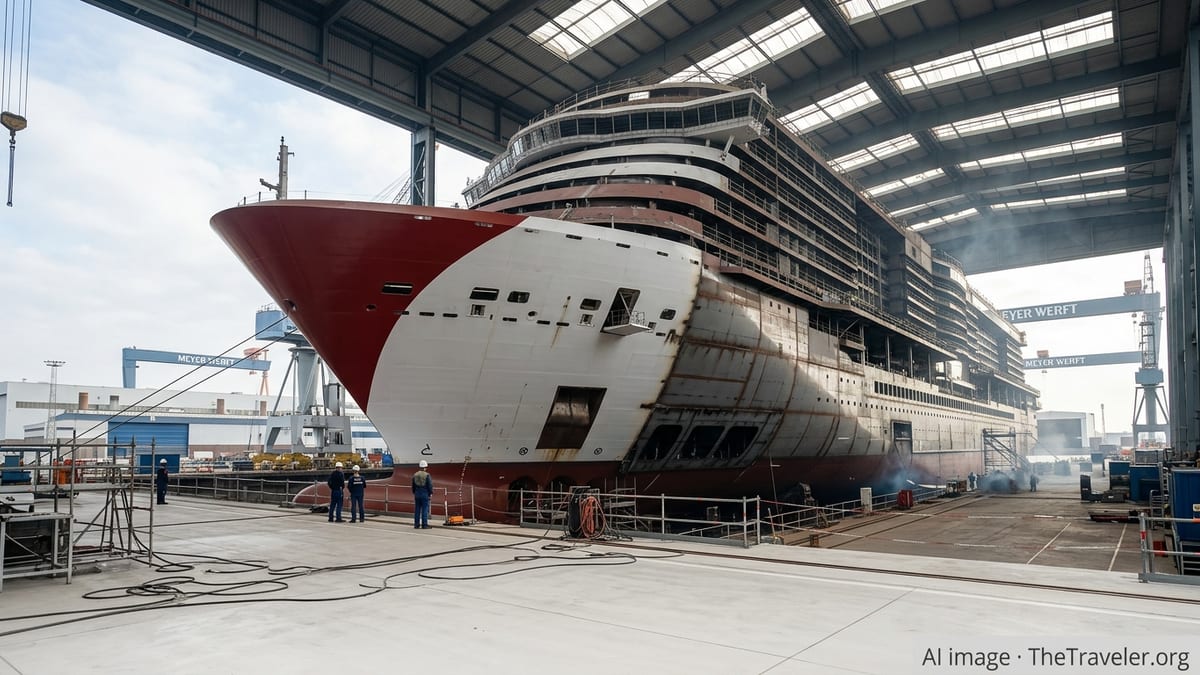
Engine and LNG System Progress at Meyer Werft
Recent project updates from Germany indicate that Carnival Festivale’s propulsion and fuel systems are entering an advanced stage of installation at Meyer Werft’s covered dock in Papenburg. Publicly available information shows that all liquefied natural gas storage tanks have now been installed, a prerequisite for integrating the ship’s dual-fuel engines and related machinery. This development signals a shift from structural assembly toward outfitting the ship with core technical systems.
The LNG tanks sit deep within the hull and are among the most complex pieces of equipment to position, given their size, weight, and stringent safety requirements. Reports from German cruise-industry coverage describe steady progress in aligning these components with the ship’s future engine rooms and fuel-handling systems, indicating that the project is tracking toward its scheduled 2027 delivery window.
While detailed technical specifications for Carnival Festivale’s engines have not been broadly disclosed, information from shipbuilding and industry reports on the Excel class suggests a configuration of high-efficiency dual-fuel engines capable of operating on LNG and marine gas oil. Integrating these units is regarded within the industry as a major milestone because it allows parallel work on propulsion, power distribution, and hotel systems throughout the ship.
Germany’s Role in Carnival’s Excel-Class Expansion
Carnival Festivale represents the latest collaboration between Carnival Corporation and Meyer Werft, further entrenching Germany’s shipbuilding sector as a key hub for large LNG-powered cruise vessels. Meyer Werft previously built Carnival Jubilee, delivered in 2023, and has pioneered the adaptation of its Papenburg facilities for a new generation of low-emission cruise ships. Industry references identify Carnival Festivale as yard number S724, reinforcing its place in a long-running production program of large cruise newbuilds.
According to cruise-industry analyses, Festivale will be one of the largest ships ever completed at the German yard, with an expected gross tonnage around 180,000 and capacity for more than 6,000 guests. The vessel continues a shipbuilding line that includes Mardi Gras, Carnival Celebration, and Carnival Jubilee, with Germany now responsible for a growing share of Carnival’s Excel-class tonnage. Observers note that the latest milestone is further evidence that German yards remain competitive in high-value, technologically advanced cruise construction.
Engineering progress in Papenburg also highlights the intricate logistics required to move massive engine blocks, LNG tanks, and exhaust systems into the enclosed building dock. Reports indicate that Meyer Werft continues to leverage its long-standing expertise with modular construction, floating sections, and precision block assembly to keep the timeline on track for a second-quarter 2027 handover.
LNG Propulsion and Sustainability Objectives
Carnival Festivale’s engine installation is closely tied to Carnival Corporation’s broader transition toward lower-emission propulsion technologies. Corporate sustainability documents list Festivale among a new generation of vessels designed to run primarily on LNG, a fuel that can significantly reduce sulfur oxides and particulate emissions compared with conventional marine fuels. The integration of engines, LNG tanks, and exhaust systems in Germany is therefore seen as central to both the ship’s performance and the company’s environmental roadmap.
Industry fact sheets describe how Excel-class ships incorporate dual-fuel engines alongside advanced emissions-management and energy-efficiency systems. These include optimized hull forms, heat-recovery solutions, and air-lubrication technologies that reduce drag along the hull. Carnival Festivale is expected to benefit from similar features, aligning the newbuild with corporate goals for reduced carbon intensity across the fleet.
The timing of the latest engineering milestone is noteworthy because it comes as cruise operators face tightening environmental regulations and greater scrutiny of emissions in port communities. By advancing engine and fuel-system integration now, Meyer Werft and Carnival Cruise Line are positioning Festivale to enter service with a propulsion plant that responds to evolving environmental expectations in North American and European markets.
Countdown to 2027: From German Yard to Port Canaveral
According to port and cruise-line communications, Carnival Festivale is scheduled to debut from Port Canaveral in 2027, operating week-long itineraries in the Caribbean. The ship will join fellow Excel-class vessel Mardi Gras at the central Florida homeport, reinforcing Port Canaveral’s status as a major base for LNG-powered cruise ships. With the engines and energy systems now progressing at Meyer Werft, the pathway from steel assembly in Germany to guest operations in the United States is becoming more clearly defined.
Construction milestones such as keel laying, hull block assembly, tank installation, and eventual sea trials are closely watched by travel planners and cruise enthusiasts, particularly those looking ahead to booking inaugural voyages. Bookings for Carnival Festivale’s early sailings opened following earlier construction milestones, and the latest engineering progress is likely to reassure prospective travelers that the new ship remains on course for a spring 2027 start.
In the interim, the focus in Papenburg will increasingly shift from heavy steel work to interior outfitting and the installation of public spaces, accommodation, and entertainment venues. Once the main propulsion and hotel-power systems are commissioned, Festivale will move through a series of dock and sea trials before leaving Germany for its transatlantic repositioning to Florida, marking the final step in a multi-year German-led construction effort.
Music-Themed Design Meets Mega-Ship Scale
Alongside its technical progress, Carnival Festivale is drawing attention for its music-inspired design concept. Cruise-line releases describe the ship as a “music-themed” Excel-class vessel with new entertainment zones and experiences, extending across multiple decks. These zones are intended to build on the brand’s established focus on live performance, but on a scale made possible by one of the largest ships in the fleet.
Reports on the ship’s layout indicate that Festivale will feature dedicated spaces for live music, interactive performances, and themed dining, with two major zones running across decks 6 to 8. This emphasis on music and entertainment, layered over the familiar Excel-class framework of water parks, family areas, and adult retreats, is designed to differentiate Festivale within Carnival’s growing portfolio of large LNG-powered ships.
For Germany’s cruise-construction sector, the combination of advanced propulsion systems and ambitious experiential design underscores the complexity of modern cruise projects. As engine installation progresses in Papenburg, the emerging outline of Carnival Festivale reflects both the technical capabilities of Meyer Werft and the evolving expectations of travelers who will eventually board the ship in Florida in 2027.