

More news on this day
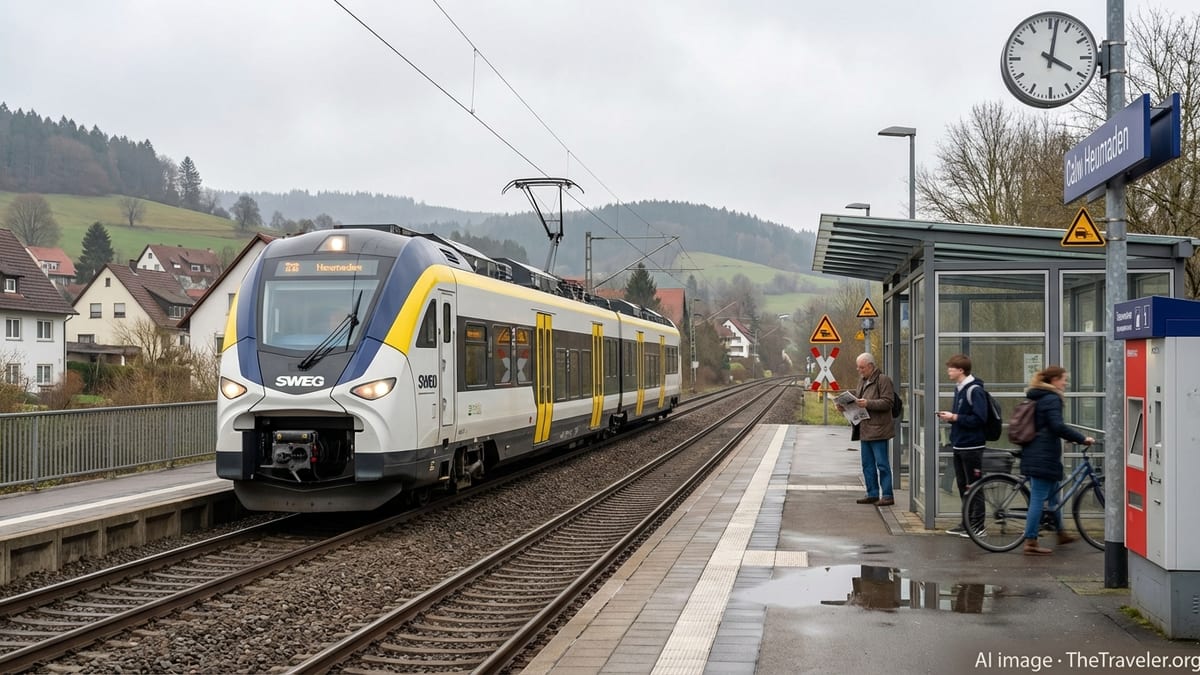
Germany’s long-dormant Hermann Hesse Line is back on the map. After more than four decades without passenger trains, the 23 kilometer route in Baden Württemberg has reopened with hourly services, cutting-edge battery hybrid trains and a planned extension to Renningen that will plug the northern Black Forest more tightly into the Stuttgart metropolitan network.
Local leaders see the revival as both a climate milestone and a structural boost for a region that once watched its rail link fade into disuse.
More News
- Caribbean Travel to U.S. Upended by New Visa Freezes and Expanded Bans
- Mexico Restores E-Visas for Brazilians, Paving the Way for Borderless Tourism
- Philippine Airlines Joins Regional Carriers Powering Southeast Asia’s Tourism Boom
A Historic Black Forest Line Returns to Service
The Hermann Hesse Line, linking Calw and Weil der Stadt, officially returned to operation at the end of January 2026 following years of planning, public debate and construction. The ceremonial reopening took place on January 31, 2026, with invited guests riding a special train and crowds gathering along the route. Regular timetabled passenger services under the designation RB76 began the next day, on February 1.
The line, named after Nobel Prize winning author Hermann Hesse, who was born in Calw, last saw regular passenger traffic in 1983. It was one of several lightly used regional routes that were gradually withdrawn during the era of car focused transport policy. Reactivation has been under discussion since the 2000s, and construction on modern safety systems, stations and track upgrades accelerated over the past decade.
Today’s service connects Calw with intermediate stops at Calw Heumaden, Althengstett and Ostelsheim before reaching Weil der Stadt, where passengers can transfer to Stuttgart’s S Bahn network toward the state capital. The line’s reinstatement forms part of Baden Württemberg’s wider strategy to reopen rail corridors and shift more regional journeys from road to rail.
Local authorities and the state transport ministry describe the reopening as a symbolic “rail comeback in the Black Forest,” pointing to the way the project reverses a long period of closures and underinvestment in regional rail. For many residents, it restores a direct rail option that had been missing for an entire generation.
Battery Hybrid Trains at the Heart of the Reopening
Crucial to the Hermann Hesse Line’s revival is the deployment of modern battery hybrid trains, which make it possible to offer electric, locally emission free operation without installing overhead wires along the entire rural route. Three two car Mireo Plus B battery electric multiple units from Siemens Mobility work the service, operated by Southwest German Transport (SWEG), a company owned by the state.
These trains run in battery mode on the unelectrified section between Weil der Stadt and Calw, drawing power from high capacity traction batteries mounted on board. On electrified sections of the Stuttgart S Bahn network, such as between Weil der Stadt and Renningen, the trains charge their batteries from overhead lines. The real world battery range is around 80 kilometers, more than sufficient for the branch line segments they serve.
The state first ordered Mireo Plus B units in 2020 for the Ortenau regional network and later exercised an option for three additional trainsets dedicated to the Hermann Hesse corridor. The trains were delivered in 2023 and entered passenger service in Ortenau in April 2024, proving the technology in regular operations before moving onto the Calw route.
Officials stress that without these battery hybrid units, providing fully electric service on the reopened line would have required either years of overhead line construction or the continued reliance on diesel trains. By using batteries instead of diesel engines on non electrified segments, Baden Württemberg can advance its goal of procuring no new purely diesel rail vehicles while still expanding service into rural areas.
From Hourly Trains to a Denser Timetable and Renningen Extension
At launch, the Hermann Hesse Line offers an hourly service pattern between Calw and Weil der Stadt, with connections onward to Stuttgart. The end to end journey from Calw to Stuttgart, including a change of trains in Weil der Stadt, averages around one hour. For commuters in the Calw district, this provides a new rail alternative to congested roads into the Stuttgart region.
The state’s timetable plans, however, go beyond hourly service. From April 12, 2026, the line is scheduled to step up to a half hourly pattern during most of the day. Trains will then operate every 30 minutes between Calw and Weil der Stadt, with a reduced hourly frequency in the late evening and on weekends and public holidays. Authorities forecast around 3,000 daily passengers, a mix of commuters, students and tourists.
An important milestone follows later in the year. From June 24, 2026, services are planned to be extended beyond Weil der Stadt to Renningen, a key junction on the Stuttgart S Bahn network in the Böblingen district. This extension will allow through running of the battery hybrid trains onto electrified tracks, improving charging opportunities and expanding direct travel options toward Stuttgart and neighboring employment centers.
The phased introduction of the Renningen extension reflects delays in installing and commissioning some of the necessary signaling equipment. Until those systems are fully operational, trains will terminate in Weil der Stadt. State officials confirm that construction and testing are in the final stages, clearing the way for the June launch of continuous Calw Renningen operations.
Financing, Operations and the Role of SWEG
The reopened line is run by SWEG under contract with the state of Baden Württemberg. The region’s transport ministry and the special purpose association responsible for the Hermann Hesse project coordinated infrastructure works and rolling stock procurement, while national promotional bank financing supported the train purchase.
The three battery hybrid units for the Hermann Hesse Line were acquired through options linked to an earlier bulk order of Mireo Plus B trains for the Ortenau network. A long term maintenance agreement with Siemens Mobility covers upkeep over the trains’ entire service life, reflecting the importance of reliable battery performance and advanced monitoring systems. Siemens uses cloud based applications and data analytics to enable predictive maintenance, with the aim of minimizing disruptions.
On the infrastructure side, the project included the rehabilitation of the existing formation, modernization of level crossing protection, installation of contemporary signaling and the construction or refurbishment of platforms that meet current accessibility standards. Preparatory works also took into account integration with the Stuttgart transport association, which will apply its fare system on the line from February 1, allowing through tickets across bus, S Bahn and the Hermann Hesse trains.
Local leaders emphasize that close coordination between the state, the Calw district, municipalities along the line and federal bodies was necessary to bring the project over the finish line after multiple postponements and legal challenges. With the line now in service, attention is turning to fine tuning operations, monitoring passenger demand and ensuring smooth multimodal connections at key hubs.
Climate Policy Meets Rural Mobility
The Hermann Hesse Line has become a flagship example of how climate policy and rural mobility goals can be aligned. Baden Württemberg’s transport ministry has repeatedly underlined its commitment to ending the procurement of new diesel multiple units for regional services. Instead, it is banking on a mix of full electrification, battery trains and other alternative propulsion technologies to decarbonize its rail network.
By using battery electric trains on a largely non electrified route, the state can avoid the cost and visual impact of installing overhead wires along every kilometer of rural track while still eliminating local diesel emissions. For communities at Calw, Althengstett and Ostelsheim, that means quieter, cleaner trains passing through their towns compared with traditional diesel units.
The line also plays a role in shifting more journeys from private cars to public transport. The Calw district lies on the edge of the northern Black Forest, with a sizable share of residents commuting toward Stuttgart and surrounding employment areas. Officials argue that the reopened line, particularly once it is running every 30 minutes and extended to Renningen, gives these commuters a credible alternative to driving, reducing congestion and emissions along busy road corridors.
The project fits into a broader German and European trend of reactivating disused branch lines, especially where demographic and economic changes or environmental objectives justify fresh investment. The Hermann Hesse Line stands out because it couples that reactivation with one of the country’s first dedicated regional applications of battery hybrid rolling stock.
Tourism, Heritage and the Hermann Hesse Connection
Beyond daily commuting, the revived line is expected to stimulate tourism in and around Calw. The town promotes its association with Hermann Hesse, whose novels and essays draw on the landscapes and small town life of the region. Easier rail access opens the door for more visitors from Stuttgart and further afield to explore the author’s birthplace, local museums and walking routes.
The railway itself has become part of that story. For local tourism bodies, the ability to market a scenic, climate friendly Black Forest rail journey ties in neatly with growing demand for sustainable travel experiences. Day trippers can travel by train from Stuttgart to Calw, wander through the historic town center, and venture into forest trails without needing a car.
Heritage railway groups and rail enthusiasts have also followed the project closely. The line’s original closure was emblematic of a period when many lightly used rural routes were seen as expendable. Its return in 2026, equipped with futuristic battery technology, is being presented as a reversal of that thinking and an example of how traditional corridors can be reimagined rather than abandoned.
Municipalities along the line are exploring how to integrate station areas into wider urban development and tourism strategies, from improved cycling links to local events tied to rail themed excursions. Over time, the success of these efforts will help determine whether passenger numbers meet or exceed projections.
Technical Innovations Behind the Battery Hybrid Fleet
The Mireo Plus B units working the Hermann Hesse Line embody several technical innovations that underpin Germany’s wider push toward greener rolling stock. The two car trains are designed for energy efficiency, with lightweight construction, regenerative braking and sophisticated onboard energy management systems that optimize battery use across electrified and non electrified sections.
In battery mode, the trains rely on lithium ion packs sized for regional operations, with range tailored to realistically cover routes like Calw to Weil der Stadt while maintaining reserves for contingencies. On electrified tracks, pantographs draw power from the overhead line both to propel the train and to recharge the batteries en route or during layovers at terminal stations such as Weil der Stadt and, later, Renningen.
Condition based maintenance, supported by remote diagnostics, plays a central role in ensuring availability. Data from the trains is transmitted to back office systems where algorithms analyze performance trends, flagging potential issues before they cause service interruptions. For passengers, the benefits are largely invisible but translate into more reliable timetables and fewer cancellations.
The choice of battery hybrid technology, rather than hydrogen or biofuel alternatives, reflects a calculation that short to medium branch lines in southern Germany can be most efficiently decarbonized by leveraging existing electrified cores while extending reach through onboard storage. The Hermann Hesse Line offers an early, high profile test of that strategy in everyday commuter and regional use.
FAQ
Q1. When did the Hermann Hesse Line reopen for passenger service?
The ceremonial reopening took place on January 31, 2026, and regular passenger services resumed on February 1, 2026.
Q2. Which towns are currently connected by the Hermann Hesse Line?
At present the line links Calw with Weil der Stadt in Baden Württemberg, with intermediate stops at Calw Heumaden, Althengstett and Ostelsheim.
Q3. When will trains start running through to Renningen?
According to the current timetable plans, services are due to be extended from Weil der Stadt to Renningen on June 24, 2026, once signaling works are completed.
Q4. How often do the trains run on the reopened line?
Initially trains operate hourly between Calw and Weil der Stadt. From April 12, 2026, the service is scheduled to increase to a half hourly pattern during most of the day, with hourly trains in the late evenings and on weekends and public holidays.
Q5. What type of trains are used on the Hermann Hesse Line?
The service is provided by three Siemens Mireo Plus B battery electric multiple units, which are two car battery hybrid trains operated by Southwest German Transport (SWEG).
Q6. How do the battery hybrid trains work on a partly non electrified route?
The trains draw power from overhead lines on electrified sections, such as between Weil der Stadt and Renningen, charging their batteries there. They then run in battery mode on the unelectrified part between Weil der Stadt and Calw, allowing locally emission free operation without overhead wires along the entire route.
Q7. Why was the Hermann Hesse Line closed for more than 40 years?
Regular passenger services on the route were withdrawn in 1983 as part of a broader wave of regional line closures at a time when car travel was expanding and rail investment in many rural areas was declining. The reactivation reverses that earlier decision in light of today’s mobility and climate priorities.
Q8. Who operates the Hermann Hesse Line and who owns the trains?
The service is operated by Southwest German Transport, a state owned company in Baden Württemberg. The battery hybrid trains were ordered by the state through its rail vehicle authority and are maintained under a long term agreement with Siemens Mobility.
Q9. Will the Hermann Hesse Line be integrated into the Stuttgart fare system?
From February 1, 2026, the line is included in the Stuttgart transport association’s tariff area, meaning passengers can use through tickets that cover travel on the Hermann Hesse trains as well as buses and S Bahn services in the wider region.
Q10. How many passengers are expected to use the reopened line each day?
Forecasts from local authorities suggest that around 3,000 passengers per day, including commuters, students and tourists, will use the Hermann Hesse Line once the planned half hourly service and the extension to Renningen are in place.