

More news on this day
Germany has joined the United Kingdom, France, Poland and other key European markets in accelerating air links to Tunisia’s Enfidha-Hammamet International Airport, reinforcing the country’s record-breaking tourism momentum and positioning the coastal hub as a central gateway for resorts along the Gulf of Hammamet and the wider Sahel region.
Get the latest news straight to your inbox!
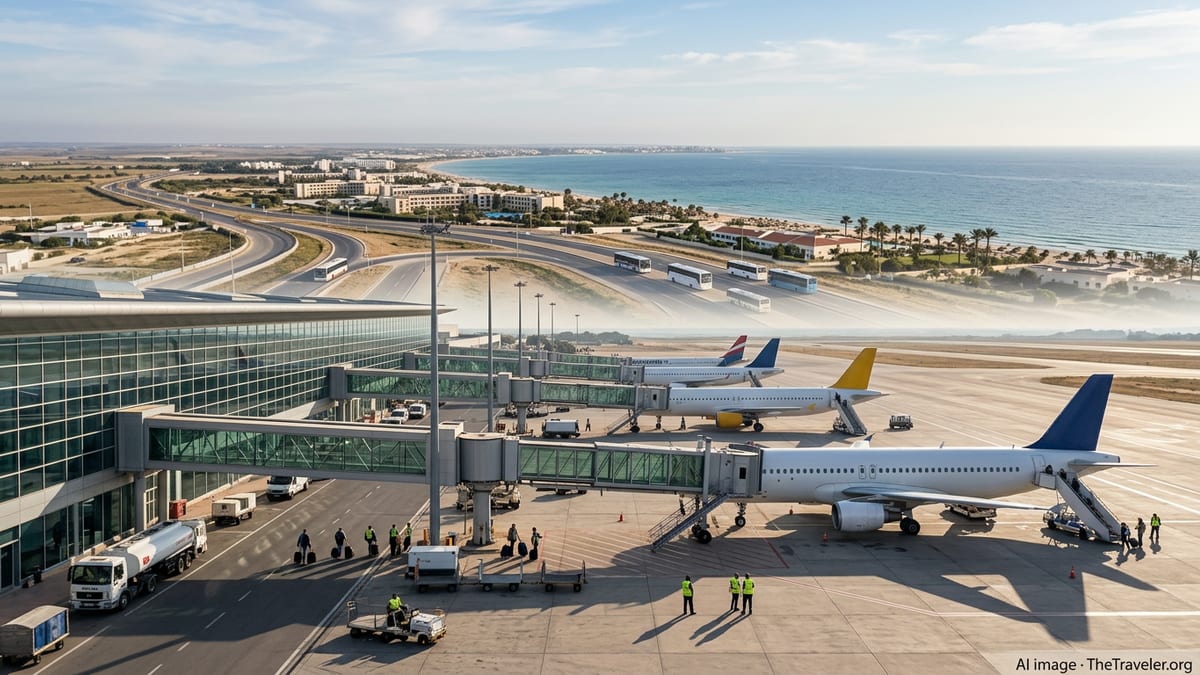
Enfidha-Hammamet Emerges as a Strategic Mediterranean Gateway
Located between Hammamet and Sousse, Enfidha-Hammamet International Airport has rapidly evolved from a secondary gateway into a strategic hub for Tunisia’s tourism industry. Developed and operated by TAV Tunisie, the airport was designed to divert pressure from Tunis-Carthage and to sit close to the high-density resort belt lining Tunisia’s eastern coastline. After several subdued seasons earlier in the decade, recent data and industry reports indicate that the airport is now experiencing a strong upswing in international arrivals, particularly from Europe.
Recent coverage focused on TAV’s 2025 outlook indicates that Enfidha-Hammamet is expected to handle around 1.5 million passengers this year, up from roughly 1.3 million in 2024. That increase of more than 200,000 travelers highlights both recovering demand and the airport’s capacity to accommodate further growth. The facility was initially built with substantially higher theoretical capacity, so current traffic levels are still widely viewed as leaving significant headroom for additional scheduled and charter services.
At the national level, Tunisia has been posting record tourism numbers. Industry analyses for 2024 and 2025 point to more than 10 million international visitors in 2024 and around 11 million in 2025, surpassing pre-pandemic benchmarks and placing Tunisia among Africa’s busiest destinations. Within that total, European markets remain critical, and the shift toward using Enfidha-Hammamet as a primary arrival point is visibly reshaping how tourists reach the country’s established and emerging resorts.
Publicly available statistics and sector briefings show that France continues to lead as Tunisia’s largest European source market, followed closely by Germany, the United Kingdom and Poland. The renewed emphasis on Enfidha-Hammamet allows these markets to connect more directly with major resort clusters, supporting tour operators and airlines that prioritize short ground transfers and high aircraft utilization.
Germany Joins UK, France and Poland in Expanding Capacity
Tunisia’s traditional European source markets have long included France, Germany, the United Kingdom and Italy, with Poland and other Central and Eastern European countries emerging strongly over the past decade. Recent tourism reports highlight that, alongside France, visitor numbers from Germany, the UK and Poland have all recorded solid growth since 2023, with some segments posting double-digit increases. Germany in particular is now being cited among the fastest-growing European contributors to Tunisia’s latest tourism surge.
German tour operators have historically focused on package holidays to Hammamet, Sousse and Monastir, but new and reinstated flight programs are increasingly routed via Enfidha-Hammamet. Sector coverage notes that additional capacity from German airports is being concentrated in the peak summer season, often under charter or seasonal models that are closely tied to large tour brands serving the mass-market beach segment. This puts Germany in line with the United Kingdom and Poland, where charter-driven demand has been central to Tunisia’s recent rebound.
From the British market, publicly reported figures for 2024 and 2025 show particularly strong percentage growth, with the UK registering more than 40 percent year-on-year gains in visitor numbers and passing the 400,000-visitor threshold. Analysts link much of that expansion to additional charter and low-cost flights into coastal airports, including Enfidha-Hammamet, which offer shorter transfers to popular resort zones than flights into the capital.
Poland, which has emerged as one of Tunisia’s rising European source markets, is also benefiting from expanded seat capacity into Enfidha and Monastir. Travel-industry commentary points to stable or growing charter programs from Warsaw and regional Polish airports, reflecting a broader trend of Central European travelers seeking competitively priced Mediterranean beach alternatives. France, meanwhile, retains its lead with more than a million annual visitors, underpinned by a mix of scheduled and charter services that use Enfidha-Hammamet as a convenient entry point to nearby resort regions.
Resort Belt Access: Shorter Transfers, Wider Choice
Enfidha-Hammamet’s location along Tunisia’s main north–south motorway corridor, within driving distance of Hammamet, Yasmine Hammamet, Sousse, Port El Kantaoui and Monastir, is central to its growing role. The airport sits close to the A1 motorway, which connects Tunis to the Sahel region, and is linked to an established network of hotel transfer services operated by local ground handlers and international tour operators.
For travelers from Germany, the UK, France, Poland and other European countries, one of the key selling points is reduced transfer time compared with routing via Tunis-Carthage or more distant airports. Tour packages marketed in these source markets increasingly highlight transfer durations of around 30 to 60 minutes from Enfidha-Hammamet to many of the main resort clusters. This is in line with broader Mediterranean trends, where quick airport-to-hotel connections are considered a decisive factor for family and short-stay beach holidays.
The airport is also broadening access to emerging and upgraded resort zones. Industry observers point to new or renovated properties along the Gulf of Hammamet and the Sousse area that are being added to major European tour operator brochures. Direct arrivals into Enfidha-Hammamet facilitate same-day access to these properties even on evening flights, enabling operators to optimize room occupancy and reduce the need for overnight staging in gateway cities.
For Tunisia’s tourism planners, the concentration of European arrivals through Enfidha-Hammamet supports efforts to extend the traditional summer season. With more flights and a connected resort belt, packages can be spread more evenly from early spring to late autumn, particularly appealing to German and British travelers who often book shoulder-season breaks. This seasonal smoothing is seen as an important factor in raising overall revenue and employment stability in coastal regions.
Charter Flight Growth and Capacity Utilization
The resurgence of charter operations has been one of the most visible features of Tunisia’s tourism recovery, and Enfidha-Hammamet is at the center of this trend. Data from aviation and tourism reports show a clear increase in charter frequencies from European markets, with tour operators scheduling multiple weekly flights from major cities in Germany, the UK, France, Poland, the Czech Republic and Scandinavia during the summer peak.
Many of these flights are operated by leisure carriers and low-cost airlines under block-seat or full-charter agreements with tour operators. This model allows operators to align aircraft capacity closely with hotel inventory in coastal resorts and to react more quickly to demand changes. Enfidha-Hammamet’s design, including multiple parking stands and a terminal configured for rapid passenger processing, has been cited in trade coverage as a competitive advantage in handling concentrated waves of leisure traffic.
Despite the recent jump to an expected 1.5 million passengers in 2025, analysts note that Enfidha-Hammamet still operates below its designed capacity, which leaves significant room for further expansion of charter and seasonal scheduled services. TAV Tunisie and its partners have used this headroom to court new routes and extend existing ones, particularly from secondary European cities where outbound leisure demand is strong but direct Mediterranean connections are limited.
Charter growth is also tied to Tunisia’s broader strategy of diversifying source markets while maintaining strong ties with core European origin countries. By providing flexible slots, competitive handling arrangements and proximity to extensive resort inventories, Enfidha-Hammamet is being positioned as an attractive alternative to more congested Mediterranean gateways, which can face slot constraints and higher operational costs during peak summer months.
Tourism Outlook: Consolidating Gains and Diversifying Markets
With Tunisia achieving more than 10 million international visitors in 2024 and approaching or surpassing 11 million in 2025 according to multiple industry summaries, stakeholders are now focused on consolidating these gains. European travelers, particularly from Germany, the UK, France and Poland, remain at the core of this expansion, but tourism planners are also looking at opportunities in other regions, including North Africa, the Middle East and selected long-haul markets.
Enfidha-Hammamet’s role in this next phase is expected to revolve around both volume and diversification. While traditional beach holidays to established resort areas will remain the backbone of demand, the airport is well placed to support niche segments such as golf, wellness, cultural tourism and combined itineraries that link coastal stays with visits to Tunis, Kairouan or interior desert regions. Industry observers suggest that better connectivity and competitive package pricing could help Tunisia capture a larger share of multi-destination Mediterranean trips originating in Germany and other high-spending European countries.
At the same time, travel trends across Europe indicate continued appetite for affordable short- and medium-haul sun destinations. Recent analyses of outbound tourism from Germany, the UK, France and Poland show robust demand for Mediterranean and North African breaks, supported by high levels of holiday travel spending. Tunisia’s positioning as a value-oriented destination, combined with growing seat capacity into Enfidha-Hammamet, aligns closely with these trends.
As airlines and tour operators finalize their programs for upcoming seasons, observers will be watching whether new or expanded routes from Germany and its European neighbors further accelerate traffic through Enfidha-Hammamet. For Tunisia’s coastal regions, the combination of improved air connectivity, expanding resort inventories and a broadening charter network suggests that the airport’s transformation into a primary tourism gateway is likely to continue shaping the country’s tourism map in the years ahead.