

More news on this day
South African travellers face a new layer of red tape in Europe as Germany moves to reinforce biometric checks, identity verification and visa controls, joining a growing list of more than 110 countries worldwide that now subject South African passport holders to tighter entry requirements alongside Mexico, Italy, France, Canada, Morocco and Poland.
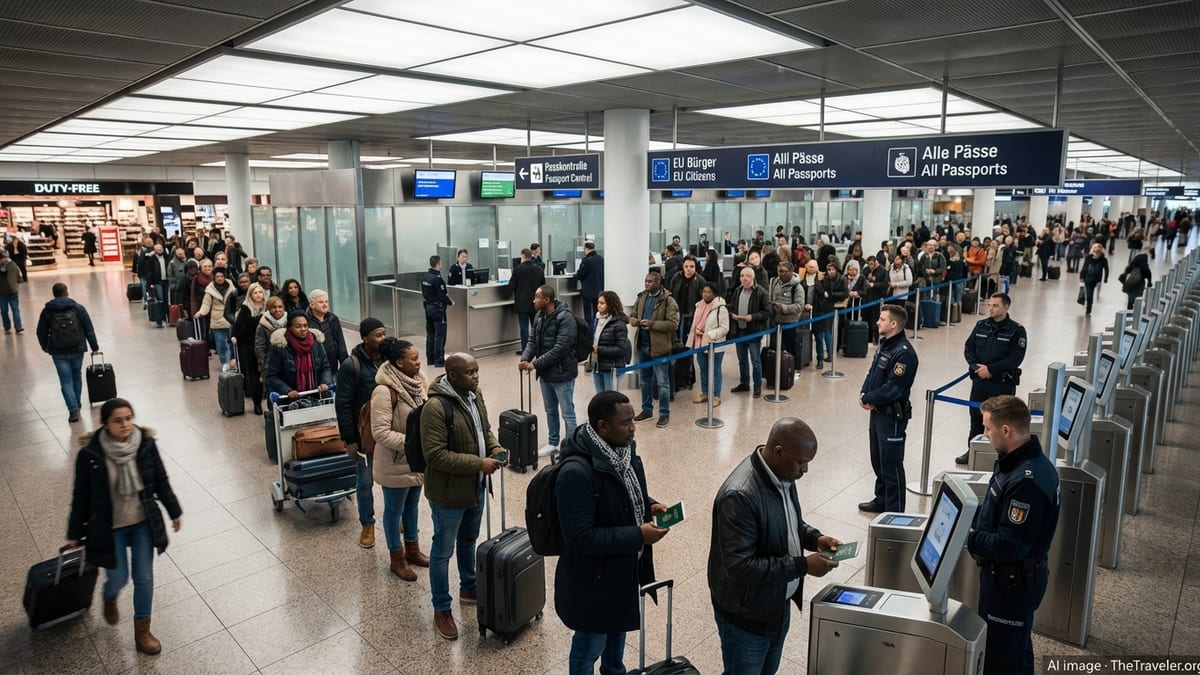
Germany Aligns With Stricter Schengen Entry Controls
Germany’s stance on South African travellers is being reshaped within the wider overhaul of European border management, as authorities phase in a tougher combination of advance visa screening, mandatory biometrics and systematic identity checks for non European Union visitors. While South Africans have long required a Schengen visa to visit Germany, the practical experience of crossing the border is changing, driven by new security technology and harmonised data systems across the bloc.
The rollout of the European Union’s Entry Exit System, which began phased implementation in late 2025, means that South African visitors to Germany and other Schengen countries are increasingly processed through biometric kiosks that capture fingerprints and facial images, replacing manual passport stamps with a centralised digital record of each entry and exit. For South African travellers, this transforms what was once primarily a paper visa and passport inspection into a data intensive identity confirmation at the border.
German authorities have framed the shift as a security and migration management measure designed to track overstays more accurately and combat document fraud. For South Africans, however, the new regime can translate into longer queues at busy airports, closer scrutiny of travel histories and stricter enforcement of the standard 90 days in a 180 day Schengen stay limit, with every border crossing logged in a shared database.
Biometrics, ID Checks and What They Mean in Practice
The tightening of German entry procedures is part of a worldwide trend where biometrics and digital identity systems have become the backbone of border control. South Africans arriving in Germany can increasingly expect their fingerprints and facial image to be captured or verified on arrival, particularly at major hubs where automated e gates and staffed biometric booths operate side by side.
In practice, this means that the visa in a South African passport is now only one component of a broader identity profile. Border officials compare biometric data against watchlists and previous travel records, while automated systems flag inconsistencies, such as mismatched identities or unexplained gaps in exit data. Travellers who have previously relied on smooth, low profile crossings may find their movements more visible and more easily questioned if irregularities appear in the system.
For many South Africans accustomed to manual stamps in their passports, the new approach can feel intrusive and unfamiliar, but it reflects a reality in which physical documents are no longer seen as sufficient proof of identity. Germany’s adoption of these tools brings it in line with countries such as the United States, Canada and several Asian states that already require foreign visitors to submit fingerprints and facial scans as standard.
Mexico, Canada, Italy, France, Morocco and Poland Already in the Fold
Germany’s move places it alongside a broad coalition of states that have progressively tightened entry rules for South African nationals in recent years. Mexico and Canada, once perceived as more accessible long haul destinations, have both embedded biometric enrolment and stricter visa pre screening into their systems for South African passport holders, aligning with a security first posture that seeks to track who enters and exits their territory in real time.
Within Europe, Italy, France and Poland are part of the same Schengen architecture as Germany, so any change in how external borders are managed affects South Africans crossing into any of these states. As biometric systems come online at more airports and land crossings, a South African tourist flying into Paris, Milan or Warsaw undergoes similar checks, with biometric and biographic data instantly shared across participating countries.
In North Africa, Morocco also operates increasingly structured controls for South African visitors, with an emphasis on clear documentation, advance bookings and proof of funds, even where formal biometric capture is not used as extensively as in Europe and North America. Taken together, these moves illustrate how diverse destinations on South Africans’ travel wish lists have converged on a model that links visas, biometrics and centralised databases, reducing the room for informal discretion at the border.
More Than 110 Countries Now Enforcing Tighter Rules for South Africans
Travel data compiled by international passport and mobility indices shows that South African passport holders now face some form of advance visa requirement in well over half of the world’s countries, and that an expanding subset of these states have added biometric enrolment as a standard part of the application and arrival process. The number of destinations applying structured biometric checks, identity verification and visa controls to South Africans has climbed beyond 110, reflecting a global shift toward risk based screening.
In many regions, the change has been incremental rather than sudden. Countries that initially introduced simple visa forms and manual background checks have layered biometric capture and database cross checks on top of existing systems. For South African travellers, the net effect is that journeys which once required only a passport and proof of accommodation now often demand online pre registration, in person biometric appointments at visa centres and the prospect of biometric scans at ports of entry.
The pattern is particularly evident across Europe, North America and parts of Asia, where visa waiver or simplified regimes have become rarer for South Africans, replaced by detailed application forms that probe travel history, employment, financial means and planned itineraries. As Germany’s updated procedures take hold, it reinforces the perception that South African travellers are entering a world in which thorough identity vetting is the norm rather than the exception.
Impact on South African Leisure and Business Travel
The tightening of entry rules in Germany and other popular destinations has practical implications for South African tourists, students and business travellers. Holidaymakers planning European itineraries built around Germany, Italy or France may need to budget additional time and money for visa appointments, biometric enrolment fees and document gathering, including comprehensive travel insurance, proof of accommodation and bank statements demonstrating sufficient funds.
For business travellers, the increased scrutiny can add friction to tight schedules, as interview style visa appointments and in depth background questions become more common. Tech and corporate professionals who previously relied on frequent, short notice trips to European clients may now face longer lead times while waiting for biometric appointments and processing decisions, particularly during peak travel seasons.
Families are also affected, especially when travelling with children. Many systems exempt younger children from fingerprinting but still require facial images and full documentation for each minor. Parents must ensure that school letters, consent documents and financial guarantees are prepared in advance, as German and other Schengen consulates place greater emphasis on preventing child trafficking and irregular migration.
How South African Travellers Can Prepare
In this more demanding environment, preparation has become critical for South Africans heading to Germany or any of the other countries tightening controls. Travellers are increasingly advised to begin visa applications several weeks or even months before departure, taking into account the need to secure biometric appointments at third party visa centres and to accommodate potential delays if additional documentation is requested.
Maintaining a clean, well documented travel record is also more important than ever. Consistent observance of visa conditions, particularly the Schengen 90 day rule, reduces the risk of flags appearing in shared European databases. South African travellers who overstay in one Schengen country may find their future applications to Germany or others delayed or rejected, as biometric data makes it easier to identify repeated violations.
Experts recommend that travellers keep digital and printed copies of key documents, including confirmed return tickets, hotel bookings and invitation letters, to present quickly if questioned by German or other border officers. Being able to clearly explain the purpose and duration of a trip, supported by evidence, can speed up checks in busy arrival halls increasingly dominated by biometric gates and structured interviews.
Domestic Policy Shifts in South Africa and Reciprocal Measures
South Africa’s own border management policies are evolving in parallel, with authorities moving toward electronic travel authorisations and enhanced security screening for certain foreign nationals. These domestic changes are partly a response to international expectations that partner countries will tighten their own systems, and partly an attempt to modernise ageing infrastructure that has struggled with irregular migration and document fraud.
Although South Africa has traditionally granted generous visa free access to many African and selected non African states, recent debates in Pretoria have highlighted the tension between openness and security. The tightening of entry regimes abroad, including in Germany and across the wider Schengen zone, has prompted calls for more reciprocal measures, with some policymakers arguing that South Africa should match biometric and visa requirements imposed on its own citizens.
For now, the focus remains on improving South Africa’s own capacity to verify identities and monitor movements, both to reassure international partners and to support negotiations for future easing of restrictions. Officials recognise that better data, stronger document security and credible exit controls may, over time, help rebuild trust and open the door to more favourable visa arrangements for South Africans abroad.
What This Signals for the Future of South African Mobility
Germany’s alignment with a broad group of countries enforcing biometrics, identity verification and visas for South African travellers underscores a wider recalibration of global mobility. For many South Africans, especially younger, globally minded professionals and students, international travel is no longer a simple extension of personal freedom but a bureaucratic process that demands strategic planning and careful compliance.
Travel analysts note that countries are unlikely to roll back biometric systems once they are in place. Instead, future reforms are expected to focus on streamlining processes through digital applications, pre travel risk assessments and, in some cases, trusted traveller programmes that reward consistent compliance. South Africans could eventually benefit from smoother experiences if they build strong track records across multiple trips to destinations such as Germany, Mexico, Canada and Italy.
In the near term, however, the direction of travel is clear: more countries, more data and more structured controls for South African passport holders. Germany’s reinforced entry regime is both a symptom and a driver of this trend, signalling that the era of low friction, lightly documented international movement is giving way to one in which identities are checked, cross checked and stored every time a border is crossed.