

More news on this day
Germany is accelerating a quiet revolution on the tracks, using high-speed trains, digital timetables and climate-focused upgrades to turn its rail system into a faster, cleaner backbone for European travel.
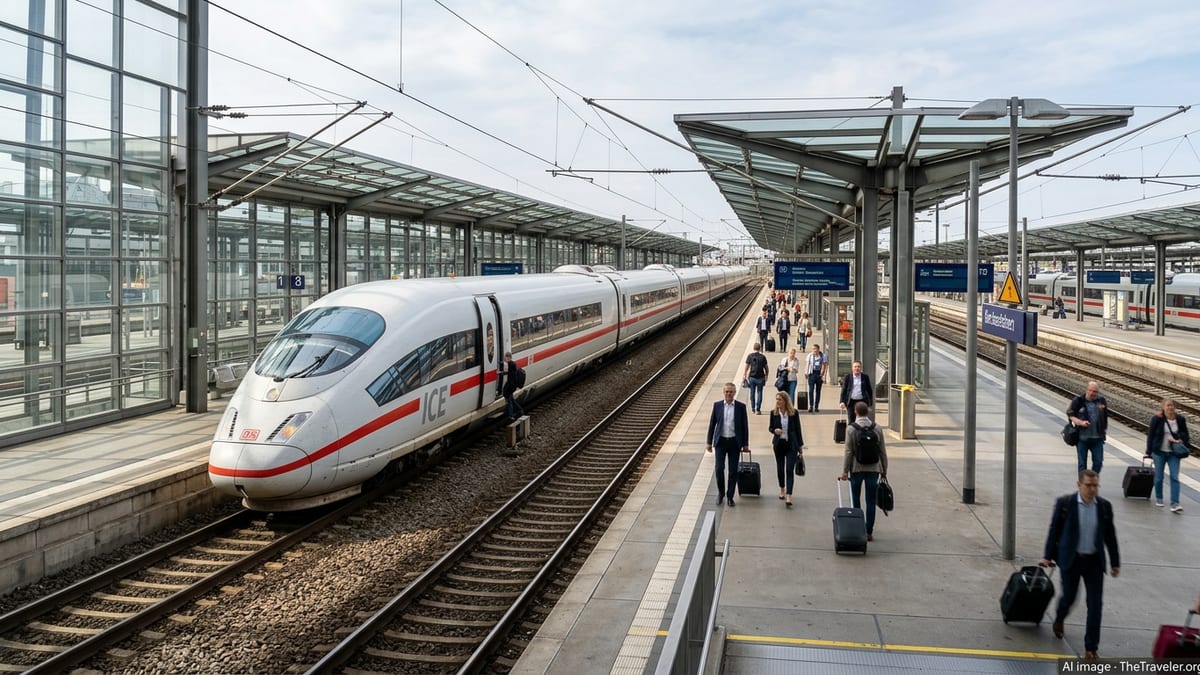
High-Speed Lines Cut Journey Times Across Germany
Germany’s high-speed Intercity-Express (ICE) network is at the core of this transformation, shrinking journey times between major cities and strengthening its role as a continental hub. New infrastructure such as the Wendlingen–Ulm high-speed railway in Baden-Württemberg, which allows trains to run at up to 250 km/h, has already reduced travel times on the key Stuttgart–Ulm corridor and improved long-distance links between western Germany, Munich and Austria.
The Wendlingen–Ulm line, which opened to commercial traffic in late 2022, is part of the larger Stuttgart–Augsburg project, designed to support sustained speeds of up to 250 km/h towards Stuttgart and 200 km/h towards Augsburg and Munich. These upgrades are intended not only to speed up flagship ICE services, but also to add capacity for regional and freight trains on parallel routes, relieving bottlenecks on one of Europe’s most heavily used stretches of rail.
Underpinning the new lines is a major modernization of Stuttgart’s rail hub. The Stuttgart 21 project replaces the city’s historic terminus with an underground through-station connected directly to the high-speed route, enabling faster arrivals and departures and cutting time lost in reversals. When the remaining sections are commissioned later this decade, travel times between Stuttgart and Munich are expected to fall significantly, reshaping rail’s competitiveness against road and air on one of southern Germany’s busiest corridors.
Seamless Connections Under the Deutschlandtakt Vision
Speed alone is not enough to transform how people move, and planners are betting heavily on better coordination. Germany’s nationwide integrated timetable concept, known as the Deutschlandtakt, aims to synchronize long-distance, regional and local services so that trains connect at regular, repeating intervals, typically every 30 or 60 minutes. This pattern is being used to redesign infrastructure and service plans, with new high-speed lines like Stuttgart–Ulm treated as structural “backbones” around which connections are built.
The idea is that passengers travelling from smaller cities and towns will gain predictable, short-transfer links into the high-speed network, rather than having to plan around a handful of long-distance departures each day. Projects around Stuttgart, including the Filstal Bridge and new junctions near Wendlingen, have been engineered specifically to allow frequent ICE services to dovetail with regional trains serving the Swabian Alb and Neckar valleys, turning formerly peripheral stations into gateways to the wider European network.
Digitalization is a central pillar of this effort. Deutsche Bahn is rolling out digital interlockings and the European Train Control System on key corridors to increase capacity, improve punctuality and give dispatchers more flexibility in handling disruptions. The Stuttgart hub is among the first in Germany to be equipped as a “digital node,” a test case for how modern signalling and automated traffic management can support a dense, tightly timed national schedule.
Cross-Border Links Put Europe Within Overnight Reach
The transformation of Germany’s rail network is being closely coordinated with European partners, as new high-speed and night-train links redraw the map of cross-border travel. Deutsche Bahn and France’s SNCF are preparing a new generation of joint services, including high-speed routes between Paris and major German cities such as Munich, designed to bring journey times closer to the threshold at which rail competes directly with short-haul flights.
To the east, Deutsche Bahn has announced a substantial expansion of services to Poland, with a new timetable adding more than a dozen cross-border routes from December 2025. These additional trains will strengthen links between Berlin and major Polish cities, reflecting rising demand for rail travel within central Europe and easing connections onto domestic Polish networks.
Germany is also emerging as a central node in Europe’s night-train renaissance. Partnerships with operators such as Austria’s ÖBB and Italy’s Trenitalia are delivering new overnight connections that use German corridors as through-routes between the Netherlands, Austria and Italy, while independent operators plan routes linking Berlin with Paris and other capitals. For travellers, the result is a growing menu of options that combine daytime high-speed journeys with overnight sleepers, allowing cross-continental trips with a single change of train.
Sustainability at the Heart of Rail’s Resurgence
Environmental performance is a major driver of the shift towards rail, and Germany’s system is being positioned as a flagship for low-carbon mobility. Deutsche Bahn reports that its long-distance services are the most climate-friendly mode for many trips within Germany when measured in grams of greenhouse gas emissions per passenger kilometre, undercutting private cars and domestic flights by a wide margin. The company has set a target of climate neutrality and is expanding its use of renewable electricity, while also experimenting with alternative fuels such as hydrotreated vegetable oil on non-electrified routes.
Alongside cleaner traction power, infrastructure projects are designed to encourage a broad shift from road and air to rail. High-speed lines and digital capacity upgrades allow more trains to run on the same tracks, accommodating both fast ICE services and slower regional trains without sacrificing punctuality. This is intended to make it easier for travellers and logistics operators to choose rail for both domestic and international journeys, contributing to national and European climate goals.
Passenger-facing initiatives are also part of the sustainability push. Tools such as Deutsche Bahn’s emissions comparison calculators help travellers see how much CO2 they can save by choosing the train over a flight or a long car journey. Combined with improving onboard comfort, reliable onboard connectivity and station upgrades that favor walking, cycling and public transport interchanges, Germany’s rail system is being marketed not just as a green option, but as the most convenient and comfortable way to cross the country.
Comfort, Technology and the Next Generation of ICE Trains
The experience on board Germany’s high-speed trains is evolving in parallel with the infrastructure beneath them. New ICE generations are being introduced with redesigned interiors, quieter bogies and better suspension to make 250 km/h cruising feel smoother and less tiring, even on long journeys. Features such as spacious family areas, business zones, improved wheelchair access and generous luggage space reflect the rising expectations of passengers who are choosing rail for trips that once defaulted to the plane.
Connectivity has become a core part of the product. Modern ICE sets come equipped with signal-transparent windows, onboard repeaters and upgraded Wi-Fi systems to keep passengers connected even as trains pass through tunnels or rural areas at high speed. Power outlets at every seat, real-time journey information on screens and in apps, and the ability to book, rebook and claim compensation digitally are being treated as essential components of a premium long-distance service.
Looking ahead, Deutsche Bahn is planning new train generations and timetable expansions that will deepen these trends, extending frequent high-speed service to more corridors and integrating Germany’s network even more tightly with its neighbours. For travellers, this means that crossing Europe by train from a German hub is increasingly becoming a matter of choosing a departure time, stepping on board and letting a connected, low-carbon rail system handle the rest.