

Phnom Penh is a city in motion. Motorbikes buzz past saffron-robed monks, tuk-tuks weave between SUVs, and on the riverfront new pedestrian zones are testing a more walkable future. For visitors, the sheer energy is part of the appeal, but it also raises a practical question: what is the smartest way to get around?
Choosing between tuk-tuks, walking and other forms of transport is about more than comfort. It affects how safely, efficiently and sustainably you experience Cambodia’s capital.
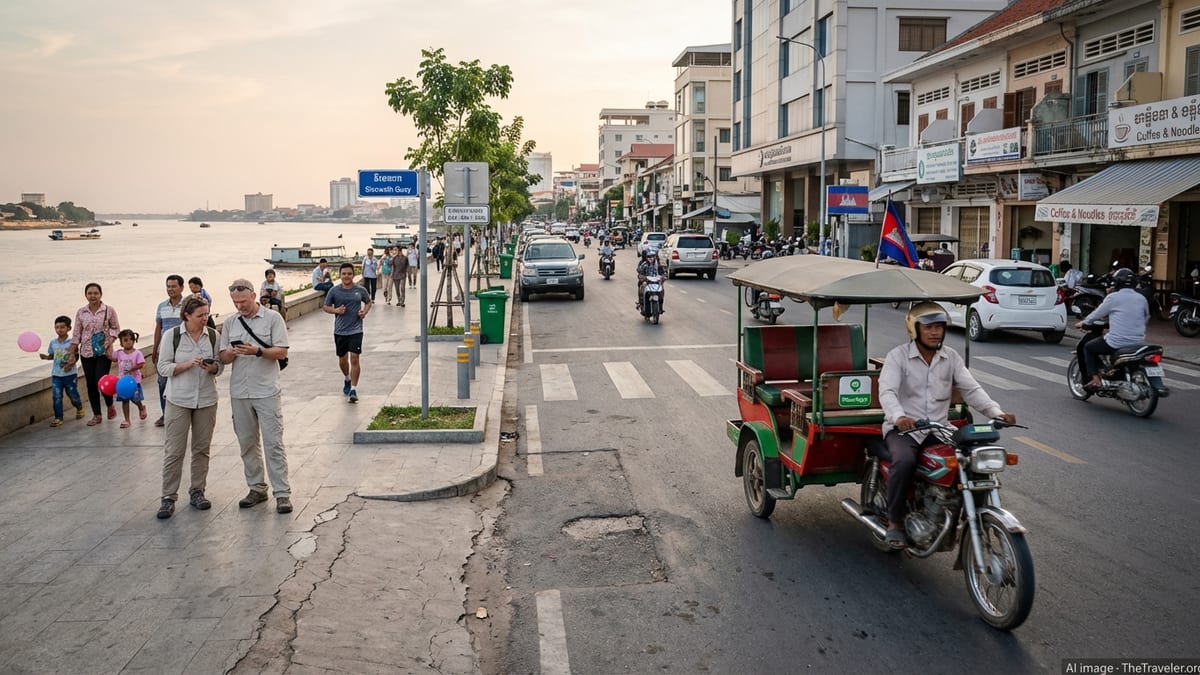
Understanding Phnom Penh’s Urban Layout
Phnom Penh spreads out from the confluence of the Mekong and Tonle Sap rivers, with a relatively compact historic core surrounded by fast-growing suburbs. The central districts around Riverside, the Royal Palace, Wat Phnom and the Central Market hold many of the city’s key sights, hotels and restaurants. At first glance the flat topography might suggest that walking everywhere is simple, but traffic density, lack of continuous sidewalks and the heat quickly complicate that assumption.
Major north-south corridors such as Norodom Boulevard and Monivong Boulevard carry heavy traffic at almost all hours. East of these main roads, the riverside Sisowath Quay has been increasingly shaped into a leisure and pedestrian space, including weekend evening closures to vehicles along a long stretch between the Post Office and the Royal Palace. Away from the riverside, grid-like numbered streets branch off the main boulevards, making navigation straightforward for tuk-tuks and ride-hailing drivers but sometimes disorienting for first-time visitors on foot.
Most tourist-friendly neighborhoods sit within a 2 to 4 kilometer radius of each other. In theory this puts many attractions within a 30 to 40 minute walk. In practice, many travelers end up combining short walks within their immediate area with tuk-tuk or ride-hailing trips for cross-town journeys. Understanding what feels comfortable to do on foot, and when to rely on motorized transport, is the foundation for planning your days in the city.
Another factor is the rapid pace of urban change. New flyovers, widened junctions and pedestrian initiatives have begun to alter how traffic flows in the city. Road rules and driver behavior, however, have not caught up at the same speed. Any visitor comparing walking and tuk-tuks in Phnom Penh needs to factor in not only distance, but also how easy it is to cross busy roads and how predictable traffic patterns really are from hour to hour.
The Tuk-Tuk Experience: Classic and App-Based
For many visitors, tuk-tuks are synonymous with Phnom Penh itself. The most common style is a covered, open-air carriage pulled by a motorbike. Short rides within central areas typically cost only a few US dollars, while longer cross-city trips and airport transfers are still affordable compared to prices in many other capitals. Tuk-tuks offer a breezy, unobstructed view of street life and provide a flexible way to hop between markets, museums and riverfront cafes with minimal planning.
Until a few years ago, most tuk-tuk trips relied on ad hoc bargaining. Visitors would flag down drivers, agree a fare in a mix of English, Khmer, hand gestures and scribbled numbers, and then climb aboard. That system still exists, especially around tourist sites like the Royal Palace, Wat Phnom and popular markets. However, the arrival of ride-hailing platforms has significantly changed how both locals and foreigners book tuk-tuks and small cabs.
PassApp, a Cambodian ride-hailing service launched in 2016, has become one of the dominant ways to book tuk-tuks and rickshaw-style mini cars in Phnom Penh. International platforms such as Grab and regional services like Tada and WeGo also operate here, offering options that range from motorbikes to SUVs. These apps allow riders to set pick-up and drop-off points on a map, see an estimated fare in advance and often choose between vehicle types, including the classic open-air tuk-tuk.
The main advantage of app-based tuk-tuk travel for visitors is price transparency. Instead of haggling each time, you see the fare before confirming the trip. That reduces the likelihood of misunderstandings, especially late at night or across language barriers. It also makes it easier to compare whether a tuk-tuk, a small car or a motorbike taxi makes more sense for a particular journey in terms of cost, comfort and time.
Cost, Comfort and Convenience: Tuk-Tuks vs Other Transport
On a pure cost basis, tuk-tuks remain one of the most economical ways to get around Phnom Penh for short and medium distances. With ride-hailing apps, many urban journeys fall in the range of one to a few US dollars, depending on distance and time of day. Traditional street-hailed tuk-tuks around tourist hubs may quote higher initial prices, especially if they sense uncertainty. In those cases, stating a clear destination and a firm but fair counteroffer tends to lead to a quick agreement.
Compared with taxis or private cars booked through apps, tuk-tuks occupy a middle ground between price and comfort. They are fully open to the air on the sides, which is pleasant in the evenings but can feel intense in midday heat, heavy rain or severe air pollution. Visitors who are sensitive to exhaust fumes, noise or dust may find that a small closed car with air conditioning is a better choice for longer trips or during rush hour, even if the fare is slightly higher.
In terms of convenience, tuk-tuks can often navigate congested streets more easily than larger vehicles, slipping into gaps and taking narrow side routes. That agility is particularly helpful in neighborhoods like BKK1, where popular cafes and boutique hotels sit on smaller streets branching off busy arterials. During peak travel periods or in heavy rain when demand spikes, app-based platforms sometimes show long wait times or surge pricing. In those moments, flagging down a passing tuk-tuk may actually be faster than waiting for an app driver to arrive.
There is also the question of social interaction. Many tuk-tuk drivers in Phnom Penh have years of experience shuttling visitors between key sights and are quick to share recommendations or snippets of local history. While not every conversation will be in fluent English, a friendly greeting, an attempt at a few words of Khmer and a relaxed attitude often lead to pleasant exchanges. For travelers who value that human element, tuk-tuks can make the city feel more approachable than sealed cars or buses.
Safety and Etiquette When Using Tuk-Tuks
Safety is central when weighing tuk-tuks against walking or other forms of transport. Phnom Penh’s roads are busy and enforcement of traffic rules can be inconsistent. Tuk-tuks, however, are widely used by both locals and visitors and are generally considered a practical everyday option. Choosing how and when to ride can help reduce risks. Many travelers prefer app-booked vehicles because the platforms log driver details and trip routes, providing an additional layer of accountability compared with anonymous street hails.
Seat belts are rare in tuk-tuks, and the open sides mean riders should be alert to their surroundings. Keeping arms and bags inside the vehicle and staying seated while moving are simple but important habits. Bag snatching from passing motorbikes can occur in busy areas, so it is wise to keep phones, cameras and handbags on the side away from traffic and avoid holding valuables loosely near the edge of the carriage. Traveling with handbags across your body rather than over one shoulder also reduces temptation for opportunistic thieves.
Road conditions vary, with potholes, sudden puddles in rainy season and uneven drainage covers. Alert drivers will slow down over rough patches, but it is still prudent to hold on to the rail or seat edge, especially at night when obstacles can be harder to spot. If a driver seems to be speeding or overtaking in a way that makes you uncomfortable, a calm request to slow down is usually respected. Visitors are not expected to tip heavily, but rounding up the fare by a small amount is customary when the ride has been smooth and courteous.
Etiquette also matters. Agreeing on the fare beforehand for street-hailed rides, speaking respectfully and avoiding raised voices over small price differences all help maintain a positive atmosphere. Drivers may offer unsolicited suggestions for additional stops or detours to shops and restaurants where they receive commissions. If you are not interested, a firm but polite refusal is sufficient. Compared with walking by yourself late at night in quieter neighborhoods, a tuk-tuk ride can often be a safer choice, particularly for solo travelers.
Walking Phnom Penh: Possibilities and Limitations
On paper, Phnom Penh’s flat terrain and relatively compact core make it attractive for walking. Certain areas genuinely reward exploration on foot. The riverfront promenade along Sisowath Quay is especially pleasant in the early morning and late afternoon, with locals exercising, families gathering and food vendors setting up. Since 2025, weekend evenings have seen much of this stretch turned into a pedestrian-only zone for several hours between early evening and late night, creating long car-free corridors that feel safer and more relaxed for walkers.
Around the Royal Palace, the National Museum and Wat Ounalom, side streets can be surprisingly calm, particularly outside rush hour. In neighborhoods with embassies and older villas, sidewalks are more consistent, shade trees are more frequent and traffic speed is somewhat lower. In these enclaves, strolling between cafes, galleries and boutique hotels can be a highlight of time in Phnom Penh, offering a slower and more intimate connection with the city than motorized transport allows.
The reality in many other parts of the city is more complicated. Sidewalks may be uneven, partially broken or occupied by parked motorbikes, food carts and informal stalls. Pedestrian crossings with functioning signals are limited, and vehicles do not always yield to people on foot. Crossing multi-lane boulevards at busy intersections can be intimidating for new arrivals. One common local technique is to walk steadily and predictably through gaps in traffic rather than attempting to sprint. Even then, many visitors prefer to cross near groups of locals or wait until traffic thins out.
The tropical climate also shapes the walking experience. From late morning to mid-afternoon, temperatures and humidity can be high, making long walks uncomfortable or even risky for those not accustomed to the heat. During the rainy season, sudden downpours can flood low-lying streets within minutes. Combining shorter walks with strategic tuk-tuk rides during the hottest or wettest parts of the day often makes for a more comfortable itinerary. Carrying water, a hat and basic sun protection is recommended for anyone planning to explore on foot for more than brief stretches.
Public Buses, Taxis and Motorbikes: Alternatives to Tuk-Tuks
Beyond tuk-tuks and walking, Phnom Penh now has a functioning municipal bus network that has expanded steadily over the last decade. The city bus system, which began with just a handful of routes, has grown to cover key corridors into the northern, southern, eastern and western suburbs. As of the mid 2020s, more than twenty lines operate daily, connecting parts of the city that once required multiple tuk-tuk changes. Fares remain low, with a flat price per ride in local currency that makes buses appealing for budget-conscious travelers and commuters alike.
However, the bus system still presents hurdles for short-term visitors. Route maps and English-language information can be patchy, and bus stops are not always clearly marked. Buses can be crowded during peak hours and are generally less convenient for travelers on tight schedules or with large luggage. On the other hand, for those with time and curiosity, riding a city bus at least once offers a window onto everyday Phnom Penh well beyond the riverfront and tourist core.
Traditional metered taxis are less visible in Phnom Penh than in some neighboring capitals, but sedan and SUV rides booked through ride-hailing apps are widespread. These can be a sensible alternative to tuk-tuks during heavy rain, late-night trips or when traveling with more than two passengers and substantial luggage. For airport transfers, app-booked cars allow you to avoid haggling after a long flight while benefiting from air conditioning and secure space for bags. Fares remain modest by international standards but are generally higher than those of tuk-tuks for the same route.
Motorbike taxis, both informal and app-based, represent another layer of the urban transport mix. They can be the fastest way to cut through congestion, particularly at rush hour. Yet they also expose riders to more direct physical and environmental risks than tuk-tuks or cars. Helmets should always be worn, and travelers uncomfortable with motorbike travel elsewhere are unlikely to find Phnom Penh an easier place to start. For many visitors, motorbikes are better suited to intercity journeys with experienced tour operators than to everyday city-hopping.
Environmental and Cultural Considerations
Phnom Penh is confronting the same environmental questions that many fast-growing cities face. Rapid increases in private car and motorbike ownership have brought congestion, noise and air pollution. In this context, the choice between walking, tuk-tuks and other transport options has broader implications. Walking and cycling, where practical, are the least polluting modes, but the current streetscape does not always support them comfortably. Tuk-tuks, while not emission-free, can be more efficient than single-occupancy cars when carrying two or three passengers on short urban trips.
The introduction of regular pedestrian-only periods along the riverfront is part of a wider conversation about livability. These car-free hours, concentrated on weekend evenings, show how reallocating street space can change the character of central districts, turning busy corridors into social and recreational spaces. For visitors, planning to walk these stretches during closure times allows a very different experience from navigating the same streets during weekday rush hour. As more residents embrace this model, additional pedestrian initiatives may emerge in other parts of the city.
Culturally, tuk-tuks remain woven into the fabric of Phnom Penh. Many drivers come from rural provinces and support extended families through their work. Choosing to negotiate fairly rather than driving the price to the absolute minimum acknowledges the value of their labor while still keeping transport costs well below those in many countries. Using local platforms and paying in Cambodian riel where possible also supports the domestic economy and helps you engage just a little deeper with everyday life in the capital.
Being a considerate guest in the city includes thinking about noise and disruption as well as money. Late at night in residential neighborhoods, minimizing loud conversations in open tuk-tuks or avoiding unnecessary honking contributes to a more respectful presence. When walking, being mindful not to block narrow sidewalks or doorways and to give space to elderly pedestrians, children and monks aligns with local expectations of courtesy.
Planning Your Days: When to Walk and When to Ride
Deciding between walking and tuk-tuks in Phnom Penh is rarely an all-or-nothing choice. Most visitors find a blended approach works best, guided by time of day, neighborhood and personal comfort levels. Early mornings are ideal for walking longer stretches, especially along the riverfront or through temple and market districts before the full heat and traffic build. Midday and mid-afternoon are more comfortable for tuk-tuk or car travel, with brief walks reserved for shaded streets or indoor attractions located close together.
In the early evening, particularly on weekends, the pedestrianized riverside offers a chance to wander without constant vigilance for vehicles. You might ride a tuk-tuk from your hotel to the start of the car-free area, explore on foot for an hour or two, then take another tuk-tuk onward to dinner or back to your accommodation. At night, especially after 10 pm in quieter parts of town, many solo travelers prefer to take tuk-tuks even for relatively short distances rather than walking dark or unfamiliar streets.
Digital tools help make these decisions smoother. Having a local SIM card or reliable roaming data allows you to compare estimated fares across platforms, check real-time traffic conditions and orient yourself on the map before deciding whether a destination is best reached on foot or with a ride. Even if you plan to hail tuk-tuks directly on the street, glancing at current app prices gives you a benchmark for fair negotiation, reducing uncertainty for both you and the driver.
Building small buffers of time into your daily schedule is important too. While tuk-tuks and ride-hailing apps are generally quick, sudden downpours, traffic incidents or street closures for events can delay even the best-planned itinerary. Allowing extra minutes for transfers, especially when connecting to buses or intercity transport, keeps minor disruptions from becoming major stresses.
The Takeaway
Phnom Penh is a city that rewards flexibility. Tuk-tuks remain the backbone of informal urban transport, offering affordable, characterful rides that bring you close to the city’s energy. Walking, while constrained by heat and infrastructure gaps, delivers some of the most memorable moments along the riverfront and in quieter side streets, especially during newly introduced pedestrian-only hours. Public buses and app-booked cars fill in the gaps, providing options for longer cross-town journeys, airport transfers and rainy days.
For most travelers, the smartest approach is not to choose between tuk-tuks and walking, but to understand when each mode shines. Use tuk-tuks or app-based rides for airport transfers, cross-town trips, late-night movements and any route that requires crossing multiple busy boulevards. Reserve walking for cooler times of day, compact neighborhoods with sights clustered together and clearly defined pedestrian zones. Consider environmental impact, cultural sensitivity and personal safety as you decide how to move from place to place.
With a bit of preparation and realistic expectations, getting around Phnom Penh can be straightforward and even enjoyable. Instead of seeing transport as a hurdle between attractions, it becomes part of the experience: conversations with drivers, glimpses of everyday markets from open carriages, quiet riverside strolls at dusk. Balancing tuk-tuks, walking and other transport options allows you to experience Cambodia’s capital in a way that is not only efficient, but also immersive, respectful and memorable.
FAQ
Q1. Is it safe to use tuk-tuks in Phnom Penh at night?
Using tuk-tuks at night is common and generally considered practical, especially compared with walking long distances in poorly lit areas. Booking through a ride-hailing app adds a layer of safety because the trip and driver are recorded. As with any city, sit inside the vehicle away from traffic, keep bags secure, and avoid displaying valuables.
Q2. How much should I expect to pay for a short tuk-tuk ride?
For short journeys within central Phnom Penh, many app-based tuk-tuk fares fall in the low single-digit US dollar range. Street-hailed drivers around tourist sites may initially quote more. Checking an app first gives you a reference price so you can negotiate a fair amount if you choose to pay cash directly.
Q3. Can I walk between major attractions like the Royal Palace, Central Market and Wat Phnom?
Yes, these sights are within a few kilometers of each other and many visitors walk at least part of the way, especially along the riverfront. However, sidewalks can be inconsistent and crossings busy. If you are uncomfortable with traffic or the heat, you may prefer to combine short walks with tuk-tuk rides between clusters of attractions.
Q4. Are there pedestrian-only areas in Phnom Penh?
Certain stretches of the Riverside along Sisowath Quay are closed to vehicle traffic on weekend evenings, creating a pedestrian-friendly zone between the Post Office and the Royal Palace. These car-free hours are excellent times to walk, people-watch and enjoy the riverfront without navigating constant traffic.
Q5. Do I need to download a local ride-hailing app before I arrive?
Downloading at least one ride-hailing app that operates in Cambodia is recommended. Apps such as PassApp and regional platforms allow you to see estimated fares and track your driver. Having them installed before arrival saves time at the airport and makes it easier to compare prices and options once you are in the city.
Q6. Is the public bus system useful for tourists?
The city bus network is expanding and offers very low fares along key routes, but route information and stop signage can be confusing for short-term visitors. If you are comfortable navigating local buses and have flexible timing, they can be an interesting way to experience everyday life. For most first-time visitors, tuk-tuks and app-based cars tend to be more straightforward.
Q7. What is the best way to get from Phnom Penh International Airport to the city center?
Many travelers choose app-booked cars or tuk-tuks for airport transfers, as these offer predictable pricing and door-to-door service. Some city buses connect the airport area with central Phnom Penh at very low cost, but they may be less convenient if you have heavy luggage or arrive late at night.
Q8. How walkable is Phnom Penh for travelers with limited mobility?
Phnom Penh presents challenges for visitors with limited mobility. Sidewalks may be uneven, blocked or absent, curb cuts are inconsistent and public buses are not always fully accessible. In such cases, relying on tuk-tuks or app-booked cars for most movements and choosing accommodation with good vehicle access at the entrance is usually the most practical approach.
Q9. Should I pay tuk-tuk drivers in US dollars or Cambodian riel?
Both US dollars and Cambodian riel are widely accepted in Phnom Penh. For small cash fares, carrying a mix of low denominations in both currencies is helpful. If you pay in dollars, expect to receive change in riel. When using ride-hailing apps, the fare is quoted in local currency, and you can pay cash or, on some platforms, by card.
Q10. Is it advisable to rent a motorbike instead of relying on tuk-tuks and walking?
Motorbike rental is available in Phnom Penh but is not recommended for most short-term visitors. Traffic is dense, road rules are loosely enforced and accidents are not uncommon. Unless you have extensive experience riding in similar conditions, it is usually safer and more relaxing to combine tuk-tuks, walking and app-booked cars to get around the city.