

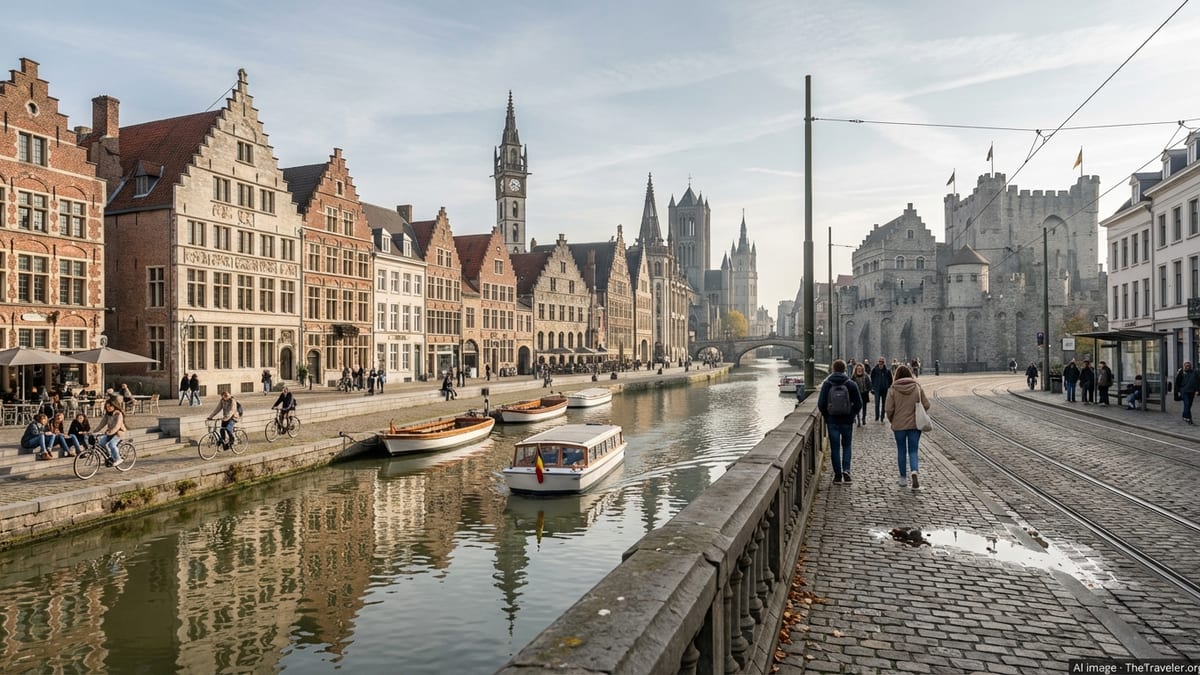
Ghent’s old town is one of Europe’s most atmospheric historic centers, a compact knot of medieval towers, canal-side guildhouses, and cobbled squares that still feel lived in rather than preserved. At its heart stands Gravensteen, a brooding stone castle that looms over the waterways and tram lines.
Within a few minutes’ walk you can move from cathedral altarpieces to student bars, from quiet side canals to busy markets. This guide focuses on the core of the old town, giving you practical, up-to-date advice on visiting Gravensteen, exploring the canals, and understanding the main historic squares that structure the city’s life.
Getting Oriented in Ghent’s Old Town
Ghent’s historic center sits between the Leie and Scheldt rivers and is largely car free, which immediately changes the feel of the place. Instead of traffic, you share the streets with cyclists, trams, and pedestrians, and most sights in the old town are within a 10 to 15 minute walk of each other. Key landmarks help you get your bearings: the three medieval towers of St. Nicholas’ Church, the Belfry, and St. Bavo’s Cathedral line up along one axis, while Gravensteen anchors the other, overlooking the Leie and the small square of Sint-Veerleplein.
The main train hub, Gent-Sint-Pieters, lies a short tram ride from the old town. Tram line 1 runs directly from the station to the center, with stops at Korenmarkt and Gravensteen, which are perfect jumping-off points for exploring. The old town is also inside a low-emission zone, so if you plan to arrive by car you must check in advance whether your vehicle is allowed and where you can park on the edge of the center, then continue by tram or on foot into the medieval core.
Ghent is very walkable, but it is also one of the most bike-friendly cities in Belgium. Dedicated cycle lanes converge on the center, and a number of rental outfits allow you to pick up a bike for a day to link the old town with outlying areas like the artsy Dok Noord district or the green ring of parks. Within the historic core, though, walking is often the best option. Short distances and frequent tram stops make it easy to pause at a cafe or detour along a side canal whenever something catches your eye.
Gravensteen: Castle of the Counts
Gravensteen is the defining monument of Ghent’s skyline, a full-scale medieval fortress right in the city center. Built in the late 12th century for the Counts of Flanders, it was both a symbol of their power and a practical stronghold controlling the waterways and trade routes. Over the centuries it served as a court, a prison, and even a factory before being restored in the 19th and 20th centuries, when the city decided to keep its castle rather than demolish it, as many other European cities had done. Today it stands almost complete, with wall walks, towers, and a keep that give a clear sense of how a feudal stronghold worked.
Practically speaking, visiting Gravensteen is straightforward. The official address is Sint-Veerleplein 11, right on the square of the same name. As of early 2026, the castle is open daily from 10 am to 6 pm, with last admission at 4:40 pm and closures on 24, 25, and 31 December and 1 January. Standard adult admission is around 15 euros, with discounted tickets for young adults and teens, and free entry for children up to 12 years old who still need a ticket for capacity reasons. The popular audio guide is included in the ticket price and is well worth using, both for the historical context and for its contemporary, sometimes humorous narration.
Capacity is controlled, and the castle is one of Ghent’s busiest attractions, especially between late spring and early autumn and during school holidays. Booking tickets online in advance for your chosen time slot is strongly recommended, particularly if you want to visit mid-morning or on weekends. If you have a CityCard Ghent, Gravensteen is included, and you can go directly to the e-ticket gate without a separate online reservation. Even with a timed ticket, arrive a little early to account for bag checks and to give yourself at least 90 minutes to explore without rushing.
Inside the Castle: What to See and How to Visit
Once inside, the visit follows a one-way route that winds up through the main gatehouse and into the central keep, then along the ramparts and back down via the inner courtyards. The audio guide takes you through the life cycle of the fortress, explaining how the Counts used it as a residence, how later authorities turned it into a courthouse and prison, and how it narrowly escaped demolition during Ghent’s industrial boom. Exhibits are scattered through the rooms rather than concentrated in a single museum wing, which helps maintain the atmosphere of a working castle rather than a static display.
The arms and armor collection is one of the highlights. Suits of mail, swords, and crossbows are exhibited in former ceremonial spaces, while a separate section focuses on judicial and penal history. Here you see instruments of punishment and execution, including a guillotine used into the 19th century, a powerful reminder that the building’s history extends well beyond the Middle Ages. Interpretation panels are clear and multilingual, but the audio guide provides additional stories that bring specific cases and characters to life.
One of the most memorable parts of a visit is the walk along the outer walls. From the ramparts and the main tower you enjoy sweeping views over the old town. To one side you see the jagged line of church spires and the Belfry; to the other, the canal-front facades of Graslei and Korenlei, and beyond them the denser residential quarters. On clear evenings the light over the water and the red roofs is particularly striking. Parts of the wall walk involve steps and uneven surfaces, so visitors with reduced mobility should check current access information in advance and allow extra time.
Gravensteen is engaging for children as well as adults. The combination of stone towers, narrow staircases, and slightly macabre exhibits makes it easy to turn the visit into an informal history lesson. During winter, Ghent often stages a “Winter Castle” event, giving the fortress a festive lighting scheme and occasional family-oriented activities. Whenever you visit, dress for conditions. The stone interiors can be cool and damp, especially outside summer, and many paths are exposed to the wind on the ramparts.
Canals, Quays, and Waterside Life
Ghent’s old town is shaped as much by water as by stone. The Leie River splits and rejoins around the center, forming picturesque quays that have been trading hubs for centuries. The twin embankments of Graslei and Korenlei, a few minutes’ walk from Gravensteen, are the most famous. Here medieval guildhouses line the water, their stepped gables and stone reliefs reflected in the river. In warm weather, steps to the water’s edge fill with people drinking, reading, or simply watching boat tours glide past.
One of the best ways to understand the old town’s layout is from the water itself. Regular boat tours leave from several points along the Leie, typically running 40 to 60 minutes with commentary in multiple languages. You pass under low stone bridges, around bends lined with warehouses and merchants’ houses, and get unusual angles on Gravensteen’s outer walls as they drop almost directly to the water. If you hold a CityCard Ghent, a standard boat tour is included once during the card’s validity, which makes it easy to slot a canal cruise into a busy day of sightseeing.
Beyond the main quays, smaller side canals such as those along Kraanlei and Oudburg offer a slightly calmer atmosphere. These streets mix independent boutiques with cafes, bars, and the occasional museum. The House of Alijn, for example, stands on Kraanlei and interprets the everyday life of Ghent residents in the 20th century, a useful counterpoint to the aristocratic and ecclesiastical history you see in the castle and cathedrals. Crossing the small bridges between these canals provides constant changes of perspective on facades and rooflines.
The canals are not only for tourists. Houseboats are moored along quieter stretches, and university buildings, studios, and offices face the water. Runners and cyclists use the towpaths, especially in the morning and late afternoon. When planning your own walk, allowing an extra half hour to meander along the water between Gravensteen, Graslei, and the Brabantdam side of town pays off in views that most quick itineraries miss. Early mornings often bring mist rising from the water, while evenings see lights from cafes glinting off the surface, creating a different mood entirely.
Historic Squares: Sint-Veerleplein, Korenmarkt, and Vrijdagmarkt
Squares structure Ghent’s old town as much as canals do. The smallest of the three main ones, Sint-Veerleplein, sits directly in front of Gravensteen. It is more intimate than imposing, bordered by gabled houses, the former fish market, and restaurant terraces. In summer it is a lively place to linger after a castle visit, while in winter it can feel almost enclosed by the looming castle walls, especially in the evening when illuminated. From here, narrow streets lead towards the canals and deeper into the pedestrian core of the city.
A short walk away, Korenmarkt forms one of the central junctions of the historic center. Trams slide through the square below the tower of St. Nicholas’ Church, and arcaded facades house cafes and shops. Korenmarkt is both a transport node and a place to pause; you will likely cross it multiple times a day as you move between Gravensteen, the Belfry, and the shopping streets. Despite the constant movement, it retains its historic outlines, and from certain angles you can still imagine the grain traders and merchants who once crowded the space.
A little further to the northeast lies Vrijdagmarkt, a broad square that has hosted markets and gatherings for centuries. It remains one of Ghent’s most impressive civic spaces, ringed by guildhouses and more recent examples of eclectic architecture. The statue of Jacob van Artevelde stands at its center, commemorating the 14th-century statesman associated with Ghent’s medieval prosperity. Today, regular markets still take place here, and the square is lined with bars and restaurants that stay busy into the evening, especially at weekends.
Together, these squares form a natural circuit through the old town. You might begin at Sint-Veerleplein with Gravensteen, stroll along the canals to Graslei, cut across to Korenmarkt for a coffee, then continue to Vrijdagmarkt for lunch or a market visit. Because the area is compact, there is no single correct direction; wandering between the three, taking in side streets and small courtyards along the way, is part of Ghent’s charm. Even on busy days, you can usually find a quieter corner just a block or two off the main routes.
Cathedrals, Belfry, and the “Three Towers” Skyline
While the castle dominates one end of the old town, Ghent’s other defining view is the alignment of three towers: St. Nicholas’ Church, the Belfry, and St. Bavo’s Cathedral. Standing on the bridge near Korenmarkt, you can see all three in perspective, each representing a different strand of the city’s medieval story. St. Nicholas’ Church grew from the wealth of merchants and guilds, the Belfry from civic pride and autonomy, and St. Bavo’s Cathedral from religious authority and artistic patronage.
The Belfry, recognized as part of a group of UNESCO-listed belfries in Belgium and France, is particularly important in understanding Ghent’s independent streak. For centuries it served as a watchtower, bell tower, and archive for city charters. Today you can climb or take a lift to viewpoints partway up, where the carillon and its dragon-topped spire are close enough to appreciate in detail. Entry is included in the CityCard Ghent, and typical opening hours run from mid-morning to late afternoon, with slight variations by season. Lining up a Belfry visit on a clear day offers perhaps the best panoramic view of both Gravensteen and the wider city.
St. Bavo’s Cathedral, a short walk from the Belfry, is home to one of the most important works of Northern Renaissance art: the Ghent Altarpiece, also known as the Adoration of the Mystic Lamb. The polyptych has undergone extensive conservation in recent years and is now displayed in a climate-controlled setting with updated interpretation. There is a separate admission charge to view the altarpiece, while general entry to the cathedral nave is typically free or donation-based. Opening hours can vary, especially on Sundays and religious holidays, so always check the latest times before planning a visit.
St. Nicholas’ Church, nearest to Korenmarkt, is often seen mainly from the outside as a photogenic backdrop, but stepping inside rewards you with a quieter interior and another vantage point on how different Gothic structures evolved in a compact area. Combining these three sites with a visit to Gravensteen creates a well-rounded view of Ghent’s medieval and early modern identity, revealing how civic, religious, and feudal powers all left their marks on the old town’s layout.
Practical Tips: CityCard, Transport, and When to Visit
For visitors planning to explore several major sights in a short time, the CityCard Ghent is one of the most convenient tools. As of early 2026, the card costs around 42 euros for 48 hours or 48 euros for 72 hours. It includes one-time entry to almost all main attractions in the city, such as Gravensteen, the Belfry, many museums, and a standard boat tour, as well as unlimited use of local trams and buses within the validity period. You also receive a city map and an overview of included sites, which makes planning a route through the old town much easier.
The card can be purchased at the tourist information center, many hotels, and participating attractions. It is particularly good value if you plan to visit Gravensteen, the Belfry, at least one or two principal museums, and take a boat tour. Children and teenagers often receive free or reduced admission to individual attractions, so families should compare the cost of single tickets versus the card for each member before buying. Note that while the card simplifies access, it does not automatically reserve time slots at every attraction, so popular sites can still require some forward planning.
Public transport within the old town is dominated by trams, with line 1 being the most useful for tourists, linking Gent-Sint-Pieters station, Korenmarkt, and Gravensteen. Buses supplement this network, reaching districts just beyond the center. Tickets can be purchased via machines at some stops, on board in limited circumstances, or through mobile apps. If you hold a CityCard Ghent, regular tram and bus travel within the city is already covered for the duration of your pass, which removes the need for separate tickets.
In terms of timing, Ghent’s old town is attractive year-round. Spring and autumn bring mild temperatures and relatively fewer crowds, making them ideal for extended walking along canals and through squares. Summer is livelier, with more outdoor events and long evenings, but also busier, especially during the Ghent Festival period when the city fills with music and performances. Winter can be atmospheric, particularly when seasonal lights and events transform Gravensteen and the central squares, but you should be prepared for cool, damp weather. Regardless of season, early morning and late afternoon remain the most rewarding times for photography and quieter exploration.
The Takeaway
Ghent’s old town combines a visually striking medieval core with a contemporary, lived-in character that sets it apart from more heavily touristed destinations. Gravensteen provides a tangible link to the age of counts and crusaders, while the canals, guildhouses, and squares show how commerce and civic life developed around that power. The city’s decision to maintain a largely car-free center and to encourage public transport and cycling means that exploring on foot feels natural rather than forced.
Spending a full day or two in the old town allows you to move beyond a checklist of sights. You can climb the Belfry to see how Gravensteen anchors the cityscape, then descend to wander along the Leie, or drift from Sint-Veerleplein’s intimate terraces to the broader sweep of Vrijdagmarkt. Whether you arrive for a quick castle visit or a longer stay, Ghent offers enough layers of history, art, and everyday urban life to reward slow exploration as much as it does a packed itinerary.
FAQ
Q1: How much time should I plan for visiting Gravensteen?
Most visitors are satisfied with 1.5 to 2 hours inside the castle, including time for the audio guide, the exhibits on judicial history, and a slow walk along the ramparts. If you are particularly interested in medieval architecture or photography, allow up to 3 hours.
Q2: Do I need to book Gravensteen tickets in advance?
Advance booking is strongly recommended, especially in spring, summer, and during school holidays. The castle operates with timed entry and capacity limits, and same-day walk-up tickets can sell out at busy times. If you have a valid CityCard Ghent, you can usually go straight to the e-ticket gate without separate online reservations.
Q3: What are the current opening hours for Gravensteen?
As of early 2026, Gravensteen is open daily from 10 am to 6 pm, with last admission at 4:40 pm. The castle is closed on 24, 25, and 31 December and 1 January. Hours can occasionally change for events or maintenance, so check the latest information shortly before your visit.
Q4: Is the CityCard Ghent worth it for exploring the old town?
If you plan to visit several major attractions such as Gravensteen, the Belfry, and key museums, and also want to take a boat tour or use public transport, the CityCard Ghent is usually good value. For a shorter or more limited visit, or for families with children who already receive free or reduced admission at many sites, calculating individual ticket costs before purchasing the card is advisable.
Q5: How do I get from Gent-Sint-Pieters station to the old town and Gravensteen?
Tram line 1 is the simplest route. It runs from Gent-Sint-Pieters station to Korenmarkt and then on to the Gravensteen stop, both of which are within a few minutes’ walk of the main old town sights. The ride takes around 15 minutes, and trams run frequently throughout the day.
Q6: Are Ghent’s old town and Gravensteen accessible for visitors with reduced mobility?
The old town’s main squares and many streets are relatively flat, but cobblestones and occasional uneven surfaces can pose challenges. Gravensteen itself has steep staircases and narrow passages, which limit access to some areas. The city and the castle both publish updated information on accessible routes and facilities, so checking these before your trip is important if mobility is a concern.
Q7: When is the best time of year to visit Ghent’s old town?
Spring and autumn offer a good balance of pleasant weather and manageable visitor numbers, making them ideal for walking and canal exploration. Summer brings longer days and more events but also more crowds. Winter is quieter and can be very atmospheric, especially around seasonal events and lighting at Gravensteen and in the main squares, but you should expect cooler, wetter conditions.
Q8: Can I take a boat tour with commentary in English?
Yes. Several operators run regular boat tours along the Leie and surrounding canals, and most provide live or recorded commentary in multiple languages, including English. Tours typically last 40 to 60 minutes, and one standard tour is usually included for holders of the CityCard Ghent within its validity period.
Q9: Are there any major museums or attractions in the old town currently closed?
At the time of writing, the Design Museum Ghent, located close to the canals, is undergoing expansion and renovation, with reopening planned for 2026. Other major sites such as Gravensteen, the Belfry, and St. Bavo’s Cathedral are open, but specific galleries or exhibitions can occasionally be closed for conservation or installation work.
Q10: Is Ghent’s old town suitable for a day trip, or should I stay overnight?
Ghent works well both as a day trip and as a longer stay. In a single day you can comfortably visit Gravensteen, stroll along Graslei and Korenlei, see at least one of the major churches or the Belfry, and get a feel for the main squares. Staying one or two nights, however, lets you experience the city in the evening, explore quieter side streets, visit additional museums, and enjoy the canal views at a more relaxed pace.