

More news on this day
Switzerland’s Glacier Express, one of the world’s best known scenic trains, is drawing renewed attention as travelers seek slow, panoramic journeys through the heart of the Alps in 2026.
Get the latest news straight to your inbox!
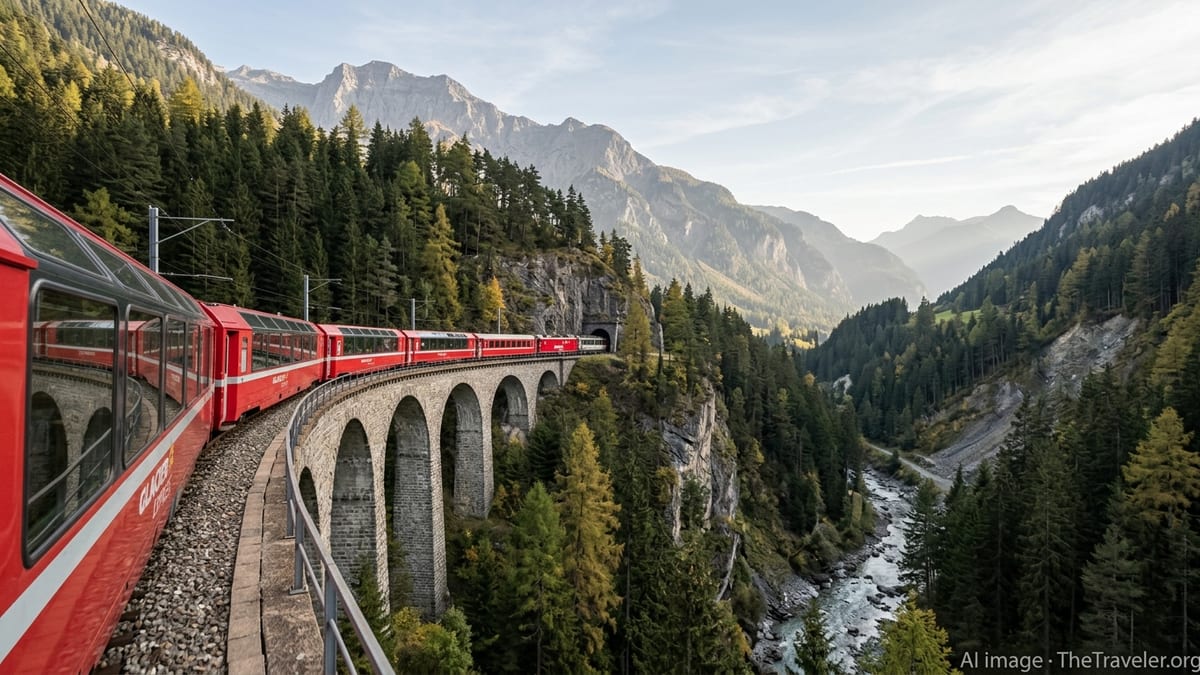
A Classic Alpine Route Refined for Modern Travelers
Running between the resort towns of Zermatt and St. Moritz, the Glacier Express covers about 291 kilometers across southern Switzerland, linking some of the country’s most celebrated mountain landscapes. Publicly available information shows that the journey typically takes just under eight hours and traverses three cantons, connecting high Alpine passes with deep valleys and river gorges.
The train operates with a seasonal timetable and a scheduled maintenance pause in late autumn, so departures are concentrated between early December and mid-October. Current timetables indicate that in winter 2025–2026 there is at least one direct daily Glacier Express service in each direction, with additional frequencies in the spring and peak summer months to respond to strong demand.
The route is marketed as a panorama express service, with limited intermediate stops and a focus on uninterrupted views from end to end. While regular regional trains cover many of the same tracks, the Glacier Express is positioned as a curated experience that links two flagship destinations along one continuous scenic corridor.
Ridership figures from recent years and ongoing booking trends suggest that demand remains strong, particularly for the full-length trip between Zermatt and St. Moritz. Travel planners report that seats in premium classes can sell out months ahead for popular dates, underlining the train’s status as a bucket-list journey for visitors from Europe, North America and Asia.
Panoramic Cars, Premium Classes and a Focus on Comfort
The Glacier Express is widely recognized for its panoramic carriages, which feature oversized windows that extend into the roofline, enabling wide-angle views of peaks, forests and villages. The interior layout emphasizes comfort over capacity, with spacious seats and large tables designed to encourage passengers to remain facing the landscape rather than moving around the train.
Standard offerings include second and first class, with first class providing more generous seating and slightly quieter carriages for longer journeys. In recent years, operators have added Excellence Class, a top-tier product with limited seating, dedicated staff, and upgraded meals and drinks served at the seat. Industry reports note that Excellence Class is now offered on at least one daily service during much of the operating season, though it is temporarily suspended in March 2026 for planned works on board.
Onboard services are aligned with the scenic focus of the trip. Multilingual audio commentary points out engineering landmarks, traditional villages and natural highlights as the train progresses, giving context to what passengers see outside. Meal service is timed around the most dramatic sections, with dishes inspired by regional Swiss cuisine and prepared in an onboard galley.
Booking channels caution that all passengers must hold both a valid travel ticket and a mandatory seat reservation on the Glacier Express, including rail pass holders. Reservation fees vary by class and season, and travel advisors consistently recommend securing seats well in advance for travel around peak school holiday periods and major winter sports events.
From High Alpine Passes to UNESCO-Listed Landscapes
One of the defining features of the Glacier Express is the range of terrain covered within a single day. From Zermatt, in the shadow of the Matterhorn, the train follows the Matter Valley before crossing to the upper Rhône valley and climbing steadily toward the Furka region. Reports highlight the crossing of the Oberalp Pass as the literal high point of the journey, reaching about 2,033 meters above sea level, often surrounded by snow well into spring.
After the Oberalp, the line descends toward the Rhine and continues through a landscape carved by ice and water. Many guides describe the Rhine Gorge near Chur as one of the most photogenic stretches accessible as a short side trip, with pale rock walls and turquoise waters earning it comparisons to a “Swiss Grand Canyon.”
From Chur onward, the Glacier Express runs through the Albula Valley on infrastructure that forms part of the Rhaetian Railway in the Albula and Bernina Landscapes, a UNESCO World Heritage site since 2008. UNESCO documentation emphasizes the combination of early 20th-century engineering and carefully integrated viaducts and tunnels that follow the contours of the high Alpine terrain, creating a route where railway design and landscape are closely intertwined.
Among the best-known man-made landmarks on this section is the Landwasser Viaduct, a curved stone bridge that leads directly into a tunnel cut into the rock wall above the Landwasser River. This structure, with its six arches and dramatic setting, appears prominently in tourism campaigns and is frequently cited as a highlight for photographers on board the Glacier Express.
Year-Round Scenery, Shifting With the Seasons
While the Glacier Express runs in both winter and summer seasons, the scenery changes considerably over the year, offering different experiences for repeat visitors. In winter, the section between Andermatt and Disentis and the approach to the Oberalp Pass are often described as a snowy plateau, with frozen lakes, white slopes and clusters of wooden chalets providing a classic Alpine atmosphere.
As spring and summer progress, green pastures, waterfalls and wildflower meadows dominate the view from the panoramic windows. Travel features published in early 2026 underline how the valleys open up into patchworks of farmland and forest, with grazing cattle, small hamlets and church steeples appearing regularly beside the tracks. Autumn departures, which run until mid-October, can coincide with larch forests turning golden, especially in the higher valleys near the Engadine.
Weather conditions can influence visibility, but the route is maintained to operate in a wide range of conditions, including heavy snow. Operators provide updates about construction work and temporary route closures, such as the short-term suspension between Chur and Domat-Ems in March 2026, allowing passengers to plan connections and alternative itineraries when needed.
Photographers and content creators often emphasize the benefits of slower travel on this route. Large windows and a steady pace enable travelers to adjust camera settings and frame shots without the rush associated with highway viewpoints or mountain passes driven by car, making the Glacier Express a favored choice for those documenting Switzerland’s landscapes.
Planning a Scenic Rail Journey Through Switzerland
As demand for rail-based tourism grows, the Glacier Express is increasingly positioned as an anchor experience within broader Switzerland itineraries. Travel media recommend pairing the route with additional nights in Zermatt or St. Moritz to explore surrounding hiking trails, ski slopes and mountain viewpoints before or after the journey.
Booking platforms for 2025 and 2026 show dynamic pricing for seat reservations by season and class, alongside optional upgrades such as Excellence Class or regional add-on journeys. Travelers holding multi-day Swiss rail passes can often use these passes for the underlying transport while paying the Glacier Express reservation fee separately, an arrangement that encourages longer rail-based stays.
Because the Glacier Express runs on infrastructure shared with regional trains, visitors also have the option to break the journey into shorter sections using regular services if direct seats are unavailable on preferred dates. Industry observers note that some travelers choose to combine individual legs with overnight stops in Andermatt, Chur or the Engadine, creating more flexible itineraries while still sampling key scenic segments.
With updated timetables, enhanced premium offerings and sustained interest in low-impact, scenic travel, the Glacier Express continues to function as both a practical trans-Alpine connection and a showcase journey through some of Switzerland’s most celebrated mountain landscapes.