

More news on this day
Two scarlet trains wind through the high Alps and across social feeds worldwide: the Glacier Express and the Bernina Express. Both promise glass-roofed views of glaciers, gorges and storybook villages, but for travelers planning a 2026 Swiss rail itinerary, the choice between them is more nuanced than it appears on Instagram.
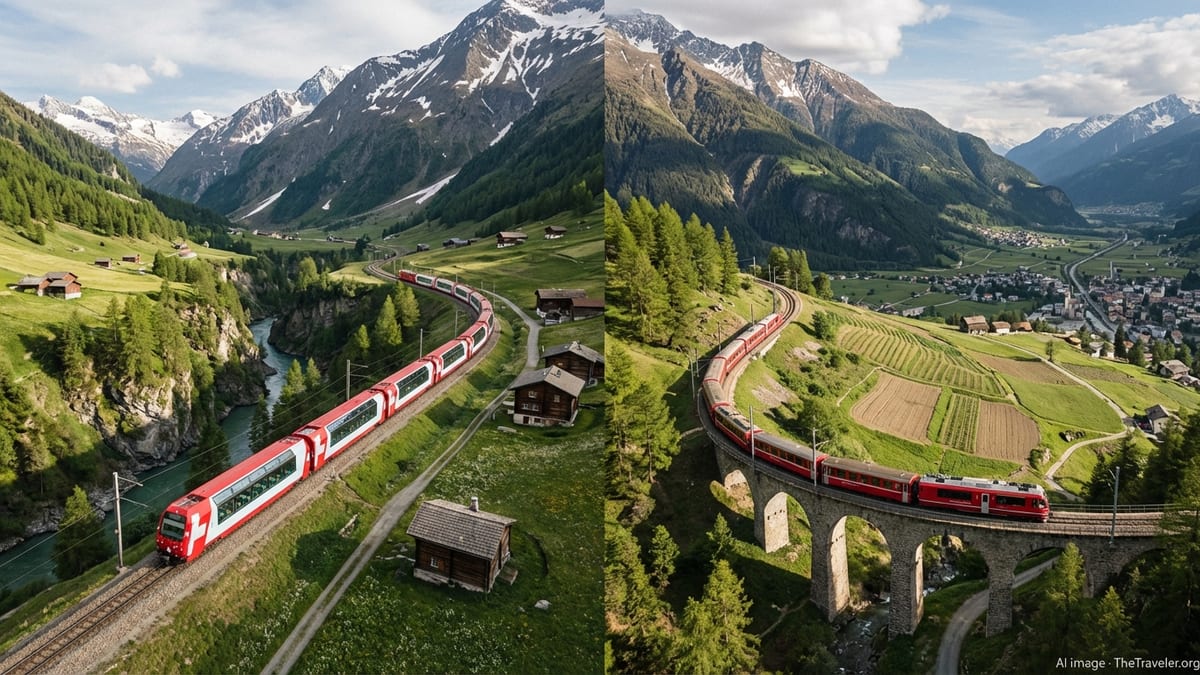
Two Legendary Routes, Two Very Different Journeys
On paper, the Glacier Express and Bernina Express appear closely related: both are premium panoramic services operated on narrow-gauge tracks in southeastern Switzerland, both use modern coaches with wall-to-wall windows, and both require advance seat reservations in their core tourist season. In reality, they deliver notably different experiences, from journey length and landscape to how they fit into a wider Swiss or European trip.
The Glacier Express is marketed as “the slowest express train in the world,” taking around eight hours to cover roughly 291 kilometers between the resort towns of Zermatt and St. Moritz. It threads an east–west line across the country, climbing from the Matterhorn’s base through the Upper Rhône Valley, over the Oberalp Pass and along the Rhine Gorge before entering the Engadin. For many, it is a once-in-a-lifetime, full-day rail event, with restaurant-style service and, at the very top tier, a full luxury product in Excellence Class.
The Bernina Express, by contrast, feels more like an intense Alpine crossing than a grand procession. Its signature run is north–south between Chur or St. Moritz and Tirano in northern Italy, topping out at the Bernina Pass before spiralling down past glaciers, alpine lakes and finally vineyards and palm trees. Chur to Tirano takes about four hours, St. Moritz to Tirano around two and a half, and many travelers slot it into a broader loop that continues by regional train or dedicated bus towards Lugano or Milan.
Both trains can be done as straightforward out-and-back excursions, but they also anchor very different kinds of itineraries. Understanding that distinction is the starting point for deciding which one is “better” for your own trip.
Scenery: Big-Screen Alps vs High-Drama Pass
When it comes to scenery, both routes are world-class, but they showcase contrasting moods of the Alps. The Glacier Express offers a cinematic cross-section of Switzerland: snowy high peaks around Zermatt, the wide Rhône Valley, the stark white summit of the Oberalp Pass, and the deep, twisting Rhine Gorge that has drawn comparisons to a miniature Grand Canyon. Long stretches unfold at a stately pace, designed for lingering over lunch or a glass of wine while the landscape rolls by outside.
The Bernina Express route is shorter but more intense. Between Pontresina and Alp Grüm the line clings to high slopes, with close-up glacier views and turquoise reservoirs at Ospizio Bernina. The descent towards Italy is all drama, from the tight curves above Poschiavo to the iconic Brusio circular viaduct, where the train loops over itself on a stone arc that has become a signature image of the journey. Travelers experience a striking climate shift in just a few hours, descending from treeline tundra to a town lined with palm trees and Italian cafes.
Landscape variety is one of the main trade-offs. The Glacier Express covers more types of terrain and feels like a geography lesson in motion, with its long valley sections and multiple river systems. The Bernina line, much of which is recognized as a UNESCO World Heritage railway, delivers denser Alpine spectacle and more extreme altitude change in a shorter time. For travelers who prize constant high-mountain drama, Bernina usually gets the edge. Those wanting a broader sweep of the Swiss interior often favor the Glacier Express.
Season also matters. The Glacier Express runs most of the year, pausing only for its usual autumn maintenance break, so its winter journeys through snowbound passes are a major part of its appeal. The Bernina route is spectacular year-round, but its sharp contrast between snow and green valleys is especially striking in late spring and autumn, when higher sections can still be dusted in white while Tirano basks in milder sunshine.
Timetables, Frequency and Flexibility for 2026
For 2026 planners, the two services diverge in how rigidly they structure your day. Glacier Express departures are concentrated in the morning, with one or two full-route departures in each direction between Zermatt and St. Moritz depending on season. Current timetables published for the winter and summer periods in 2025–2026 indicate morning departures around 08:38 or 08:52 in St. Moritz and Zermatt for the main trains, with selected dates adding a second train roughly an hour later.
The Glacier Express also continues its long-standing pattern of an autumn break, with no full-route services expected for several weeks between mid-October and early December 2026. That gap is important for shoulder-season visitors: regular regional trains still cover the same tracks, but the signature panoramic coaches and onboard catering are not available during the suspension.
The Bernina Express, operated by Rhaetian Railway, generally runs multiple times daily on its core legs between Chur, St. Moritz, Pontresina and Tirano, with slight seasonal variations. Summer 2026 schedules show two Bernina Express trains per day on the classic Chur–Tirano route in each direction, alongside additional services linking St. Moritz or Pontresina with Tirano. A companion Bernina Express bus continues to connect Tirano with Lugano on selected dates, allowing travelers to combine an Alpine crossing with a lakeside stay in the Italian-speaking south.
In practice, the Bernina network offers more flexibility. Because the Bernina Express is integrated into the wider RhB network, travelers can mix panoramic services with regional trains that follow the same tracks, sometimes riding unreserved coaches on the same route if panoramic seats are sold out. The Glacier Express route is also served by regular trains, but its dedicated express departures are fewer and more rigidly timed. For travelers who want to keep departure times fluid or add spontaneous stops en route, Bernina’s structure is more forgiving.
Onboard Experience, Classes and Comfort
Both trains run with air-conditioned panoramic coaches in first and second class, featuring large sealed windows that curve into the roofline. Seating is broadly similar: in first class, more generous space and a quieter atmosphere; in second, a denser layout but the same views. In both cases luggage storage is straightforward and there are dedicated spots for larger suitcases at the carriage ends.
The Glacier Express differentiates itself with a much more formal onboard service. Dedicated kitchen and restaurant staff serve pre-booked three-course or five-course menus at your seat, with wine pairings and plated dishes closer to airline business-class than a standard dining car. An audio infotainment system, accessible via individual headphone jacks or personal devices, provides commentary on landmarks, history and engineering features in multiple languages throughout the day.
At the top end sits Excellence Class, a limited-capacity lounge-style coach that has become one of Switzerland’s most talked-about rail products. Travelers sit in spacious single or paired armchairs facing oversized windows, with a guaranteed window seat, multi-course gourmet menu, bar service and concierge-style attention. Availability is restricted to the full Zermatt–St. Moritz route and to specific trains, and the supplement for 2025–2026 is substantial, topping the cost of a standard first-class ticket by several hundred francs. Seats for peak dates often sell out months in advance.
The Bernina Express offers a simpler but still comfortable onboard experience. There is no dedicated luxury tier comparable to Excellence Class, and catering is more informal, usually focused on snacks, drinks and regional specialties served from a trolley or small counter rather than a full restaurant kitchen. The emphasis is very much on the view: panoramic windows, high Alpine curves and the constant shift in light as the train winds from glaciers to vineyards. For many passengers, that stripped-back service feels appropriate for a journey that lasts a few hours rather than a full day.
Fares, Reservations and Value for Money
Cost is where the two trains diverge most sharply. Both require mandatory seat reservations for the panoramic services, charged on top of a regular ticket or rail pass. For the 2026 season, published reservation fees and sample fares indicate that Glacier Express supplements are higher than those for the Bernina Express, reflecting its reputation as a flagship international product with elaborate onboard service and longer journey time.
On the Glacier Express, travelers must pay for a point-to-point ticket or hold a valid pass, then add a reservation fee that varies by season and route length. Full-route second-class tickets between Zermatt and St. Moritz are typically priced above the 200-franc mark before reservation costs, with first class and Excellence Class significantly higher. By the time food and drinks are included, a day in Excellence Class can rival the cost of a multi-night hotel stay in a mid-range Swiss property.
The Bernina Express, by comparison, comes in notably cheaper. Typical second-class fares for the St. Moritz–Tirano segment are well under half the price of the Glacier’s full east–west run, and seat reservations on the panoramic coaches are also lower. Holders of national or regional rail passes still need to reserve seats on most Bernina Express departures, but they can often avoid the fee by opting for equivalent regional trains on the same line and riding in standard, non-panoramic carriages.
For value-focused travelers or families, that flexibility can be decisive. The ability to experience the UNESCO-listed Bernina line using regular trains, with no reservation fee and the option to open windows in some older coaches, makes it easier to keep costs down while still securing the main visual highlights. The Glacier Express has fewer such workarounds if you specifically want the branded panoramic experience, so the cost difference between the two products feels larger than the distance charts might suggest.
Stops, Side Trips and How Each Train Fits an Itinerary
Another key question for 2026 visitors is how easily each train can be combined with other destinations. The Glacier Express links two headline resorts: Zermatt in the west and St. Moritz in the east. Both are major gateways to high-end hotels, skiing and hiking, so the train functions as a scenic bridge between multi-night stays rather than a simple excursion. Many itineraries see travelers spending several days in Zermatt, riding the Gornergrat or Matterhorn Glacier Paradise lifts, then boarding the Glacier Express to reach the Engadin without changing trains.
Intermediate stops on the Glacier Express route, such as Andermatt or Chur, are possible but constrained. Because seat reservations are mandatory and sold for specific segments, hopping on and off the branded train multiple times in a single day is not straightforward. Those who want to break their journey overnight typically book separate Glacier Express segments or switch to regular services, which handle local traffic between Brig, Andermatt, Disentis and Chur with more flexibility.
On the Bernina route, intermediate stops are a core part of its appeal. Towns like Poschiavo, Miralago and the high station at Alp Grüm offer viewpoints and walks that many passengers choose to explore for a few hours before continuing on a later train. Because regional services shadow much of the route, it is easier to combine a morning on the panoramic Bernina Express with an afternoon leg on a standard train, building a more free-form day around short hikes, lakeside picnics or village strolls.
Connections at each end also differ. From Tirano, travelers can continue by regular Trenord services into Milan, or by the seasonal Bernina Express bus to Lugano, building a triangle between German-speaking, Romansh-speaking and Italian-speaking corners of Switzerland and northern Italy. From Zermatt, onward options revolve more around returning to the main Swiss network by reversing as far as Visp or Brig. In short, the Bernina Express is easier to stitch into a broader European rail adventure, while the Glacier Express is best suited to travelers structuring their trip primarily around Switzerland’s flagship mountain resorts.
Weather Risks, Crowds and Booking Strategy
With both trains heavily marketed worldwide, crowding and weather have become recurring concerns, especially in the July and August peak. For the Glacier Express, seats in first class and Excellence Class on summer departures can sell out months ahead, and hotel availability in Zermatt and St. Moritz tightens around the same dates. Travelers aiming for those peak windows in 2026 are advised to reserve as soon as the booking period opens, typically around three months in advance for standard classes and earlier access for Excellence Class.
On the Bernina Express, demand is also high in summer and around festive periods such as Easter and Christmas, but the mix of panoramic and regional trains spreads capacity more widely along the line. Last-minute travelers who cannot find Bernina Express reservations may still be able to ride equivalent sections using regular RhB services, especially outside weekends. However, those wanting guaranteed seats in the panoramic cars on the busiest days should still book early.
Weather is an unavoidable wildcard on both routes. Panoramic windows mean that low cloud, snowfall or fog can significantly reduce visibility, especially on high passes such as Oberalp or Bernina. Travelers with flexible itineraries sometimes build in contingency days, aiming to ride when a clear forecast is in place. In shoulder seasons, when storms can close mountain passes, the operators occasionally adjust schedules or routes, and passengers may be rerouted onto regional trains. Checking operational updates in the days before departure is sensible for both trains, particularly in late autumn and early spring.
One subtle difference is that the Bernina route’s shorter duration and greater frequency make it easier to reschedule at the last minute if conditions are poor. A full-day Glacier Express trip is harder to shift without disrupting hotel bookings at each end, which raises the stakes for those gambling on clear skies on a single chosen day.
So Which Train Is Better in 2026?
With both routes well established and their 2025–2026 timetables largely confirmed, the “better” journey in the coming seasons depends mostly on what kind of travel experience visitors want. The Glacier Express is the clear choice for those seeking a slow, indulgent showcase of Switzerland’s interior, with white-tablecloth dining, a full day of scenic immersion and the possibility of a top-tier luxury product. It is also the more natural fit for travelers already planning multi-night stays in both Zermatt and the Engadin, or those marking a special occasion with a once-off rail splurge.
The Bernina Express, by contrast, suits travelers who prioritize concentrated high-mountain drama, cross-border contrast and flexibility. Its shorter run, more modest supplements and integration with regional trains make it easier to fold into longer rail journeys around Europe or to combine with lakeside stays in Lugano or Milan. For budget-conscious visitors, families or spontaneous planners, the option to sample the same world-famous route on standard trains without hefty reservation fees is a significant advantage.
For many rail enthusiasts and first-time visitors alike, the answer in 2026 may simply be to ride both, linking them via St. Moritz or Chur to build a multi-day loop that circles some of the most scenic tracks in Europe. For those who must choose, the decision comes down to whether the dream is a leisurely, all-day procession across the heart of Switzerland, or a dramatic Alpine crossing that drops you, a few hours later, into a bustling Italian piazza with the scent of espresso in the air.