

More news on this day
Glasgow’s 127-year-old Subway has entered a new era of pay-as-you-go convenience, with the launch of tap-in, tap-out contactless bank card payments expected to streamline journeys for visitors and residents while strengthening the city’s tourism offer.
Get the latest news straight to your inbox!
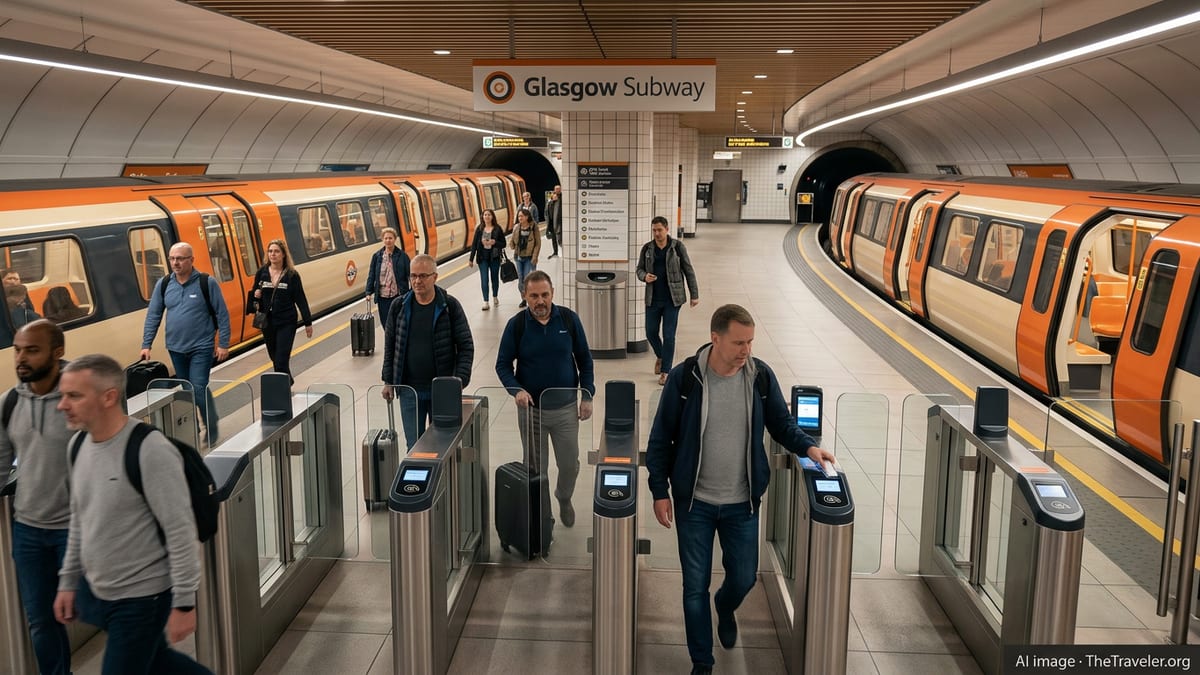
Century-Old Network Steps Into Tap-In, Tap-Out Era
The Glasgow Subway, one of the world’s oldest metro systems, has been moving steadily toward a fully modernised operation, with smart ticketing at the core of its upgrade programme. Publicly available information shows that the network has long used ITSO-based smartcards alongside paper tickets, but the latest stage introduces direct contactless bank card payments at the ticket gates, similar to systems in London and other major European cities.
According to recent coverage of transport policy in Scotland, the Subway is part of a wider national strategy to deliver smart, integrated ticketing and contactless payments across multiple modes. Reports indicate that the system is being equipped with tap-in, tap-out readers at stations, allowing riders to use contactless Visa or Mastercard cards or compatible devices, with fares calculated automatically at the end of the travel day.
Transport planning documents highlight that this approach, sometimes referred to as account-based ticketing, is designed to reduce barriers to using public transport by removing the need to understand local ticketing products before travelling. For a compact circular network like the Glasgow Subway, where trains are frequent and distances between stations are short, removing friction at the gates is expected to have a visible impact on station throughput.
Industry updates on the modernisation programme also point to complementary investments, including upgraded ticket gates, new back-office systems and preparations for driverless operations and platform screen doors by the middle of the decade. Together, these changes position the Subway as a modern urban metro, despite its Victorian origins.
Faster, Simpler Journeys For International Visitors
For tourists, the most immediate effect of the new contactless option is the ability to ride the Subway without first navigating unfamiliar ticket machines or smartcard schemes. Travel features on Glasgow’s visitor offer regularly highlight the Subway’s role in linking cultural districts, university areas and riverside attractions, yet first-time users have often needed to purchase paper tickets or local smartcards before entering the system.
With contactless now available at the gates, visitors arriving from cities where tap-to-pay is standard can use the same bank cards they rely on at home. Public information on current fares indicates that contactless journeys are charged in line with existing pay-as-you-go prices, with daily and weekly caps mirroring the Subway smartcard structure. This means occasional users can simply tap in and out without worrying about overspending compared with local riders.
Travel advisers note that this change dovetails with broader trends in tourism, where contactless payments have become a baseline expectation. Visitors planning short breaks in Glasgow can now treat the Subway as an intuitive, hop-on-hop-off connector between accommodation, nightlife and major venues, removing one layer of logistical uncertainty from their itineraries.
Combined with the compact nature of the network, the streamlined payment process is likely to make the Subway an even more attractive option for exploring the West End, city centre and riverside locations in a single day, encouraging greater use of public transport rather than ride-hailing or private cars.
Boost For Local Businesses And City Branding
Tourism and city marketing bodies have long promoted the Glasgow Subway as a distinctive part of the city’s character, from its orange livery to its tightly looped route. The arrival of contactless payments adds a modern layer to that image, aligning Glasgow more closely with other major European destinations that already offer frictionless metro access for visitors.
Economic development commentary suggests that easier access to public transport can translate into higher footfall for local businesses, particularly in districts clustered around stations. Cafes, bars, independent shops and cultural venues in areas such as the West End and south of the River Clyde are likely to benefit from spontaneous trips made simpler by tap-in, tap-out technology.
In addition, the integration of the Subway’s modernised ticketing with wider regional schemes, such as the digital version of the ZoneCard for multimodal travel in the west of Scotland, reinforces Glasgow’s image as a city working toward joined-up, sustainable mobility. This narrative is increasingly important for attracting conferences, events and leisure visitors who prioritise low-carbon travel options.
By demonstrating visible improvement in everyday passenger experience, the contactless rollout on the Subway may also lend weight to campaigns promoting Glasgow as a gateway for exploring wider Scotland by rail, bus and ferry, encouraging visitors to extend their stays and spending in the region.
Part Of Scotland’s Push For Integrated Smart Ticketing
The contactless upgrade on the Glasgow Subway does not sit in isolation. Policy documents published by Transport Scotland outline a national ambition for smart, digital and integrated ticketing that allows passengers to move between bus, rail, subway and ferry with minimal friction. The Subway has been identified as a key node in this network, serving both daily commuters and tourists moving across the urban core.
Recent surveys of public attitudes to ticketing in Scotland highlight strong interest in tap-in, tap-out systems that remove the need to choose between multiple complex ticket types. Respondents frequently refer to the convenience of contactless systems in other cities and express support for similar functionality across Scottish networks, including Glasgow’s urban rail and Subway services.
Technical providers working with regional transport organisations have already delivered back-office platforms to digitalise legacy paper products and support interoperable smartcards. Extending this foundation to bank card contactless is viewed within the industry as a logical next step, lowering barriers for infrequent riders who may not wish to register for a separate transport smartcard.
As additional elements of the strategy roll out, including wider real-time journey planning tools and smart ticketing across more operators, the Subway’s contactless gates are expected to play a central role in demonstrating how integrated payments can work at scale in a Scottish urban setting.
Implications For Future Visitor Numbers And Travel Habits
While precise forecasts vary, transport analysts generally agree that simplifying payment is one of the most effective levers for encouraging public transport use among occasional riders, including tourists. In Glasgow’s case, where major music venues, sports arenas and festival sites are within easy reach of the Subway, contactless payments may help shift more event-related trips from road to rail.
City tourism reports over recent years point to sustained interest in Glasgow as a city-break destination, with visitors drawn by its cultural offerings, nightlife and proximity to the Highlands and islands. By reducing friction at a critical point in the journey, the new contactless system supports this trajectory, making it easier for visitors to treat the Subway as the default way to move between hotels, attractions and onward transport hubs.
For residents, especially younger passengers and new arrivals familiar with tap-to-pay systems elsewhere, the change may further normalise public transport use for short urban journeys. Fare capping and easy, card-based access can make the network feel more flexible and less transactional, reinforcing the perception of the Subway as an everyday, spontaneous travel option rather than a service that requires careful pre-planning.
As Glasgow prepares for further upgrades to its metro infrastructure, including automation and enhanced station environments, the shift to contactless payments marks a visible step in aligning the city’s oldest rail system with contemporary expectations. For visitors and locals alike, that evolution is likely to make the distinctive orange trains an even more central part of the Glasgow experience.