

More news on this day
Glasgow is grappling with one of its worst transport crises in years after a major fire shut Scotland’s busiest railway station, yet the city’s response is rapidly transforming disruption into an unlikely magnet for visitors, even as London officials keep the chaos at arm’s length.
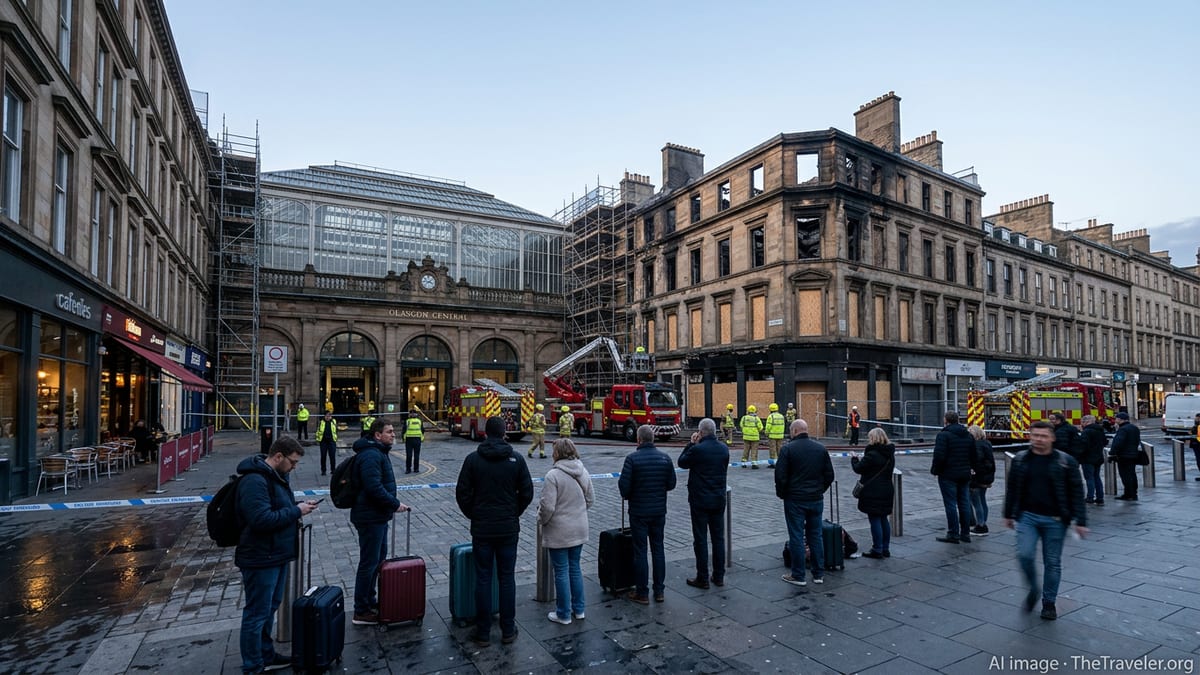
A Historic Gateway Brought to a Standstill
On March 8, a fast-moving fire tore through a five-storey corner building on Union Street, directly attached to Glasgow Central, forcing an emergency shutdown of the high-level concourse at Scotland’s busiest rail hub. Flames gutted the 19th-century block and triggered a partial collapse, sending plumes of smoke over the ornate train shed and bringing long-distance and commuter services to an abrupt halt.
Although the station itself appears to have escaped structural catastrophe, engineers and inspectors have warned that heat damage, water ingress and debris around the tracks require painstaking assessment. As of March 10, ScotRail and National Rail have both confirmed that Central’s high-level platforms remain closed until further notice, with disruption radiating across the wider Scottish network and into cross-border services.
The sudden loss of the country’s principal intercity gateway has jolted rail operators and exposed the fragility of a system still rebuilding from years of industrial action and extreme weather. For many travellers, especially those arriving from England and mainland Europe, Glasgow Central is synonymous with arrival in Scotland, its iron and glass roof a symbolic portal to the Highlands and islands beyond.
Yet even with departure boards wiped clean and services diverted to alternative stations, the scene outside has been one of curiosity as much as frustration, with visitors gathering to photograph the cordons, cranes and charred facade that now frame the station’s iconic frontage.
From Crisis Scene to Visitor Spectacle
In the hours and days after the fire, Glasgow’s city centre has taken on the uneasy atmosphere of a live event. Police tape, fire engines and structural engineers share the streets with tourists in football scarves and wheeled suitcases, all converging on the shuttered terminal that is suddenly the most talked-about landmark in Scotland.
City marketing officials and local businesses have moved quickly to redirect that attention. Visitor information staff have been deployed to key approach routes, guiding passengers towards Glasgow Queen Street, Argyle Street and the Subway, while also promoting walking routes that turn a forced detour into an impromptu urban tour. Hotel concierges and tour operators report that guests stranded by cancellations are extending stays, booking last-minute city tours and museum visits rather than rushing to leave.
Independent cafes and bars around Union Street, Gordon Street and Buchanan Street say footfall has remained unexpectedly strong, fuelled by a mix of displaced commuters and visitors searching for somewhere to regroup while services are re-planned. Some have extended opening hours and added impromptu offers aimed at rail passengers holding valid tickets or proof of delay compensation.
The visual drama of the scene has inevitably become a draw in itself. Social media feeds are filling with wide-angle shots of Glasgow Central’s glass roof framed by scaffolding and smoke-blackened stone, accompanied by stories of unexpectedly generous locals, improvised ceilidhs in hotel lobbies and pub sessions that began with “just waiting for an update from the rail app.” For now, Glasgow’s crisis is doubling as an unscripted campaign for its hospitality.
Scotland’s Proud Rail Identity Under Pressure
The closure of Glasgow Central cuts to the heart of Scotland’s rail identity, disrupting not only commuter flows but the romantic corridor linking London and the Central Belt to the Highlands, islands and coastal resorts beyond. Services operated by ScotRail, Avanti West Coast, TransPennine Express and CrossCountry have all been affected, with diversions, terminations at Motherwell and replacement road connections reshaping how visitors physically enter the country.
Tourism officials in Scotland have long argued that rail is an essential part of the nation’s brand, offering a low-carbon, scenic alternative to domestic flights and long motorway drives. In recent years, investment in routes such as the East Kilbride line and upgrades across central Scotland have been marketed alongside whisky trails and island ferries as part of a seamless visitor journey that begins the moment a traveller steps onto a train.
The fire has abruptly tested that promise. Industry groups warn that if disruption at Glasgow Central becomes prolonged, tour itineraries carefully timed around rail arrivals and departures may be forced into wholesale reworking. Tour operators are already adjusting meeting points to Queen Street or further south, while rural destinations reliant on rail-fed coaches are closely watching booking patterns for the coming Easter and summer seasons.
Despite the uncertainty, Scotland’s rail advocates see an opportunity to highlight both resilience and the case for further investment. The rapid deployment of staff to alternative stations, the integration of ticket acceptance across modes and the clear communication from operators have drawn cautious praise from some passenger groups, even as they stress that the incident underlines the need for more robust infrastructure and redundancy around key hubs.
London’s Muted Response and the Politics of Connectivity
While Glasgow’s civic leaders have been highly visible on the streets and in media briefings, national political attention from London has been notably restrained. Transport officials in the UK capital have focused on maintaining timetables south of the border, treating the Glasgow fire largely as a regional incident rather than a national transport emergency affecting one of the core gateways to Scotland.
That stance has revived long-running tensions over infrastructure priorities between Scotland and Westminster. For years, business groups and transport campaigners have pushed for improved Anglo-Scottish rail links, including higher-speed connections and better integration between Glasgow’s Central and Queen Street stations. The current disruption, they argue, exposes how heavily both Scottish tourism and UK domestic connectivity rely on a single, aging node.
In London, where commuters have grown accustomed to a drumbeat of rail strikes and weekend engineering works, the latest Scottish upheaval has attracted comparatively modest coverage. Industry reports and tourism briefings note that while visitor numbers to the UK capital have remained robust in spite of rail disruption, the same resilience cannot be taken for granted in regional cities whose international profile is more closely tied to smooth journeys by train.
Privately, Scottish tourism operators express frustration that the loss of Glasgow’s principal rail gateway has not triggered a more visible national response, particularly in international marketing channels. They warn that if overseas visitors perceive long-term uncertainty around rail access to Scotland’s largest city, they may opt to base themselves in London and take short domestic flights north, undermining both climate targets and the country’s carefully cultivated rail narrative.
Turning Disruption Into a Longer-Term Advantage
Even amid the immediate challenges of diversions, refunds and anxious passengers, Glasgow’s tourism and transport planners are already looking to what the crisis might catalyse. There is growing talk of using the forced closure to accelerate long-discussed improvements to passenger circulation, accessibility and heritage presentation at and around Glasgow Central, from refreshed concourses to better wayfinding between the city’s parallel rail axes.
Local business groups are advocating for temporary pedestrianisation measures around the station cordon, arguing that if managed carefully they could give visitors a new vantage point on the station’s grand Victorian architecture and the surrounding streetscape. Pop-up cultural programming, from street music to guided walks interpreting the history of the station and the damaged Union Corner building, is being explored as a way to turn necessary exclusion zones into spaces of discovery rather than dead ground.
For now, the timetable remains uncertain. Engineers must first confirm when high-level platforms can safely reopen, and rail operators will then begin the complex process of rethreading services through a station that handles hundreds of trains a day. Yet the days since the fire have already demonstrated something crucial: even with its proud gateway darkened and its trains re-routed, Glasgow is determined to meet disruption not with silence, but with a louder invitation to come and see how the city responds.
Whether London’s political and transport establishment chooses to listen, or continues to look away, may determine if this moment becomes a brief chapter of resilience or the catalyst for a deeper rethink of how Scotland’s railways welcome the world.