

More news on this day
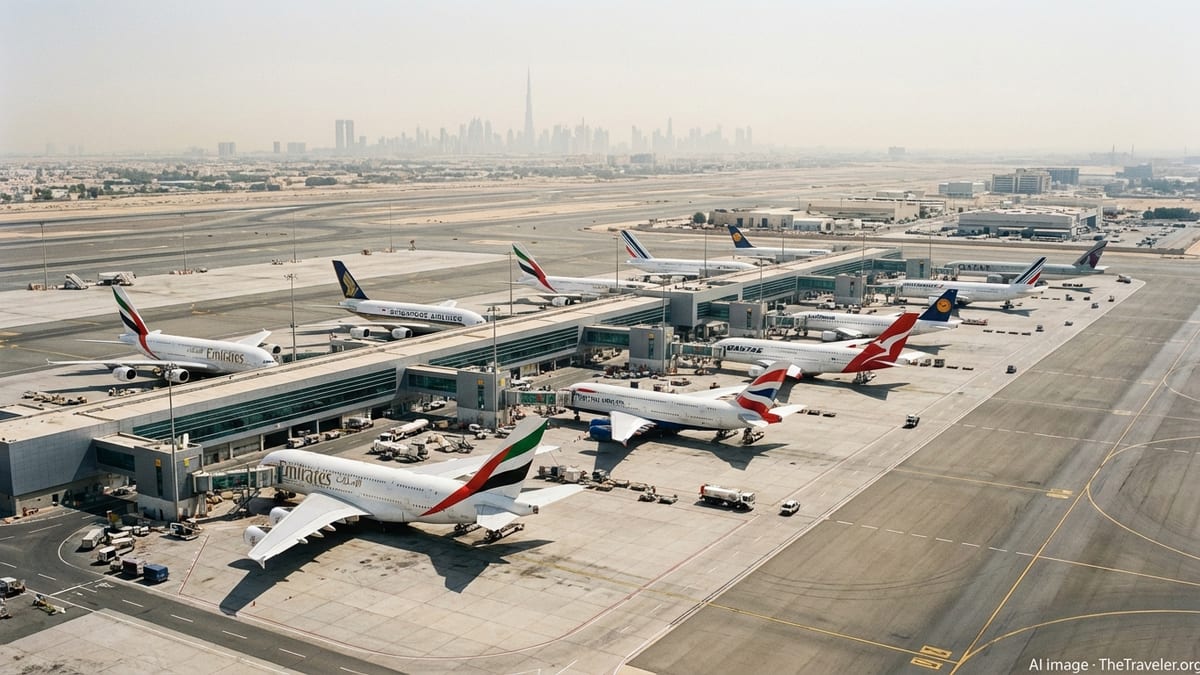
As the Airbus A380 enjoys an unexpected renaissance, a handful of global airlines are racing to redeploy the world’s largest passenger jet on flagship routes, and nowhere is that battle more visible than at Dubai International Airport, where Emirates and its rivals are using the superjumbo to cement their grip on long-haul travel.
Emirates Doubles Down on the Superjumbo Era
While many carriers once wrote off the A380 as a relic of a bygone hub-and-spoke era, Emirates has moved decisively in the opposite direction. The Dubai flag carrier remains by far the largest A380 operator, with well over 100 superjumbos either active or returning to service, and has signaled its intention to keep the type flying well into the 2030s.
Industry analysis shows Emirates targeting around 110 active A380s by the end of 2026, supported by an expansive multi‑billion dollar retrofit program that is refreshing cabins with new first and business class products and rolling out premium economy across more of the fleet. This strategy allows the airline to maintain capacity and high-yield seats on dense trunk routes while it waits for delayed next-generation widebodies such as the Boeing 777X.
Recent network moves underscore that commitment. Emirates has expanded A380 operations on routes including Dubai to Munich, where both daily flights are scheduled to use the double-decker in early 2026, and boosted A380 frequencies on high-demand Asian and European sectors. At the same time, the carrier is fine-tuning deployment, trimming A380 service in some leisure markets and secondary European cities in favor of twin-engine widebodies where demand is more variable.
Behind the scenes, Emirates is also future-proofing the fleet through long-term lease extensions that keep selected A380s in service into the next decade, and by securing parts and teardown airframes to support maintenance. Taken together, these measures position Dubai’s hometown airline as the dominant global steward of the superjumbo.
Rivals Return the A380 to the Skies
Emirates is no longer alone in betting on a second life for the A380. Singapore Airlines, Qantas, Lufthansa, British Airways and Qatar Airways have all brought superjumbos back from storage or extended their usage, turning the aircraft into a high-profile tool in the race for premium long-haul passengers.
Singapore Airlines, the original launch operator of the A380, has confirmed that it will roster the aircraft year-round on its Singapore–Dubai route from March 2026, after initially filing the deployment as seasonal. The decision effectively transforms the Middle East city pair into an A380 showcase, placing the carrier in direct competition with Emirates on a corridor that feeds connecting traffic across Asia, Europe and Africa.
In Australia, Qantas has now returned its full A380 fleet to service, following an intensive multi-year refurbishment program that saw its final stored aircraft emerge from deep maintenance in late 2025. The airline is using the type on some of the world’s longest and most prestigious routes, including Sydney–Singapore–London, Los Angeles and a newly strengthened Sydney–Dallas schedule, highlighting the superjumbo’s enduring appeal on ultra-long distance missions.
European operators are also recalibrating their strategies. Lufthansa and British Airways continue to deploy A380s from major European hubs to North American and Asian gateways where slot constraints and premium demand justify the capacity. Qatar Airways, meanwhile, has kept a smaller A380 subfleet in play on select routes, using its spacious cabins as a differentiator while newer aircraft like the A350 and 787 assume a greater share of flying.
Dubai International: The World’s Superjumbo Crossroads
At the heart of this renewed A380 competition sits Dubai International Airport, a facility that has effectively become the world’s primary superjumbo crossroads. With Emirates operating the vast majority of the global A380 fleet and routing much of that capacity through its home base, the airport sees some of the heaviest concentrations of A380 movements anywhere on earth.
The airport’s infrastructure has been shaped around handling the world’s largest passenger aircraft at scale. Multiple A380-capable concourses with dual-level boarding bridges allow simultaneous loading of upper and lower decks, while apron layouts, taxiways and gate positions are optimized for the jet’s wingspan and wake requirements. This has enabled swift turnarounds and dense waves of connecting traffic, central to Emirates’ banked hub strategy.
Dubai’s growth ambitions go beyond the current airport perimeter. The emirate has committed tens of billions of dollars to the development of Al Maktoum International, envisioned as a future mega-hub with multiple runways and hundreds of widebody-capable gates. For now, however, Dubai International remains the operational nerve center, handling record passenger flows as global travel rebounds and reinforcing the city’s status as a pivotal link between Europe, Asia, Africa and Oceania.
For rival A380 operators, Dubai is both a battleground and a marketplace. When carriers such as Singapore Airlines or Qantas send their own superjumbos into the city, they plug into an ecosystem already tuned to high-density, long-haul traffic, but they also face a home advantage held firmly by Emirates and its vast onward network.
Shifting Networks Highlight a New A380 Playbook
The A380 revival has not simply meant putting the aircraft back on pre-pandemic routes. Instead, airlines are applying a more surgical approach, concentrating the double-decker on markets where slot scarcity, sustained demand and premium yields can offset the jet’s higher operating costs.
Emirates illustrates this shift clearly. Even as it increases the number of active A380s, the airline is withdrawing the type from certain destinations such as Bali and Copenhagen in 2026, replacing it with a mix of Boeing 777 and Airbus A350 services that allow greater schedule flexibility and more right-sized capacity. On other routes, it is upgauging to high-density A380 layouts that can carry more than 600 passengers, particularly between Dubai and major European or Middle Eastern hubs.
Other carriers are following similar logic. Qantas is concentrating its A380s on a handful of marquee long-haul routes that feed into broader alliances and partnerships, while Lufthansa and British Airways are using the aircraft selectively on city pairs where business travel and connecting flows remain robust. Singapore Airlines’ move to make the A380 permanent on the Dubai route reflects both strong demand and the opportunity to showcase its latest first and business class suites in a competitive premium market.
Collectively, these network adjustments signal that the A380’s future lies in fewer routes but higher impact. Rather than being a general workhorse, the jet is evolving into a flagship deployed where it can best reinforce brand presence and capture high-value traffic, often through mega-hubs like Dubai.
A380 Supremacy and the Future of the Global Hub
The battle for A380 supremacy is ultimately about more than aircraft economics or cabin glamour. For Emirates, Singapore Airlines, British Airways, Qantas, Lufthansa, Air France in its earlier A380 era, and Qatar Airways, the superjumbo has been a symbol of hub dominance, signposting which airports act as true intercontinental crossroads.
Dubai International has emerged as the clearest winner of that symbolic contest. Even as some carriers permanently retired their A380 fleets, the airport’s daily procession of double-deckers has become part of its identity, reinforcing Dubai’s role as a neutral, globally connected transfer point. As more A380s re-enter service worldwide, many of them are once again threading through its runways and concourses.
Looking ahead, the rise of more fuel-efficient twinjets will gradually reshape long-haul networks, enabling additional point-to-point connections that bypass traditional hubs. Yet the current A380 resurgence suggests that mega-hubs still have a powerful role when it comes to aggregating demand, maximizing slot usage and delivering standout passenger experiences in premium cabins.
For now, as Emirates and its competitors fine-tune their superjumbo deployments, the world’s largest passenger aircraft remains closely intertwined with the fortunes of Dubai International. Each new A380 schedule change, cabin retrofit and route announcement adds another layer to a contest that keeps the Gulf metropolis firmly at the center of global aviation.