

More news on this day
Emirates, Delta, Lufthansa, Qatar Airways, United Airlines, and Air France are emerging as powerful demand drivers in a rapidly expanding aerobridge market that analysts say could reach about 9.5 billion dollars globally by 2030, as airports in countries such as the United States, France, Thailand, and the United Arab Emirates accelerate terminal upgrades, digitalization, and passenger experience overhauls.
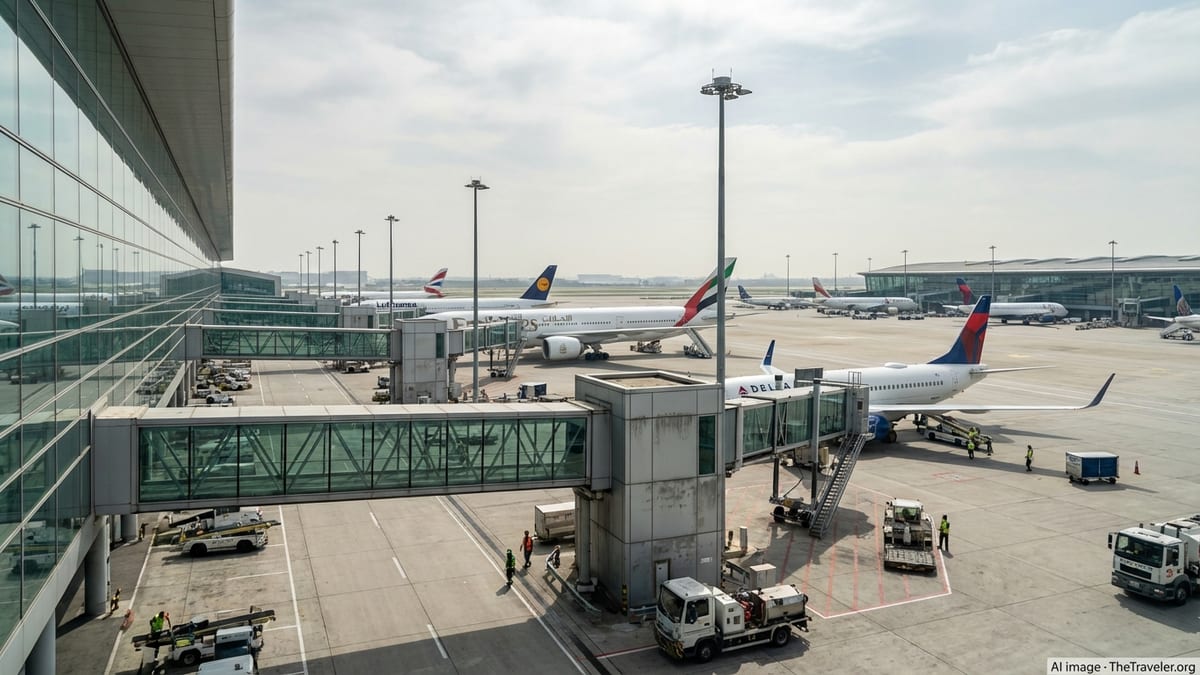
Aerobridge Market Enters a New Growth Cycle
The once‑specialized market for aerobridges, also known as passenger boarding bridges, is entering a new growth cycle fueled by record air traffic, ambitious airport expansion pipelines, and aggressive fleet renewal by major carriers. Recent industry research points to global passenger boarding bridge and related systems climbing from the low single‑digit billions today toward the upper single‑digit range by the end of this decade, with many forecasts converging near the 9 to 10 billion dollar mark by around 2030.
Market studies from multiple research houses show compound annual growth rates generally between 4 and 7 percent across the coming decade, supported by long‑term infrastructure programs rather than short, cyclical spending bursts. Analysts note that, unlike aircraft orders, aerobridge and airside equipment investments are closely tied to terminal capacity, safety rules, and accessibility mandates, which tend to move steadily upward even when airline yields fluctuate.
What is changing now is the strategic importance of aerobridges inside the broader airport modernization agenda. Where bridges were once viewed as purely functional metal tunnels, they are increasingly specified as connected, sensor‑laden assets that can cut turnaround times, reduce injuries on the ramp, support larger widebody aircraft, and integrate with biometric and contactless boarding systems. This repositioning is drawing in not just airports and manufacturers, but also the airline giants that rely on them for operational reliability.
As a result, the market is broadening from traditional steel structures to a mix of glass‑walled premium bridges, fully automatic docking systems, and digital monitoring platforms. By 2030, industry executives expect a far larger share of installed aerobridges to be “smart” units capable of feeding real‑time data into airport operation centers, a shift that is already influencing procurement at leading hubs in North America, Europe, the Middle East, and Asia.
How Major Airlines Are Quietly Shaping Aerobridge Demand
Although airports are the direct buyers of aerobridges, the strategic choices of top global airlines are heavily shaping how and where new units are installed. Emirates, Delta, Lufthansa, Qatar Airways, United, and Air France are simultaneously upgauging fleets, adding long‑haul routes, and pushing for faster, more predictable ground operations, all of which have direct implications for bridge specifications.
Emirates, which operates one of the world’s largest widebody fleets and uses Dubai International as a super‑hub, has long favored dual and triple boarding positions to load Airbus A380 and Boeing 777 jets quickly. That requirement has driven demand for multi‑tunnel, high‑reach aerobridges at Dubai and at major partner airports, encouraging manufacturers to refine designs that can service very large aircraft doors at multiple heights. A new long‑term service contract awarded in 2025 for passenger boarding bridges at Dubai International underlines how critical reliability has become at hubs dominated by one or two mega‑carriers.
In the United States, Delta and United are at the forefront of multi‑billion‑dollar terminal rebuilds in cities such as New York, Los Angeles, and Chicago. Their focus on premium cabins, efficient connections, and on‑time performance is translating into specifications for bridges that integrate seamlessly with boarding door cameras, ground‑power units, and automated docking sensors. Airlines are pressing for systems that allow single‑agent boarding and faster door closure, which in turn requires precise, repeatable bridge positioning and robust safety interlocks.
European network airlines like Lufthansa and Air France are exerting similar pressure as they modernize long‑haul fleets with Airbus A350s and Boeing 787s, aircraft that often use different door heights and layouts compared with older types. To maintain standardized boarding processes, airports serving these carriers are investing in adjustable, telescopic aerobridges capable of handling multiple aircraft types at a single gate. The result is an airline‑driven preference for modular, flexible bridge designs that lifts average unit values across the market.
Regional Impact: What It Means for the United States
For the United States, a surging aerobridge market intersects directly with a large, aging airport network and a renewed focus on passenger experience. Many U.S. terminals still rely on boarding bridges installed decades ago, with limited automation and higher maintenance needs. As passenger volumes return to and surpass pre‑pandemic levels, airports from Atlanta and Dallas to regional facilities in the Midwest and South are phasing out older units in favor of energy‑efficient, digitally monitored bridges.
Industry data shows North America accounting for close to one‑third of new passenger boarding bridge orders in recent years, with the United States representing the vast majority of that demand. Federal infrastructure funding and airport revenue bonds are underwriting large‑scale replacement programs, where 5 to 10 bridges at a single concourse may be swapped out over a short period. These programs are designed to reduce service disruptions, enable faster handling of widebody flights, and align gates with new accessibility and safety standards.
In practical terms for U.S. travelers, the next five years are likely to bring more glass‑walled bridges with better lighting and visibility, smoother transitions between aircraft and terminal floors, and fewer instances of passengers being bussed to remote stands at large airports. For carriers like Delta and United, the payoff is shorter taxi‑to‑gate times, fewer delays linked to mechanical failures of old bridges, and more predictable turnarounds that help complex hub banks run on schedule.
Behind the scenes, the United States is also emerging as an important market for smart bridge software and maintenance services. Many airports are opting for long‑term performance‑based contracts with equipment suppliers and service firms, which can monitor vibration, usage cycles, and fault codes to schedule preventive repairs. This model, already gaining momentum in jet engines and baggage systems, is now taking hold in aerobridges and could become a key growth segment of the market by 2030.
France and Europe: Modernization, Sustainability, and Premium Hubs
France sits at the heart of Europe’s aerobridge story, both as the home base of Air France and as a gateway for transatlantic and Africa‑bound traffic. Paris Charles de Gaulle and Paris Orly have embarked on modernization cycles that include upgrading boarding bridges to accommodate a changing mix of aircraft and to support more seamless Schengen and non‑Schengen flows. Older steel bridges are being replaced or extensively refurbished, often with glass‑walled designs that project a more contemporary terminal aesthetic.
Across Europe, growth in passenger boarding bridges is being driven less by brand‑new greenfield airports and more by renewal of aging infrastructure. Market research points to Europe holding roughly one‑fifth of global bridge demand, supported by regulatory pressure on accessibility, occupational safety, and environmental performance. Bridges that leak conditioned air, rely on outdated hydraulic systems, or complicate emergency evacuation routes are being flagged for replacement.
European climate goals are also shaping product specifications. Airports in France and neighboring countries are increasingly requiring energy‑efficient drive systems, low‑leakage air seals, and compatibility with gate‑based pre‑conditioned air and electrical ground power. While aerobridges are a small part of an airport’s overall carbon footprint, modern units can help reduce the need for aircraft to run auxiliary power units at the gate, cutting emissions and noise.
For Air France and partners in the SkyTeam alliance, these upgrades are central to competing with Gulf and Asian hubs on transfer quality. Fast, level boarding for passengers with reduced mobility, minimal wait times at the aircraft door, and clear sightlines onto the apron are now part of how flagship carriers define a premium ground product. As Paris prepares for future traffic growth and major international events, investment in aerobridges is likely to track closely with broader terminal expansion plans.
Thailand, ASEAN, and the Rise of Tourism‑Driven Hubs
In Southeast Asia, Thailand is emblematic of how tourism‑dependent economies are driving the next wave of aerobridge installations. Bangkok’s Suvarnabhumi and Don Mueang airports, along with expanding tourist gateways such as Phuket and Chiang Mai, are under pressure to handle rising volumes of international visitors while also serving growing low‑cost carrier networks. This dual role demands flexible gate infrastructure that can switch between narrowbody and widebody aircraft from one schedule wave to the next.
Recent research highlights ASEAN as one of the fastest‑growing regions globally for passenger boarding bridges, with growth rates comfortably above the world average. Thailand’s airport operator is pursuing terminal expansion and new apron layouts that generally favor contact gates where possible, both to improve passenger satisfaction and to reduce the operational complexity of busing large tour groups from remote stands. Each new contact gate requires at least one aerobridge, and often more than one when designed for widebody jets.
For airlines such as Emirates, Qatar Airways, and other long‑haul carriers that bring high‑spend tourists to Thailand, the spread of modern aerobridges at Thai airports has operational benefits. Bridges offer more predictable turnaround times than remote stands, protect passengers from frequent tropical downpours, and simplify security and immigration flows for connecting itineraries. They also allow premium products, such as dedicated boarding for first and business class, to be delivered more consistently.
As regional governments in ASEAN continue to promote tourism and invest in air connectivity, analysts expect Thailand and its neighbors to remain a bright spot for aerobridge suppliers. The region’s relatively young airport infrastructure means new projects can incorporate digital control systems, automated docking, and integrated safety sensors from the outset, avoiding some of the retrofitting challenges seen in older European and North American terminals.
UAE and Gulf Super‑Hubs: High‑Value, High‑Complexity Demand
The United Arab Emirates occupies a unique position in the aerobridge market as home to some of the world’s busiest international hubs, led by Dubai International and Abu Dhabi International. The high proportion of connecting passengers, the dominance of widebody aircraft, and the central role of carriers like Emirates and Etihad have pushed these airports to adopt large fleets of specialized aerobridges capable of serving everything from A380s to next‑generation twin‑jets.
Dubai’s concourses dedicated to Emirates, particularly those designed around the A380, rely on multiple aerobridges per gate, often configured to board upper and lower decks simultaneously. Maintaining that infrastructure has become a major line of business for equipment makers and service specialists, as seen in recent long‑term contracts for servicing passenger boarding bridges and associated stand equipment across all concourses at Dubai International.
Abu Dhabi’s newer terminal complexes illustrate how Gulf hubs are leveraging the latest design and technology in aerobridges. Many gates are equipped with glass‑walled bridges, smart docking systems, and integrated lighting that aligns with terminal wayfinding schemes. The emphasis here is not only on efficiency and safety but also on presenting a visually striking arrival and departure experience that reinforces the UAE’s brand as a modern, technologically advanced destination.
Given forecasts for Middle East passenger traffic to continue growing above global averages, the UAE’s share of global aerobridge spending is likely to rise. For manufacturers, these projects tend to be higher value per gate than many regional airports elsewhere, since they call for advanced automation, premium materials, and complex multiple‑bridge configurations. That helps explain why the Gulf, while smaller than Asia or North America in absolute bridge numbers, often commands outsize attention in company order books.
Technology Trends: From Steel Tunnels to Smart, Connected Assets
Technology is reshaping the aerobridge landscape almost as rapidly as it is changing aircraft cabins. Traditional steel‑walled bridges remain common, particularly at regional airports looking for robust, cost‑effective solutions, but market data shows rapid uptake of glass‑walled designs and units with embedded sensors and digital control systems. Many analysts estimate that more than half of new bridges ordered globally now feature transparent sidewalls, advanced lighting, and integrated safety cameras.
Automation is another defining trend. Fully automatic docking systems use laser or camera‑based guidance to align the bridge with aircraft doors precisely, reducing the risk of costly fuselage strikes and shortening the time from chocks‑on to “ready for boarding.” Airport operators increasingly ask for bridges that can interface with flight information and gate management systems so that docking, undocking, and fault alerts are logged and managed centrally in real time.
Environmental and lifecycle considerations are also moving up procurement checklists. Newer bridges often feature electric elevation systems replacing older hydraulics, energy‑efficient motors, and improved insulation to limit air leakage between terminal and aircraft. Over a service life that can exceed 25 years, these improvements can materially reduce power consumption and maintenance costs, turning aerobridges into a more predictable asset class for airports and private terminal investors.
For airlines like Emirates, Delta, Lufthansa, Qatar Airways, United, and Air France, these technological advances promise fewer ground delays, better protection for high‑value aircraft, and a more consistent customer experience across their global networks. As more of their major hubs transition to smart bridges, there is growing interest in harmonizing operating procedures and training so that crews encounter similar bridge interfaces from Los Angeles to Paris and from Doha to Bangkok.
Implications for Travelers and the Next Phase of Growth
For passengers, the surge in aerobridge investment is likely to be most visible in smoother, more comfortable boarding and arrival experiences rather than in attention‑grabbing new hardware. Wider, brighter bridges with even flooring make it easier to maneuver carry‑on luggage and mobility aids, while better sealing and climate control reduce the jarring temperature swings that used to greet travelers at the aircraft door.
More contact gates equipped with modern bridges should also mean fewer journeys on crowded apron buses, particularly at tourism‑heavy airports in regions like Southeast Asia and the Mediterranean. This is especially important for families, elderly travelers, and those connecting between long‑haul and short‑haul flights, who benefit disproportionately from predictable, step‑free access between aircraft and terminal concourses.
Looking ahead to 2030, industry observers expect the aerobridge market to remain tightly linked to long‑range trends in global aviation: rising middle‑class travel in Asia, the shift toward fuel‑efficient widebodies, the expansion of mega‑hubs in the Gulf, and renewed infrastructure investment in North America and Europe. If passenger forecasts hold, the total value of installed and newly ordered bridges and related systems could approach the 9.5 billion dollar threshold, with airlines such as Emirates, Delta, Lufthansa, Qatar Airways, United, and Air France continuing to act as powerful indirect buyers.
In that scenario, countries like the United States, France, Thailand, and the United Arab Emirates are likely to sit at the center of a more interconnected, experience‑driven aviation ecosystem, where the humble aerobridge plays a larger strategic role than most travelers will ever notice, quietly linking aircraft to terminals and economies to one another.