

More news on this day
Global aviation has been thrown into chaos after United States and Israeli strikes on Iran, followed by Iranian retaliation, forced much of the Middle East’s airspace to shut, delaying more than 19,000 flights worldwide and paralysing key routes between Europe, Asia and Africa.
Middle East Airspace Falls Dark After Escalation
The air travel turmoil began on Saturday, 28 February 2026, when coordinated US and Israeli strikes on Iran were followed by Iranian missile and drone attacks on targets across the region. In rapid succession, at least eight Middle Eastern states, including Iran, Israel, Iraq, Jordan, Qatar, Bahrain, Kuwait and the United Arab Emirates, announced full or partial closures of their airspace as a security precaution.
The shutdown instantly removed one of the world’s most critical aviation corridors. The Middle East has become a primary bridge between Europe and Asia, particularly since Russian and Ukrainian skies were largely closed to Western airlines. With multiple states now off limits, the normal web of north-south and east-west connections has been abruptly severed.
By early Sunday, aviation tracking platforms showed vast swathes of empty skies stretching from the eastern Mediterranean across the Gulf, with flights forced to divert hundreds of kilometres around the region. Analysts warn that even a short-lived closure will ripple across global schedules for days.
Hub Airports in Dubai, Abu Dhabi and Doha Brought to a Standstill
The most immediate impact has been felt at the Gulf’s giant hub airports, which function as stopover crossroads for tens of thousands of long-haul passengers every day. Operations at Dubai International, Abu Dhabi’s Zayed International and Doha’s Hamad International were sharply curtailed as airspace restrictions took effect and, in some cases, as facilities themselves were caught up in the violence.
Emirates, Qatar Airways and Etihad collectively cancelled more than 1,800 flights over the weekend, according to aviation analytics firm Cirium, wiping out a normal day of movements through three of the world’s busiest long-haul hubs. Industry estimates suggest around 90,000 people a day usually connect through these airports, underscoring the scale of the disruption.
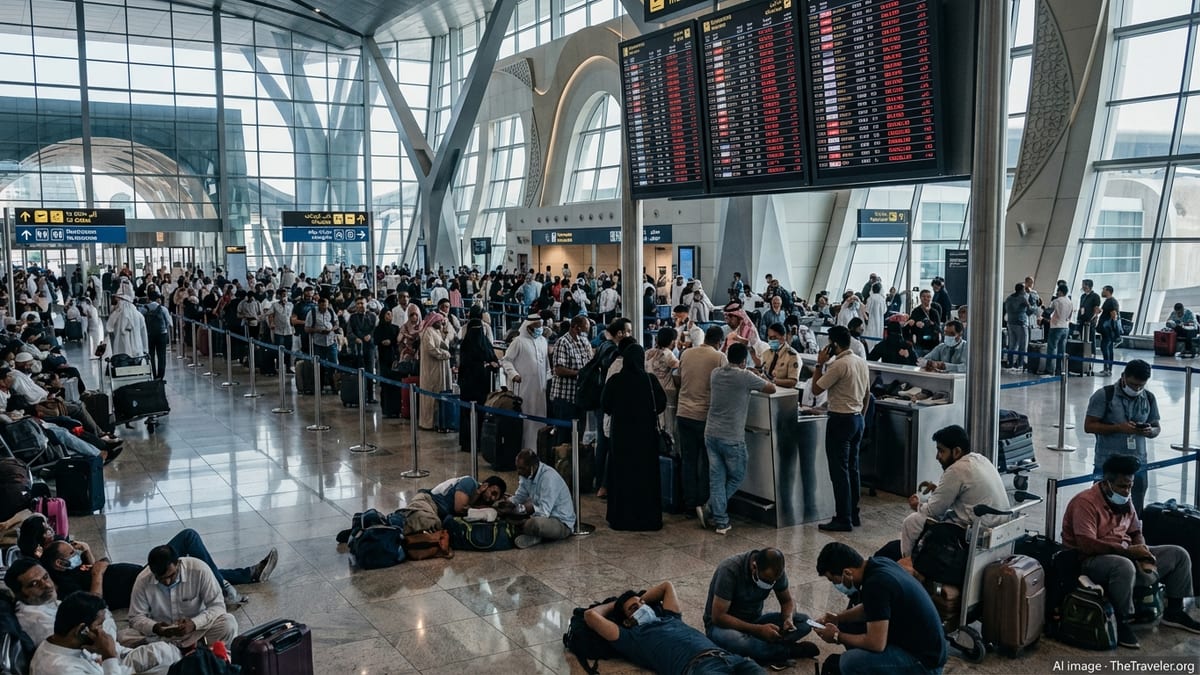
On Sunday, Etihad confirmed a temporary halt to all departures from Abu Dhabi until at least mid-afternoon local time, while Emirates suspended most services to and from Dubai and Qatar Airways sharply reduced operations in Doha. Long check-in queues built up as stranded travellers searched for information, with many forced to sleep on terminal floors as airport hotels quickly filled.
Global Knock-On Effect: Over 19,000 Flights Delayed
What began as a regional aviation crisis has rapidly escalated into a global one. With aircraft and crews out of position and key transit hubs offline, airlines around the world have been forced to cancel or significantly delay services, even on routes far from the Middle East.
Flight-tracking services reported that by the early hours of Sunday, more than 19,000 flights worldwide had been delayed and over 2,600 cancelled. A sizeable share of those flights were not bound for the conflict zone but were nonetheless affected by missed connections, aircraft shortages and air traffic congestion on alternative routes.
Carriers including Air India, Turkish Airlines, Lufthansa, Air France, KLM, British Airways, Delta and United have either suspended flights into the region, rerouted services to avoid closed airspace or warned passengers to expect major schedule changes. For many travellers, journeys that typically take seven or eight hours are stretching to 11 or 12 as planes loop south over Saudi Arabia or north via Turkey and the eastern Mediterranean.
Air traffic controllers in countries along these diversion corridors are facing added pressure as they absorb rerouted long-haul flights, prompting authorities to slow traffic flows to maintain safety margins. Industry experts say that even if some Middle Eastern airspace reopens in the coming days, airlines will need additional time to reposition aircraft and crews, prolonging the disruption.
Travellers Stranded From Europe to Asia
For passengers, the crisis has produced scenes reminiscent of the early pandemic era. Terminals from Newcastle and Dublin to Kathmandu and Nairobi have filled with travellers staring at departure boards flickering with the words “cancelled” and “delayed”, uncertain when they will be able to move.
In Europe, flights from regional airports to Gulf hubs have been heavily affected, with passengers heading to onward destinations in Asia and Australasia especially hard hit. Many have been offered hotel vouchers or the option to rebook days later, while others report being told to make their own arrangements and claim refunds later.
Across Asia and Africa, where Gulf carriers are lifelines for migrant workers and family visitors, the sudden halt to services has disrupted work contracts, medical trips and long-planned reunions. In Nepal and India, evening departures to Doha, Dubai, Sharjah and Abu Dhabi were wiped from screens, leaving workers bound for Gulf jobs scrambling for information in crowded terminals.
Travel agencies are reporting a surge in calls from anxious customers trying to reroute via remaining open hubs such as Istanbul, Cairo and Riyadh. However, the rapid build-up of diverted traffic means available seats are scarce and often more expensive, particularly in premium cabins.
What Travellers Should Expect in the Coming Days
Aviation analysts caution that the full picture of disruption will not be clear for several days, as airlines juggle safety considerations, government advisories and the complex logistics of global fleet management. While some countries may be able to reopen parts of their airspace as military operations become more defined, operators will move cautiously.
Passengers with itineraries touching the Middle East, or connecting via Europe and Asia on routes that normally overfly the region, are being urged to check flight status frequently and to maintain flexible plans. Many airlines have issued travel waivers allowing free changes for affected routes, but rebooking options may be limited due to high demand on alternative paths.
Experts warn that extended diversions around the closed skies will raise fuel burn and operating costs, pressure that could feed into higher fares if the crisis is prolonged. Airlines are also bracing for compensation claims and additional expenses for accommodation and care of stranded passengers in jurisdictions where such obligations are mandated.
For now, the consensus among industry observers is that travellers should brace for several days of rolling disruption, even in regions far from the Middle East. With a critical aviation crossroads effectively sealed off by conflict, the modern global air network is revealing just how tightly interconnected it has become.