

More news on this day
Escalating conflict centered on Iran and the Gulf has triggered sweeping airspace closures, widespread airport disruptions, and thousands of flight cancellations, as Pakistan International Airlines suspends key routes to the United Arab Emirates and global carriers race to reroute or ground services across the wider Middle East.
Get the latest news straight to your inbox!
Airspace Closures Ripple Across the Gulf and Beyond
Publicly available data on the 2026 Iran war indicates that large portions of Middle East airspace have been intermittently closed since late February, after Iranian missile and drone strikes targeted infrastructure in the United Arab Emirates, Qatar, Kuwait, Bahrain, Saudi Arabia, Israel, and other states. Analysts note that these coordinated closures have effectively created a shifting no-fly zone over some of the world’s busiest long-haul corridors linking Europe, Asia, and Africa.
Information compiled by aviation and economic observers shows that airspace shutdowns in the UAE, Qatar, Kuwait, Bahrain, and neighboring countries have led to more than 4,000 daily flight cancellations at peaks in the crisis, stranding hundreds of thousands of passengers worldwide. Major hubs such as Dubai International and Abu Dhabi International sustained damage and intermittent suspensions of operations after strikes, while Kuwait’s main airport also saw aircraft grounded following reported impacts on airport facilities.
Advisories issued in early March highlight that even when airports technically reopen, they often operate at sharply reduced capacity under emergency or evacuation-focused regimes. Hamad International Airport in Doha, for example, was reported to have reopened navigation only on a limited basis, prioritizing repatriation and cargo movements while conventional commercial schedules remained largely suspended.
The closures have not been confined to the Gulf. Separate reporting on the broader conflict notes that Israeli airspace was shut for several days during intense exchanges, further compressing routing options for airlines attempting to avoid overflight of conflict zones while keeping long-haul connections viable.
Pakistan–Gulf Links Severely Disrupted as PIA Halts UAE Flights
Against this volatile backdrop, Pakistan’s national carrier has moved to suspend multiple services between Pakistan and the UAE, particularly on links to Dubai and Abu Dhabi that traditionally rank among its highest-demand routes. While schedules remain fluid, aviation tracking and regional media coverage indicate that Pakistan International Airlines has progressively halted or sharply curtailed selected Pakistan–UAE operations as the conflict has escalated.
Available information from regional news outlets and transport bulletins suggests the suspensions are framed as a precautionary step to safeguard passengers and crews amid unpredictable risk to aircraft in and around Gulf airspace. Similar rationale has been cited in past, smaller-scale disruptions affecting Pakistan–Middle East traffic, but the current wave of cancellations is notably broader, impacting Karachi, Lahore, Islamabad, and other major Pakistani gateways.
Travel industry reports describe a cascading effect across Pakistan’s outbound market. With PIA stepping back from normal UAE schedules, travelers bound for work, family visits, medical treatment, and onward long-haul connections through Dubai and Abu Dhabi are scrambling for seats on remaining foreign carriers or attempting complex reroutings via Saudi Arabia, Oman, or Turkey. Capacity constraints and shifting schedules mean that many itineraries sell out within hours of being posted, driving up fares and lengthening journey times.
Pakistan’s aviation sector also faces wider knock-on impacts. Reduced Pakistan–Gulf connectivity curtails feeder traffic for European and North American routes, disrupts cargo flows, and complicates travel for the country’s large expatriate communities in the UAE and across the Gulf Cooperation Council states.
Hundreds of Flights Canceled Daily Across the Middle East
Travel disruption has been remarkable in scale. Studies on the economic impact of the conflict estimate that airspace closures and airport damage across the Gulf have contributed to at least 4,000 daily cancellations in and around the Middle East, with over 20,000 flights canceled in the first phase of the war. Aviation monitoring cited in international coverage reports that on certain weekends, roughly a quarter of all scheduled services to Middle East destinations were wiped from global timetables.
Major international airlines including Air India, Biman Bangladesh Airlines, British Airways, Cathay Pacific, IndiGo, Lufthansa, Virgin Atlantic, Wizz Air, and others have suspended or sharply reduced services to the region in response to heightened risk assessments and operational constraints. Some carriers have announced temporary halts on flying to the UAE, Qatar, Saudi Arabia, Israel, and parts of Iraq, while others maintain only skeleton operations focused on evacuations or strategic connections.
Regional carriers are similarly affected. Notices from airlines such as Nepal Airlines and Middle East Airlines show cancellations on routes into Dubai, Doha, Dammam, and key Gulf cities, frequently tied to overnight airspace closures or short-notice security directives. Travel advisories circulated to corporate clients describe a patchwork of “limited” or “partial” operations at airports in Saudi Arabia, Qatar, and Bahrain, with routine delays and rolling cancellations.
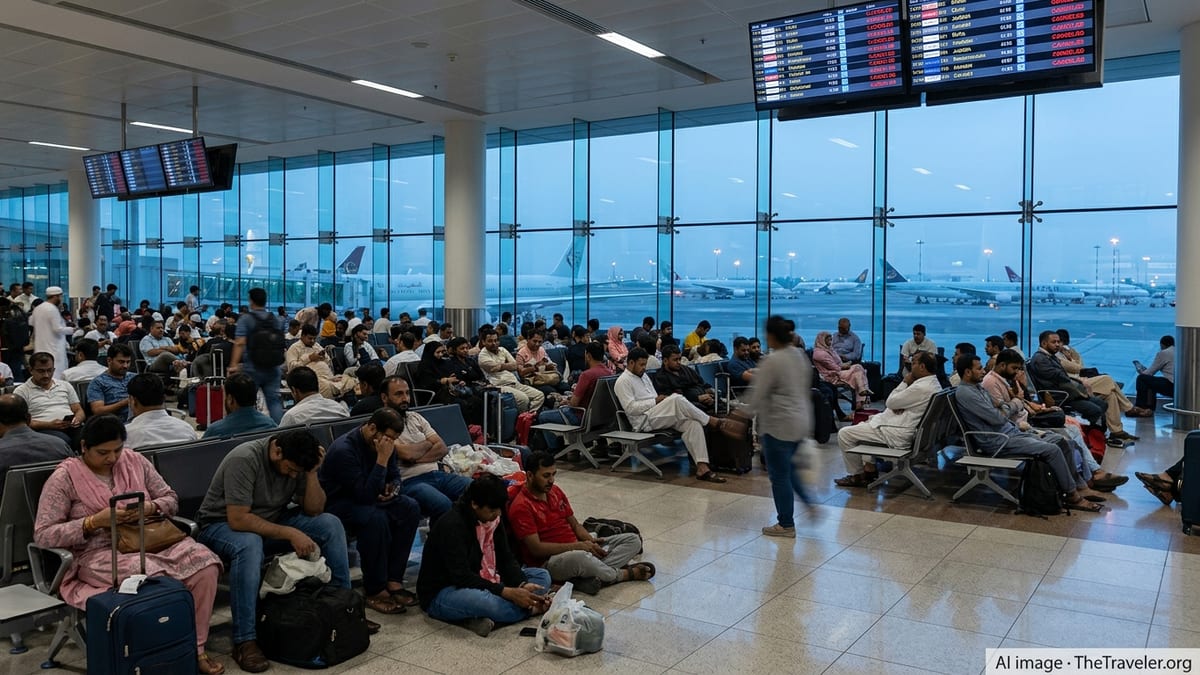
For travelers, the result is a labyrinth of uncertainty. Reports from passenger communities and travel forums describe flyers sleeping on terminal floors, waiting days for open seats, or piecing together overland journeys to alternative gateways in Saudi Arabia or Oman where limited services continue. Even when flights operate, lengthy diversions around closed airspace are common, extending flight times by hours and adding significant fuel and crewing costs for airlines.
Global Networks Rerouted as Long-Haul Carriers Skirt Conflict Zones
The Middle East’s central geographic position means that conflict-driven restrictions resonate far beyond regional markets. Publicly accessible aviation analyses show that numerous European and Asian carriers have redrawn their route maps in recent weeks to avoid Iranian and contiguous airspace, instead tracking more southerly or westerly corridors that add distance to Europe–Asia and Asia–North America journeys.
Some airlines have introduced technical fuel stops at airports outside the conflict zone, turning what were once nonstop flights into multi-leg itineraries. Others have shifted connecting flows away from affected Gulf hubs toward alternative centers in Istanbul, Cairo, Jeddah, or European cities with available capacity and stable airspace corridors. Travel waivers, flexible rebooking policies, and broad refund options have become standard features of airline communications to affected passengers.
Industry commentators note that these reconfigurations come with substantial cost. Longer routings elevate fuel burn and crew duty times, while sharp cuts to high-yield business and premium leisure traffic into Dubai, Doha, and Abu Dhabi weaken revenue projections. Freight movements have also taken a hit, with disruptions at Gulf hubs affecting time-sensitive cargo from electronics to pharmaceuticals that normally transit through the region’s vast logistics platforms.
Despite gradual resumption of limited services at some UAE airports and an incremental reopening of restricted airspace corridors, published analysis stresses that the operating environment remains fragile. New missile or drone incidents can trigger immediate closures with little warning, forcing last-minute diversions and renewed cancellations across international networks.
Travelers Face Prolonged Uncertainty Across Pakistan and the Gulf
For travelers in Pakistan, Saudi Arabia, Qatar, Bahrain, Kuwait, and neighboring states, the practical experience of the crisis is one of prolonged uncertainty rather than a single day of disruption. Airlines continue to adjust timetables on a rolling basis, and travel advisories emphasize that even confirmed bookings may be rerouted, delayed, or canceled at short notice.
Publicly available guidance from aviation risk consultants and government notices encourages passengers to monitor airline communications closely, allow significant buffers for connecting flights, and prepare for extended layovers or forced overnights. Many carriers have expanded fee waivers and rebooking windows through at least the end of March, offering options to postpone nonessential trips away from the immediate crisis period.
In Pakistan, where PIA’s suspension of key UAE routes removes a familiar and relatively affordable bridge to the Gulf, the disruption is especially acute for migrant workers and families reliant on routine travel between Karachi, Lahore, Islamabad, and Gulf cities. Reports indicate that some passengers have turned to road or sea journeys to reach alternative departure points, while others have postponed travel indefinitely.
As the conflict and its diplomatic fallout continue to evolve, aviation analysts caution that the restoration of full connectivity between Pakistan, the Gulf states, and global networks may take considerably longer than the reopening of individual airports. The combination of physical damage at select hubs, lingering security concerns, and the financial strain on airlines operating heavily disrupted schedules suggests that travelers should brace for months of irregular operations across the wider region.