

More news on this day
Air Canada has joined a widening roster of global airlines suspending services to Gulf destinations including Bahrain, Saudi Arabia, the United Arab Emirates, Kuwait, and Oman, as conflict-driven airspace restrictions and heightened security risks send shockwaves through Middle East aviation networks and disrupt travel plans worldwide.
Get the latest news straight to your inbox!
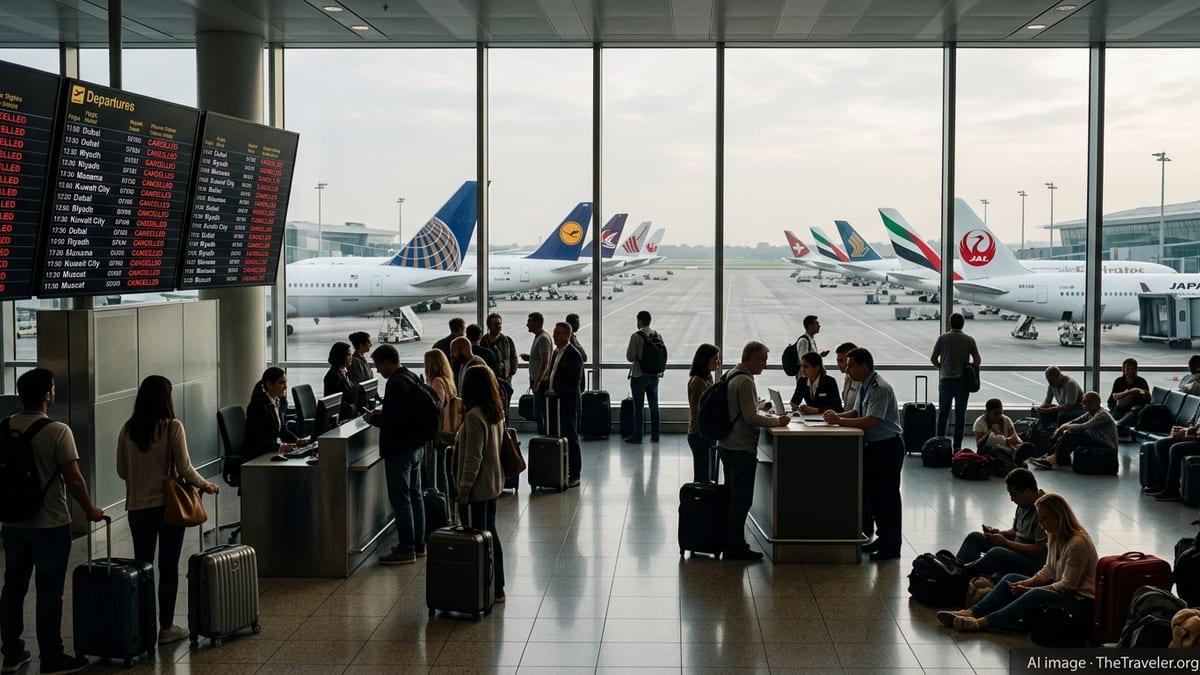
Wave of Global Cancellations Reaches North American Carriers
Publicly available operational updates and industry advisories indicate that Air Canada has halted flights to multiple Gulf destinations, aligning with widespread suspensions already in place at other international airlines. The Canadian flag carrier is understood to have withdrawn services on routes into the affected region, reflecting both direct airspace closures and risk assessments associated with overflying conflict zones.
Delta Air Lines has likewise curtailed operations touching the Gulf, with scheduling data and travel-industry briefings showing services either cancelled or rerouted away from Bahrain, Saudi Arabia, the United Arab Emirates, Kuwait, and Oman. These moves mirror earlier steps by several European and Asian carriers that have removed the region from their near-term schedules.
According to summaries compiled by travel management companies and aviation consultancies, British Airways, Lufthansa Group airlines, Air France, and others have progressively extended suspensions to major Gulf hubs, particularly Dubai and Abu Dhabi. The combined effect is a sharp reduction in transatlantic and Europe–Asia capacity via the traditional Middle East connecting corridors, leaving many itineraries either cancelled outright or restructured around longer, more southerly routings.
Schedules filed with slot coordinators and airport stakeholders suggest that the majority of these suspensions are set to last at least through the coming weeks, with some carriers signalling that select Gulf routes will not resume until much later in the year. Passengers are being shifted onto alternative routings where possible, though availability on remaining flights is increasingly limited.
European and Asian Airlines Pull Back From Gulf Hubs
The sharpest pullback has come from European network airlines that once relied heavily on Gulf hubs as key spokes in their long-haul systems. Guidance shared with airports shows Lufthansa and its group partners suspending passenger services to Dubai and Abu Dhabi, with provisional timelines suggesting cancellations through mid-March and ongoing reviews for further extensions.
British Airways has cancelled a broad swath of flights to Abu Dhabi, Bahrain, Kuwait, and other Gulf points, with publicly circulated communications describing suspensions running for months rather than days. In parallel, Air France and other continental European carriers have trimmed or suspended services that previously connected their main hubs to the Gulf, focusing instead on routes that can avoid the most restricted airspace.
Asian carriers have also adjusted. Japan-based airlines, along with a number of other Asia–Europe operators, have reduced or halted flights that transit Gulf airspace or rely on Gulf stopovers. Schedules and advisories indicate that aircraft are being redeployed onto alternative corridors that route further south or north of the main conflict-affected region, adding significant distance and complexity to some journeys.
Turkish Airlines, which normally operates a dense network between Istanbul and Gulf cities, has scaled back frequencies and temporarily suspended specific destinations within the most affected states. This has knock-on effects for travelers who would typically use Istanbul as a flexible gateway to reach secondary cities in the Middle East.
Airspace Restrictions Tighten Across the Region
The immediate trigger for the latest round of cancellations is a web of airspace closures and restrictions stretching across multiple Middle Eastern countries. Travel advisories issued in early March describe national authorities in the United Arab Emirates, Bahrain, Kuwait, Qatar, and other states imposing sweeping limits on civil aviation, closing airspace outright at times or allowing only tightly controlled corridors.
These steps follow a series of missile and drone attacks linked to the wider regional conflict involving Iran and several Gulf states. Published coverage of incidents in and around the Persian Gulf notes strikes targeting infrastructure in the UAE, Bahrain, Oman, Kuwait, Saudi Arabia, Qatar, and Israel, prompting temporary shutdowns at key airports and immediate suspensions of overflights in adjacent flight information regions.
Industry documents summarising the situation describe a patchwork environment in which some Gulf countries maintain limited operational corridors, while others retain blanket prohibitions on civil traffic for extended periods each day. Even where airspace remains technically open, many international airlines are choosing to avoid the region entirely, citing the elevated risk profile and uncertainty around short-notice closures.
In addition, existing conflict-zone advisories from regulators have already been in place over parts of the Persian Gulf and Gulf of Oman. Those frameworks, combined with new national restrictions, have significantly constrained the ability of airlines to chart commercially viable and legally compliant routings into or over the affected states.
Operational and Commercial Shock to Global Travel
The sudden loss of capacity into key Gulf hubs is reverberating across global travel markets. Before the current crisis, airports such as Dubai, Abu Dhabi, Doha, Riyadh, Jeddah, Kuwait City, Muscat, and Manama served as critical transfer points for passengers moving between North America, Europe, Asia, and Africa. With many international airlines suspending services, those networks have been sharply curtailed.
Travel-management alerts issued to corporate clients highlight widespread rerouting via alternative hubs in Turkey, Egypt, and parts of Southern Europe. Flights that would normally connect through Dubai or Abu Dhabi are instead funnelling through Istanbul, Cairo, or secondary European cities, driving longer journey times, tighter connection windows, and increased risk of missed flights.
Commercially, airlines are facing higher operating costs linked to longer flight paths, elevated insurance and war-risk premiums, and the need to keep standby aircraft and crews available for sudden schedule changes. For passengers, the most visible impacts are sold-out alternative routes, last-minute cancellations, and protracted waits for rebooking, particularly for those already in the region when closures were implemented.
Some carriers that continue limited operations into the broader Middle East have introduced technical stops at out-of-the-way airports for refuelling and crew changes, avoiding the most sensitive airspace while preserving essential connectivity. However, such workarounds are complex and capacity constrained, leaving many travellers with few immediate options.
Uncertain Timeline for Recovery
Forecasts produced by aviation consultancies and slot-coordination bodies suggest that a quick return to normal traffic patterns is unlikely. Documents circulated in mid-March reference slot alleviation measures at Gulf airports that extend well beyond the current scheduling season, signalling that regulators and coordinators do not expect full restoration of capacity in the short term.
Airlines, for their part, are publishing schedules that maintain suspended Gulf routes for weeks or months ahead, while reserving the right to reinstate flights if security conditions and airspace availability improve. Publicly available timetables and booking engines show many services into Bahrain, Saudi Arabia, the UAE, Kuwait, and Oman as unavailable for sale, or open only for dates well into the future.
Industry observers note that the eventual reopening of airspace will likely occur in phases, with limited corridors, daytime-only operations, and flight caps introduced before a broader normalization. Even once restrictions ease, carriers may move cautiously in restoring capacity, weighing route profitability against any residual security concerns and regulatory guidance.
For now, travellers with plans involving the Gulf region are being advised by airlines and travel intermediaries to monitor bookings closely, remain flexible about routings and dates, and expect that the traditional role of Gulf hubs as seamless global connectors will be significantly constrained until the regional security picture stabilizes.