

More news on this day
International air travel to and through the Gulf is facing its sharpest disruption in years, as Emirates and a growing list of major global airlines slash or freeze services to the United Arab Emirates, Qatar, Saudi Arabia, Kuwait, Iraq and other regional destinations amid cross-border strikes and rolling airspace closures.
Get the latest news straight to your inbox!
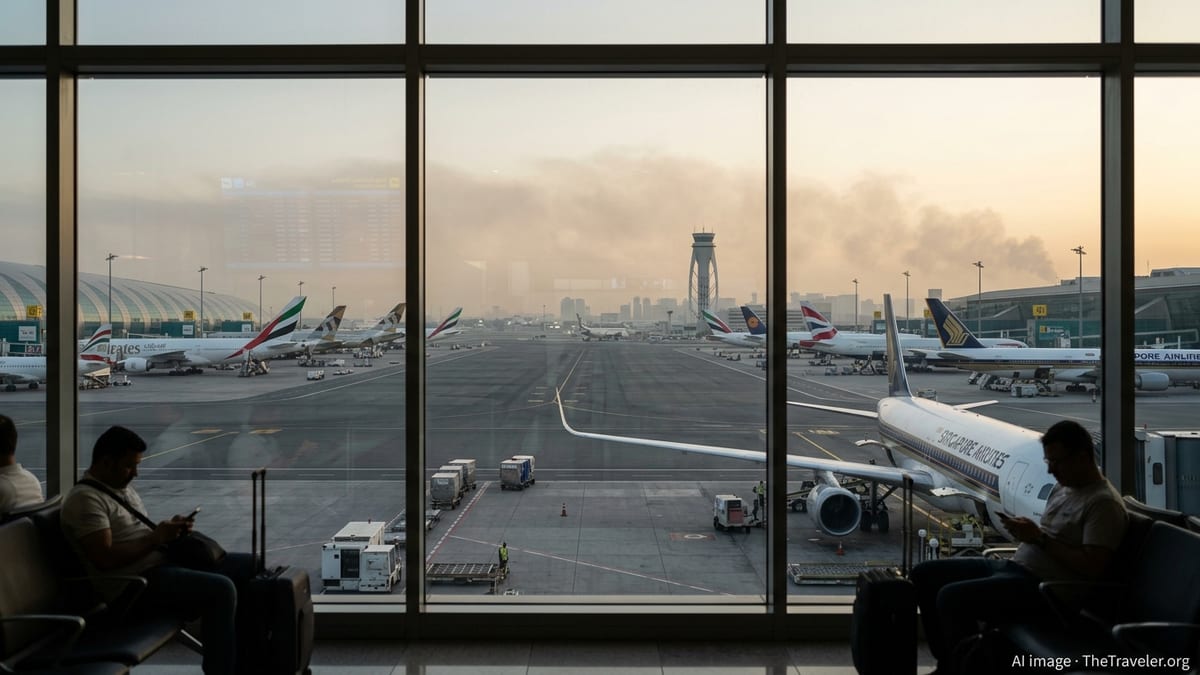
Regional Conflict Triggers Wave of Airline Suspensions
Escalating conflict involving Iran, the United States, Israel and several regional states has triggered a cascade of airspace closures across the Middle East and North Africa, forcing airlines to ground or reroute thousands of flights. Publicly available advisories describe widespread restrictions affecting Iran, Iraq, Israel, Jordan, Kuwait, Qatar, Bahrain, Syria and the United Arab Emirates, with major hubs such as Dubai, Abu Dhabi and Doha experiencing large-scale cancellations and sharply reduced schedules.
Reports from aviation risk consultancies and corporate travel providers indicate that the initial shock in late February and early March produced several thousand cancellations in a matter of days, followed by continued instability in flight schedules as airspace corridors opened and closed with little notice. Airlines have been compelled to navigate a patchwork of flight information region closures, military no-go zones and emergency routing, severely constraining operations between Europe, Asia and Africa that typically rely on Gulf hubs.
Economic analysis of the conflict’s impact estimates that flagship carriers in the region, including Emirates, Etihad and Qatar Airways, halted the bulk of their regular services at the height of the crisis, while a wide range of international airlines suspended flights into the Gulf altogether. The combination of direct suspensions and indirect knock-on effects on connecting traffic has stranded hundreds of thousands of passengers worldwide and disrupted cargo flows on some of the world’s busiest long-haul corridors.
Emirates Cuts Back as Gulf Hubs Operate on Reduced Schedules
Emirates, the largest carrier based in Dubai, has been among the most visible airlines hit by the turmoil. Information shared in public customer advisories and widely circulated in travel forums shows that the airline temporarily suspended all scheduled flights to and from Dubai for several days in early March, citing regional airspace closures. Limited services then resumed in stages as portions of Gulf airspace reopened and as safety assessments evolved.
Subsequent updates indicate that Emirates has been restoring parts of its network on a rolling basis but remains on a reduced schedule as of late March, with priority given to repatriation, essential long-haul connections and selected high-demand routes. Capacity on many Middle East and Gulf city pairs remains constrained, and passengers are being urged in publicly available notices to monitor flight status closely and avoid travelling to airports without confirmed bookings.
The disruption has extended beyond Dubai itself. Advisories focused on Gulf aviation conditions describe partial operations at Dubai International, Al Maktoum International and Abu Dhabi’s Zayed International airports, with flights subject to sudden delay or cancellation when airspace corridors are restricted or cross-border strikes intensify. Saudi Arabia’s main airports in Riyadh and Jeddah have also reported limited schedules, while airports in Qatar and Kuwait have faced intermittent suspensions linked to national airspace closures.
Global Carriers from Europe, North America and Asia Scale Back
Emirates’ retrenchment is part of a much broader realignment in global airline networks serving the Gulf. Economic and aviation assessments of the conflict’s impact note that carriers from multiple regions, including Air Canada, ITA Airways, Turkish Airlines, Air France and low-cost giant IndiGo, have sharply reduced or temporarily suspended services to the United Arab Emirates, Qatar, Saudi Arabia, Kuwait and neighbouring states.
Public travel alerts compiled by immigration advisers and corporate travel management firms describe extensive cancellations by European airlines operating into the Middle East, including route suspensions to high-risk destinations and pauses on services to major Gulf hubs. North American carriers have been curtailing direct links to the region and, in many cases, rerouting flights that would ordinarily overfly affected airspace, adding fuel and crew costs while lengthening journey times for passengers.
In South Asia, large Indian carriers such as Air India and IndiGo have pulled back from regular services to the Gulf at several points during the crisis, according to travel advisories and widely shared passenger guidance. On some long-haul routes to North America, airlines have introduced technical stops in European hubs like Rome to avoid conflict zones, adding complexity for travellers already grappling with last-minute itinerary changes.
Partial Reopenings, Repatriation Flights and Patchy Recovery
Despite the scale of the disruption, some signs of tentative stabilisation have emerged. Travel risk bulletins issued in mid-March describe partial resumptions of service at key Gulf airports after earlier blanket suspensions, with limited commercial operations layered on top of repatriation and humanitarian flights. In Qatar, air navigation authorities have allowed restricted operations under emergency conditions, prioritising evacuation and cargo, while keeping most regular commercial flights on hold.
Similarly, in the United Arab Emirates and Saudi Arabia, a gradual uptick in arrivals and departures has been reported as airspace restrictions ease intermittently. Data referenced in infrastructure and risk assessments suggests that Emirates and fellow Gulf carriers are working to rebuild truncated networks, though progress is largely contingent on the broader security environment and the risk of further cross-border attacks on aviation and critical infrastructure.
European airlines have begun to reintroduce some services to the region as well, often with adjusted routings and reduced weekly frequencies. However, schedules remain fluid and susceptible to renewed disruption. Industry observers caution that route restorations announced for late March and April could be reversed quickly if missile or drone activity escalates near key corridors or urban centers, underlining the fragility of the current recovery.
Travellers Face Extended Disruptions and Complex Rebooking
For passengers, the wave of suspensions and partial resumptions has translated into a prolonged period of uncertainty. Publicly accessible guidance from airlines, airports and corporate travel managers consistently advises travellers to verify their flight status immediately before departure, monitor email and app notifications, and avoid starting journeys that rely on tight connections through Gulf hubs.
Many airlines have introduced temporary rebooking windows, fee waivers and ticket validity extensions for itineraries touching the Middle East, though the exact terms vary by carrier and fare type. Reports from passenger forums highlight ongoing challenges in securing alternative routings, with popular detour hubs in Europe and South Asia under strain from displaced demand and some long-haul flights booked out for days.
Travel risk specialists recommend that organisations with staff in or transiting through the region consider delaying non-essential trips and, where travel is unavoidable, plan for potential layovers, last-minute airport changes and short-notice schedule shifts. With airspace closures and cross-border strikes still an intermittent feature of the security landscape, most published assessments suggest that disruptions to flights serving the UAE, Qatar, Saudi Arabia, Iraq, Kuwait and neighbouring states are likely to persist in the near term, even as airlines like Emirates and their global partners work to restore more predictable operations.