

More news on this day
American Airlines has joined Lufthansa, Air France-KLM, Turkish Airlines, IndiGo, LOT Polish and a growing list of global carriers in freezing or rerouting flights across the Middle East, after joint US-Israel air strikes on Iran triggered sudden airspace closures and cascading travel disruptions from Europe to Asia and the Gulf.
Airspace Clampdowns Following US-Israel Strikes on Iran
Air travel across West Asia was thrown into turmoil on February 28 as Iran, Iraq, Israel and Jordan imposed sweeping restrictions on their skies following overnight strikes involving US and Israeli forces against targets in Iran. Flight-tracking data showed large swathes of the region effectively emptied of civilian aircraft as airlines scrambled to divert or ground services at short notice.
Regulators and aviation agencies warned carriers to avoid affected airspace entirely, citing heightened risks to civil aviation in an active conflict zone. The closures hit a key east–west corridor that has become even more critical since Russian and Ukrainian airspace shut to many operators, forcing more Europe–Asia traffic over the Gulf and surrounding states.
In response, major airlines activated crisis protocols, rerouting long-haul flights via Egypt, Saudi Arabia and Central Asia where possible, while cancelling departures that could not safely bypass restricted zones. The resulting blank zone over parts of the Middle East rippled quickly through schedules at major hub airports.
American, European and Asian Carriers Pull Back
American Airlines confirmed it had suspended select services touching the wider Middle East and was rerouting flights that would normally pass through Iranian and Iraqi airspace, aligning itself with earlier moves by United and other North American carriers to scale back exposure to the conflict corridor. The airline said safety and regulatory guidance were dictating its decisions as conditions evolve hour by hour.
In Europe, Lufthansa suspended flights to Dubai, Tel Aviv, Beirut and Oman and announced it would avoid key parts of regional airspace until at least early March. Air France-KLM cancelled services to Tel Aviv and Beirut, while KLM accelerated the suspension of its Amsterdam–Tel Aviv route, citing the operational and security challenges of maintaining regular schedules under current restrictions.
Low-cost and leisure-focused operators are also pulling back. Wizz Air halted flights to Israel, Dubai, Abu Dhabi and Amman for several days, while LOT Polish reported that at least one Warsaw–Dubai service had been forced to return to Poland mid-flight as new airspace closures came into effect. Indian budget carrier IndiGo issued a broad advisory and canceled Middle East flights in line with evolving regional restrictions, asking passengers to closely monitor flight status.
Turkish, Gulf and Regional Airlines Face Hub Disruptions
Turkey’s flag carrier, Turkish Airlines, announced it had canceled flights to Lebanon, Syria, Iraq, Iran and Jordan until March 2 due to multiple Middle Eastern airspaces being closed or heavily restricted. It also scrapped services on February 28 to Qatar, Kuwait, Bahrain, the United Arab Emirates and Oman, warning that additional cancellations were possible as it monitored real-time developments.
In the Gulf, the impact has been especially acute. Qatar temporarily closed its airspace, effectively suspending most operations by Qatar Airways at its Doha hub and forcing diversions for overflying traffic. Authorities in the United Arab Emirates and Kuwait likewise introduced temporary closures or stringent restrictions, disrupting movements through Dubai, Abu Dhabi and Kuwait City and affecting carriers including Emirates, flydubai and Kuwait Airways.
Other regional airlines, from Aegean and Bulgaria Air to Gulf and Levantine carriers, have paused flights into Tel Aviv, Beirut and select Gulf cities. Japan Airlines cancelled its Tokyo–Doha rotation, while additional Asian and European operators are recalculating routings to keep aircraft and crews clear of the most volatile skies.
Passengers Stranded as Major Hubs Reel
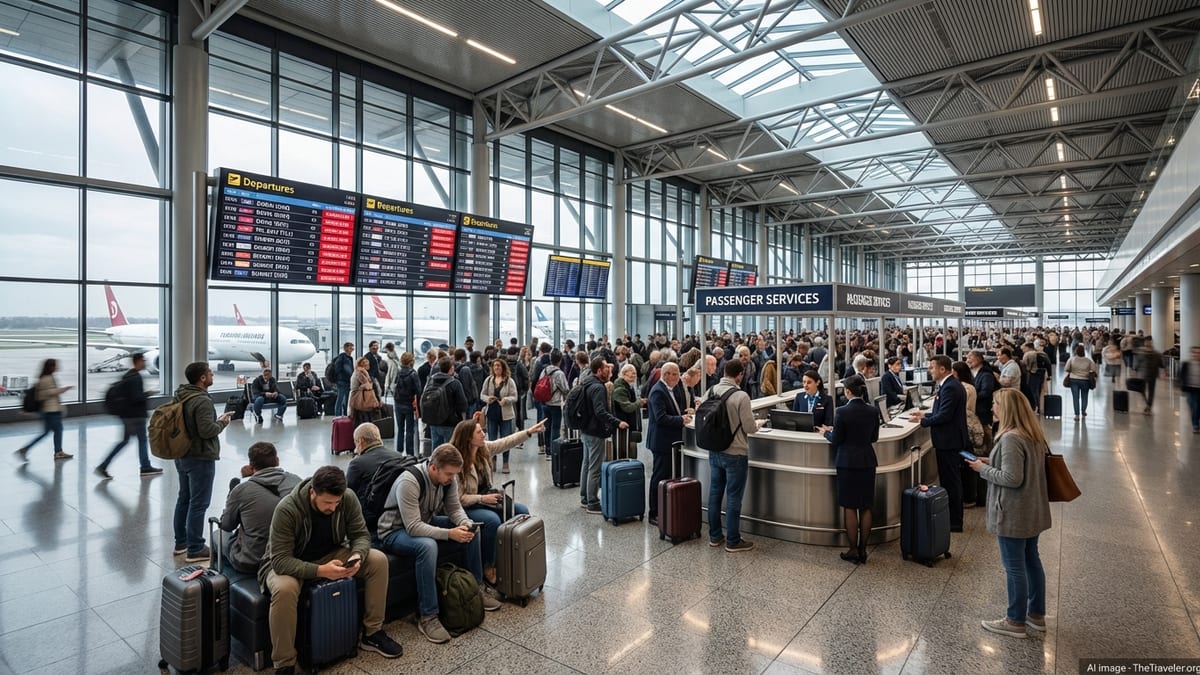
The sudden wave of suspensions and diversions has left thousands of travelers stranded or facing extended delays at key transit hubs such as Istanbul, Doha, Dubai and major European gateways. Airports reported crowds of passengers seeking rebooking options as information screens filled with “cancelled” and “delayed” notices for routes touching the Middle East.
Travel-data providers estimated that hundreds of flights had been cancelled or significantly rerouted within hours of the airspace closures, with knock-on disruption predicted to last for days even if restrictions are eased. Longer routings mean extended flying times, additional fuel requirements and tighter crew-duty limits, which in turn constrain how quickly airlines can restore normal schedules.
Airlines are offering free rebooking, refunds or alternative routings where possible, but limited spare capacity on already busy long-haul networks is making rapid recovery difficult. Stranded passengers are being urged to contact their airline directly, ensure contact details are up to date in reservation systems and expect significant queues at airport service desks.
Safety, Costs and the Outlook for Global Connectivity
For the aviation industry, the latest flare-up underscores how quickly geopolitical shocks can redraw global flight maps. With Russian and Ukrainian airspace already largely off limits to many Western carriers, the loss or restriction of key Middle Eastern corridors forces airlines into longer, more complex routings that increase fuel burn, crew costs and operational risk.
Aviation regulators in Europe and Asia have reiterated guidance to avoid Iranian and adjoining conflict-area airspace, while insurers are reassessing premiums for flights skirting the region. Airlines are conducting rolling risk assessments, weighing revenue opportunities against crew safety, aircraft security and the possibility of sudden further closures.
Travel analysts warn that if hostilities broaden or remain unresolved, airlines may be forced into more durable network changes, cutting frequencies, consolidating routes and shifting capacity to comparatively stable markets. For now, carriers stress that the measures are temporary and driven by safety considerations, but passengers planning travel via the Middle East in the coming days are being advised to prepare for ongoing disruption and rapid timetable changes.