

More news on this day
Air travel networks linking Europe, Asia, and Africa are being rapidly redrawn as airlines across the world extend mass cancellations and diversions to Dubai and Tel Aviv in response to the widening Iran conflict, disrupting itineraries for hundreds of thousands of passengers and straining alternative hubs from Cairo to Athens.
Get the latest news straight to your inbox!
From Missile Strikes to Closed Skies
The latest wave of flight cancellations stems from a sharp escalation that began on February 28, 2026, when coordinated strikes on Iranian targets were followed by retaliatory missile and drone attacks across the Gulf. Publicly available information shows that parts of the airspace over Iran, Israel, Iraq, Syria, and several Gulf states were closed or heavily restricted soon after, triggering an immediate collapse in scheduled services on key routes.
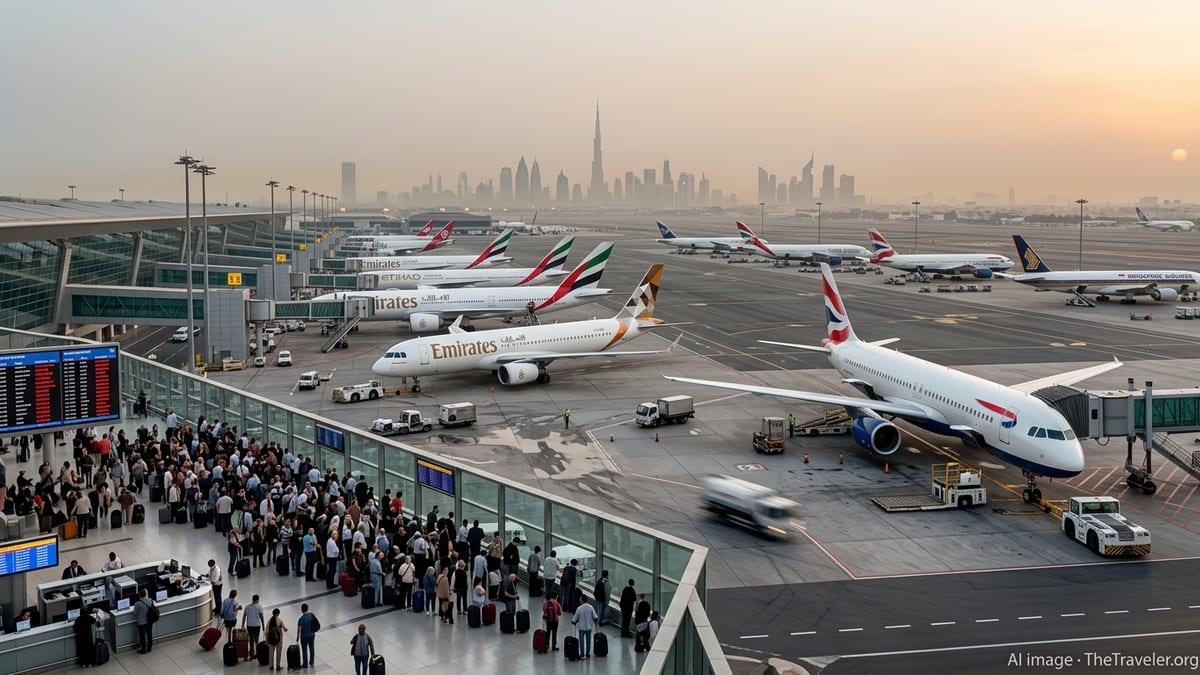
Dubai and Tel Aviv, two of the region’s most important international gateways, have been hit particularly hard. Reports indicate that debris from intercepted projectiles and nearby explosions around Dubai International Airport led to temporary suspensions of landings and a series of rolling operational pauses. At the same time, Israeli airspace restrictions have continued to limit movements in and out of Tel Aviv’s Ben Gurion Airport.
Industry advisories describe an environment in which airlines are navigating a patchwork of short-notice airspace notices and evolving risk assessments. Carriers have shifted from tactical diversions to broader schedule cuts, as it has become clear that the Iran conflict will not resolve quickly and that the risk profile over several high-traffic corridors remains elevated.
Major Carriers Extend Cancellations to Dubai and Tel Aviv
Large network airlines in Europe, North America, and Asia have progressively widened their suspensions to Dubai and Tel Aviv as the conflict drags into late March. Coverage from international outlets indicates that the Lufthansa Group has prolonged its halt on services to Tel Aviv into April, while also suspending flights to Dubai and other Gulf and Levant destinations after the latest round of strikes and airspace closures.
British and French carriers have followed similar patterns, first cutting Israel routes and then extending suspensions to Dubai as missile and drone activity moved closer to the United Arab Emirates. Travel advisories and timetable updates show that some airlines have blocked seats or removed flights to both Dubai and Tel Aviv from their systems through at least the end of March, with provisional dates stretching into late April for certain routes.
US carriers have so far focused on reducing capacity and trimming connections through partner hubs. Publicly available information on travel waivers confirms that at least one major US airline is allowing customers ticketed to Dubai or Tel Aviv to change plans without penalties through the end of March, while also signaling deeper global cuts as jet fuel prices surge in response to the conflict.
Regional players are also affected. Gulf-based airlines that once positioned Dubai as a hyper-connected super hub have, at times, seen flight numbers fall toward zero on certain days, before cautiously reintroducing limited operations where airspace and security conditions permit. Routes to Tel Aviv remain suspended or severely reduced across much of the region.
Pressure on Alternative Hubs and New Detour Corridors
As airlines avoid Iranian and adjoining conflict-zone airspace, the geometry of long-haul travel between Europe, Asia, and Africa has shifted. Reports from aviation and transport authorities highlight that Egypt has become a critical detour corridor, with Cairo and Red Sea airways carrying traffic that would normally overfly the Gulf or Iran. Egypt’s flag carrier has increased services to Gulf cities where operations remain possible, absorbing some of the displaced demand from Dubai-centered itineraries.
Further north and west, Athens and other Mediterranean gateways are emerging as key staging points for rerouted services. Coverage of Gulf carriers shows that limited Dubai–Athens flights have resumed in a bid to reconnect stranded travelers with onward European links, even as broader schedules across the Middle East remain constrained.
These adjustments come at a cost. Longer routings add hours to flight times, increase fuel burn, and compress aircraft and crew availability, which in turn reduces flexibility when fresh disruptions occur. According to analysis from global travel bodies, the region’s aviation and tourism sectors are now losing hundreds of millions of dollars per day in foregone international visitor spending as cancellations ripple across global networks.
Traveler Impact: Rolling Disruptions and Uncertain Timelines
For passengers, the most visible impact is a tangle of rolling cancellations, last-minute rebookings, and extended layovers away from the original routing. Travel advisories compiled in early and mid-March describe tens of thousands of travelers stranded at hubs from Istanbul and Doha to European capitals after onward legs to Dubai or Tel Aviv were suddenly withdrawn.
To manage the fallout, airlines have introduced broad travel waivers for journeys touching the Middle East. Publicly available guidance from multiple carriers shows flexible rebooking policies, including date changes without fees and, in some cases, the option to reroute through alternative hubs or obtain refunds. However, seats on remaining flights are limited, and replacement journeys may involve multiple connections and significant detours around closed skies.
Travel media and risk consultants are advising passengers with upcoming trips to Dubai or Tel Aviv to monitor flight status closely, keep contact details updated with airlines, and consider building in additional time for connections. Insurance specialists note that some policies may cover extended delays or enforced stopovers, but coverage often depends on how airlines handle rebooking and whether governments have raised official alert levels for affected destinations.
Uncertain Outlook for Dubai and Tel Aviv as Key Gateways
The longer-term outlook for Dubai and Tel Aviv’s air links remains uncertain as the Iran conflict continues. Analysts tracking schedule data point out that some airlines are planning only day-to-day operations into Dubai, holding back capacity decisions until there is more clarity on missile and drone activity, air-defense performance, and regional diplomatic efforts.
In Tel Aviv, extended suspensions by several major carriers into April underscore continued concern over the security environment and the potential for further escalation. Even if formal airspace restrictions ease, it may take time for airline risk committees and insurers to be comfortable restoring pre-war frequencies, particularly for overnight rotations and high-density widebody operations.
For now, global aviation is adapting in real time. Networks that once relied heavily on Dubai and Tel Aviv as high-frequency connectors between continents are fragmenting into a looser web of secondary hubs and improvised corridors. Until there is a durable reduction in regional tensions, the sky over the Middle East is likely to remain in turmoil, and travelers bound for Dubai, Tel Aviv, or routes that once passed nearby should be prepared for continued disruption.