

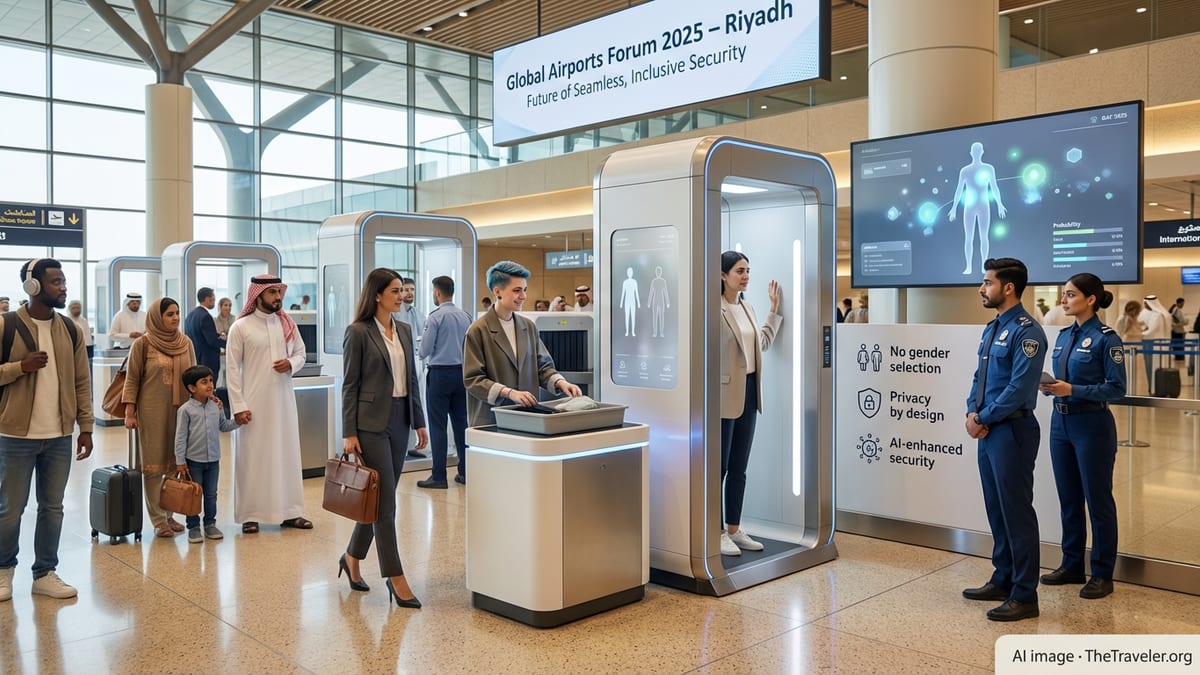
As global aviation leaders look beyond record passenger volumes toward a more seamless, inclusive journey, one of the most controversial checkpoints in modern travel is being quietly reengineered.
At the Global Airports Forum (GAF) 2025 in Riyadh, aviation security expert Dr. Ghassan Chahine used the main stage to introduce a new generation of gender-neutral body scanners, positioning the technology as a way to both tighten security and eliminate a source of anxiety for millions of travelers worldwide.
More News
- As U.S. Visitor Numbers Rebound, New Travel Bans Reshape Who Can Come
- Winter Storm Fern Triggers Historic Flight Chaos, American Airlines Cancels 9,000-Plus Flights
- Indefinite Closure of Poás Volcano National Park After Structural Damage to Access Bridge
A New Vision for the Checkpoint at GAF 2025
Held on December 16 and 17, 2025 at the Riyadh International Convention and Exhibition Center, GAF 2025 was billed as the largest edition yet of the Middle East’s flagship airports gathering, drawing airport operators, regulators, and suppliers from across the globe. The agenda was heavily focused on digital transformation in passenger processing and security, from biometrics at the curb to AI in the control room.
Within that context, Dr. Ghassan Chahine’s presentation on gender-neutral body scanners landed as one of the event’s most closely watched security announcements. Positioned at the intersection of operational efficiency and social inclusion, his proposal directly addressed one of the most sensitive friction points in airport processing: full-body screening that historically relied on gender-based assumptions.
According to conference organizers, GAF 2025 set out to highlight “cutting-edge products shaping the future of global airports,” with advanced security and passenger experience among its showcase pillars. The new scanner concept fit squarely into that brief, pitched not simply as a hardware upgrade but as a rethinking of how checkpoints can adapt to changing passenger demographics, regulatory expectations, and civil rights standards.
From Gender Buttons to Neutral Algorithms
The controversy around existing body scanners does not stem from the imaging hardware alone but from the software logic beneath it. For more than a decade, millimeter-wave scanners in many countries required security officers to manually select a “male” or “female” setting before a passenger stepped inside the machine. The algorithm then compared the image to an expected body profile; any deviation from that template could trigger an alarm, prompting a pat-down.
For transgender and non-binary passengers, and for many people whose bodies simply did not align with the default profiles, this process has often translated into misgendering, invasive secondary checks, and a disproportionate share of complaints. In the United States, authorities began shifting away from these gendered algorithms several years ago, directing new funding into software that no longer relies on a binary selection and instead focuses on detecting potential threats without encoding gender as a variable.
Dr. Chahine’s proposal at GAF 2025 builds on these early moves, but pushes them further. Rather than treating gender neutrality as an adjustment to existing systems, he framed it as a core design principle: scanners that never ask officers to guess or assign a traveler’s gender, and that instead analyze generic anomaly signatures on the body, regardless of anatomy, clothing, or gender expression.
How the New Generation of Scanners Works
Technically, the innovation lies in the fusion of millimeter-wave imaging with machine learning models trained on a far broader and more varied dataset than legacy systems. Instead of mapping a traveler’s image to a “male” or “female” baseline, the new software looks for shapes, densities, and patterns that correlate with concealed items, using probability thresholds rather than binary category matching.
According to material discussed around GAF 2025, the system is designed to significantly reduce false alarms in so-called “sensitive areas” of the body. That is where legacy scanners most frequently produced errors, triggering pat-downs that passengers often describe as embarrassing or invasive. By focusing on threat likelihood rather than deviations from an assumed body type, the new algorithms can more accurately distinguish between a medical device, a benign body feature, and something that genuinely warrants closer inspection.
Artificial intelligence plays a central role here: the algorithm continues to learn from anonymized screening outcomes, improving its ability to filter noise from signal. That capability is not just a privacy win. It also has direct operational implications by cutting back on downstream manual checks, one of the most labor-intensive aspects of checkpoint security.
Efficiency Gains: Shorter Queues, Fewer Pat-Downs
The efficiency promise behind gender-neutral scanners is straightforward: fewer false alarms translate into fewer secondary screenings, which in turn reduce average processing times per passenger. Airports, particularly those facing capacity constraints in their terminals, are acutely focused on this metric. Every additional minute at security ripples through retail dwell times, boarding punctuality, and the entire passenger experience.
In markets where gender-neutral algorithms have already begun rolling out, security agencies report declines in unnecessary pat-downs alongside improvements in overall throughput. Industry analysis suggests that even modest percentage shifts can unlock meaningful gains. If an airport processes tens of thousands of passengers per day, a reduction of only a few seconds per person accumulates into reclaimed hours across the checkpoint system.
Dr. Chahine’s intervention at GAF 2025 emphasized this point, arguing that inclusivity and efficiency are not competing priorities but mutually reinforcing ones. By eliminating systematic bias in the software, security agencies can redeploy staff from reactive pat-downs to more targeted, intelligence-led activities. That, he suggested, is how airports can scale up to meet rising demand without linear increases in checkpoint staffing.
Responding to a Changing Social and Legal Landscape
The push toward gender-neutral screening is not happening in a vacuum. Around the world, more jurisdictions are formally recognizing non-binary gender markers on passports, identity documents, and travel profiles. Airlines and airports are adjusting their systems to accommodate passengers who identify beyond the traditional male and female categories, including “X” markers in booking platforms and frequent-flyer accounts.
Security checkpoints have lagged behind that evolution, constrained by technology built for a narrower view of gender. As recognition expands and more travelers carry documents that do not align neatly with binary assumptions, the risk of friction at the checkpoint grows. Each misalignment between an identity document, an airline reservation, and a scanning algorithm becomes a potential flashpoint for confusion and complaint.
By stripping gender indicators out of the body scanner logic altogether, the approach championed by Dr. Chahine aligns the checkpoint with broader trends in policy and civil rights. It also reflects a gradual shift among regulators, who are under pressure to show that security measures do not discriminate on the basis of gender identity or expression. For airports in regions where legal recognition is advancing rapidly, early adoption of gender-neutral technology is increasingly seen as a future-proofing strategy.
Passenger Experience and Trust in the Security Process
For travelers, the checkpoint is more than a physical barrier; it is an emotional threshold between the outside world and the controlled environment of the airside terminal. Negative experiences at security tend to color perceptions of the entire journey. Surveys routinely show that intrusive pat-downs and perceived discrimination rank among the most distressing aspects of air travel, particularly for LGBTQ+ passengers.
Gender-neutral scanners are pitched as a way to rebuild trust. By removing the moment when an officer must press a gender button or visually assess a traveler’s body, the new systems aim to reduce the chance of misgendering or awkward exchanges. Instead, passengers step into a process that looks and feels more standardized, with less visible discretion at the individual officer level.
Early feedback from advocacy organizations in markets where similar upgrades are in progress suggests a cautious optimism. Many groups welcome the shift but stress that technology is only part of the equation. Training for security staff on respectful communication, clear signage about what the scanners do and do not capture, and simple options to request alternative screening all remain important components of a truly inclusive checkpoint experience.
Global Adoption Prospects and Regional Dynamics
Although GAF 2025 took place in Riyadh, the conversation it sparked was undeniably global. Delegations from Europe, North America, Asia, and Africa used the sidelines of the event to compare regulatory frameworks and procurement plans. Some markets, particularly those with centralized national security agencies, are already moving ahead with algorithm updates across entire fleets of scanners. Others are in earlier stages, piloting neutral algorithms at select hubs before considering nationwide deployment.
The Middle East presents a distinctive case study. The region’s major hubs, including those in Saudi Arabia and its neighbors, compete directly for international connecting traffic. Investments in cutting-edge technology have become a hallmark of that competition, from biometric immigration gates to AI-powered baggage systems. Within that race, adopting next-generation, gender-neutral scanners is cast not only as a compliance measure but as a way to appeal to a diverse global passenger base that increasingly expects consistent standards of dignity and privacy.
At the same time, regional differences in social norms and legal frameworks mean that implementation may vary. Some countries may emphasize the efficiency and security benefits in their public messaging, while others highlight the inclusivity angle more explicitly. For multinational airport operators and airlines, ensuring that screening experiences remain broadly consistent across their networks will be a complex, ongoing challenge.
Cost, Procurement, and Industry Collaboration
Behind the scenes, the shift to gender-neutral body scanners is also a story of budgets, tenders, and long-term vendor relationships. The software component often draws the headlines, but airports and security agencies must weigh the full lifecycle cost of upgrades, including integration with existing checkpoint layouts, maintenance contracts, and cybersecurity protections.
Many of the leading scanner manufacturers have already started to pivot, offering software-only upgrades to existing hardware as well as new units designed from the ground up for neutral screening. For agencies seeking to avoid a full replacement of their fleets, software retrofits present an attractive middle path, allowing them to deploy updated algorithms gradually while spreading investment over several budget cycles.
Industry experts at GAF 2025 underscored the importance of collaboration between regulators, airports, technology providers, and passenger advocacy groups. Certification standards, performance benchmarks, and privacy safeguards are still evolving. Without a shared set of expectations, airports risk deploying systems that perform differently from country to country, creating confusion for passengers and frontline staff alike.
What Travelers Can Expect in the Coming Years
For passengers planning international trips in 2026 and beyond, the most visible sign of change may be subtle: fewer pat-downs, slightly faster-moving queues, and less conversation about gender at the scanner itself. In many airports, the hardware will look familiar, even if the software driving it has been fundamentally reprogrammed.
Travelers are likely to encounter a patchwork of practices for some time. Some hubs will advertise their adoption of gender-neutral screening as part of broader inclusivity campaigns, while others will introduce the changes quietly as part of routine technology refreshes. As with the rollout of biometric boarding or automated border gates, adoption may be uneven, with early movers using their progress as a selling point to attract passengers and airline partners.
What is clear from the debates and demonstrations at GAF 2025 is that the future of airport security will be both more data-driven and more attentive to individual dignity. As Dr. Ghassan Chahine and his peers argue, the next generation of checkpoint technology does not simply aim to see more; it aims to see more fairly, applying the same high security standards to every traveler without forcing them into outdated categories. For an industry built on the promise of global connection, that may prove to be one of the most consequential upgrades of all.