

More news on this day
Global Airways and Investec Bank have sealed a new Airbus A320 financing deal that industry insiders say could significantly sharpen South Africa’s tourism offering by adding flexible, demand-driven capacity across domestic and regional routes.
A Strategic Partnership Built Around a Single, Powerful Asset
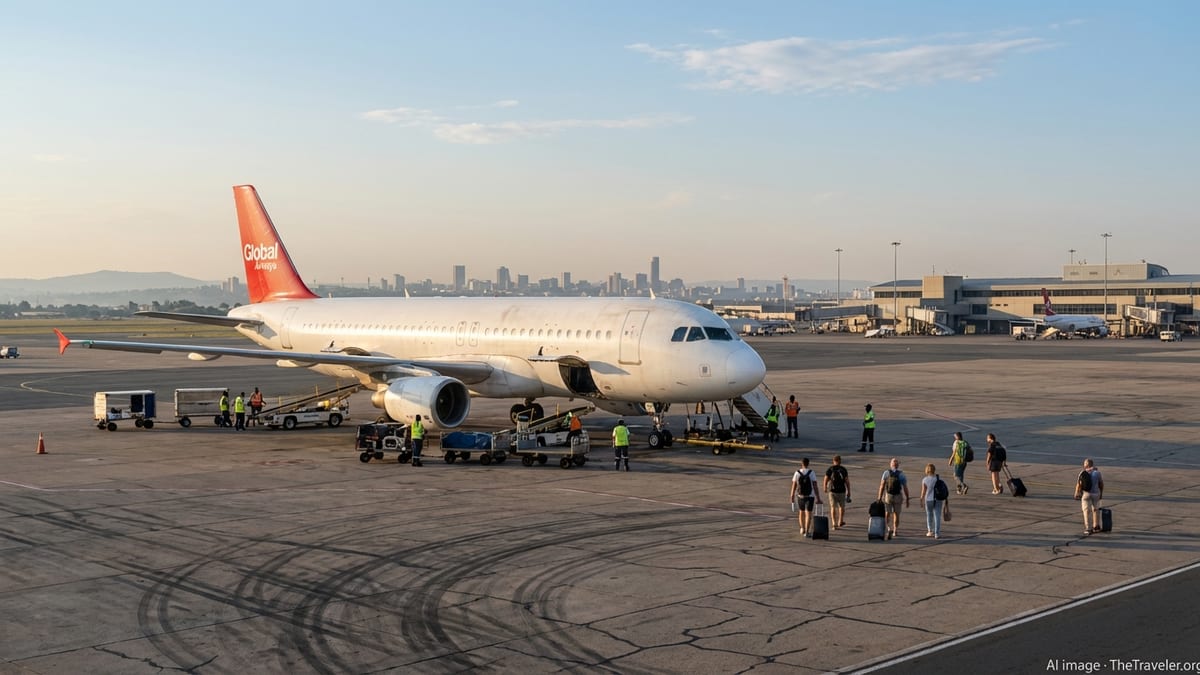
Investec Corporate & Investment Bank confirmed this week that it has structured and financed an Airbus A320 for South Africa’s Global Airways, deepening the bank’s presence in aviation while equipping the carrier with a highly adaptable workhorse aircraft. The transaction, which closed in December 2025 and was announced on 18 February 2026, positions the A320 at the heart of a dual strategy that spans both South African scheduled services and international wet lease operations.
Rather than a conventional one-off loan, Investec has created a scalable master facility that can support additional aircraft in future. For Global Airways, that structure is designed to align with the airline’s asset-light, opportunity-driven growth model, enabling it to add capacity quickly when new tourism or charter opportunities arise, without the long lead times or heavy balance-sheet commitments associated with outright purchases.
The new A320 joins what is already one of Sub-Saharan Africa’s largest privately owned Airbus fleets, operated from Johannesburg’s O. R. Tambo International Airport. Global Airways has steadily built its position as a specialist in Airbus narrowbodies and widebodies, and the latest aircraft is expected to play a central role in servicing both tourism flows into South Africa and outbound leisure demand during the Northern Hemisphere summer.
Executives on both sides describe the arrangement as a relationship-driven partnership rather than a one-off equipment deal. Investec brings deep aviation finance expertise and a growing portfolio of transactions with carriers across Africa and beyond, while Global Airways contributes operational know-how, an established maintenance arm, and a proven ability to swing aircraft between markets as demand shifts.
Seasonal Flexibility to Match Tourism Demand
At the heart of the partnership is a clear ambition to better match aircraft capacity to tourism demand, both within South Africa and on routes feeding the country’s key gateways. Global Airways has built its model around seasonal deployment, operating in Europe and other markets during their peak summer months, then pivoting aircraft back to Southern Africa as inbound holiday travel to Cape Town, Durban and safari gateways rises.
The A320 financed by Investec is structured to move seamlessly between Global Airways’ own-brand operations and services flown for its associated low cost carrier, LIFT, as well as charter and wet lease missions for third-party airlines. That flexibility is critical in a region where demand can be highly concentrated around holiday periods, school breaks and major events, yet fixed schedules and limited fleets can leave gaps in connectivity.
Industry analysts say the ability to swing one narrowbody between European leisure routes in July and August and South African domestic and regional services during the Austral summer is exactly the kind of utilisation play that African carriers will need to remain profitable as traffic grows. By sustaining high year round usage of the aircraft, Global Airways can keep unit costs competitive while still supporting tour operators and tourism boards with extra capacity during spikes.
For South Africa’s travel sector, that means more options to add flights on high-demand days, launch short seasonal routes, or run dedicated charters tied to safari packages, wine tourism and coastal holidays. In practice, tourism operators gain access to a modern, 150 to 180 seat Airbus configured for quick turnarounds, without having to assume the risk and complexity of sourcing an aircraft themselves.
LIFT, Charters and New Tourism Corridors
The Global Airways and Investec deal arrives as South African tourism stakeholders push to open new corridors and restore connectivity lost during the pandemic. Through its role as the operating partner behind LIFT, Global Airways already flies scheduled services on trunk routes such as Johannesburg to Cape Town and Durban, which serve both domestic travelers and international visitors using South African hubs as gateways.
LIFT’s network itself is edging into more tourism-focused territory, with plans to add Saint Pierre in Réunion as a new international destination from February 2026. The added Airbus A320 capacity supported by Investec gives Global Airways greater freedom to move aircraft between the LIFT schedule and charter operations, supporting offshore leisure markets that feed into South Africa’s hotels, attractions and regional circuits.
Beyond scheduled services, Global Airways is also involved in emerging charter projects designed to stimulate tourism directly. The carrier is finalising a charter arrangement providing an A320 for seven day package holidays linking Réunion and Durban’s King Shaka International Airport, backed by local tourism agencies and airport stakeholders. While the exact aircraft assigned has yet to be named, the availability of a freshly financed A320 with modern economics makes such ventures easier to structure and price.
These niche tourism corridors matter for regional economies such as KwaZulu Natal, which has long argued that better air access is the single most important factor in growing its visitor base. In that context, a single narrowbody equipped and financed to swing between regular routes and bespoke holiday charters can have an outsized impact, creating the conditions for tour operators to test demand and scale up if routes prove successful.
Why the Airbus A320 Matters for South Africa
Choosing the Airbus A320 as the asset at the centre of the Investec and Global Airways partnership reflects both the aircraft’s global ubiquity and its specific fit for South African market conditions. The type is already flown by several airlines in the country, which supports a robust ecosystem of pilots, engineers and spare parts, and allows Global Airways to leverage its Part 145 approved maintenance organisation, Global Aerotech, for efficient in house servicing.
From a tourism perspective, the A320 offers the right mix of range and capacity for most of the point to point links that matter. It can comfortably connect Johannesburg or Durban with Réunion, Mauritius, Victoria Falls and Walvis Bay, as well as serve busy domestic sectors where demand often surges on Friday and Sunday evenings. In a single cabin, the aircraft can be set up with around 180 seats, or in a mixed configuration with a small business class cabin for higher yielding leisure and corporate travelers.
The economics of a well utilised A320 are another crucial factor. With fuel efficiency and maintenance costs that compare favourably to older narrowbodies still flying in parts of Africa, the aircraft allows operators to price tickets competitively without eroding margins. That in turn supports the affordability of package holidays and regional getaways for a growing middle class in South Africa and neighbouring markets.
Equally important is passenger perception. Travelers from Europe, North America and Asia are often reassured to see familiar Airbus types when connecting onwards within Africa, particularly after long haul flights. Global Airways’ modern Airbus fleet, now strengthened by the Investec financed A320, helps reinforce South Africa’s image as a destination with contemporary aviation infrastructure and internationally benchmarked safety and service standards.
Investec Deepens Its Footprint in African Aviation
For Investec, the Global Airways transaction underscores a deliberate strategy to expand its aviation finance franchise, particularly across Africa’s fast growing but still under served airline sector. The bank has been active in structuring facilities for regional and narrowbody aircraft, arguing that these smaller jets and turboprops are the backbone of connectivity in emerging markets where long haul volumes remain limited but intra regional demand is rising.
Recent deals include support for carriers in Europe, the Caribbean and across Africa, as well as financing packages for specialist lessors. The Global Airways A320 stands out, however, because of its explicit seasonal deployment model and the clear linkage to South African and regional tourism. The facility includes an interest rate swap and tailored banking support to help the airline manage volatility in both funding costs and foreign exchange.
Investec’s aviation team, headquartered in Johannesburg with additional presence in London and New York, positions itself as a partner able to understand regulatory environments and risk profiles on both sides of the equator. By backing an operator that straddles European and African markets, it hopes to demonstrate that Africa focused aviation finance can be both commercially attractive and developmentally significant.
Within South Africa, the move also sends a signal that domestic banks are willing to back homegrown airlines with international ambitions, provided they bring disciplined fleet strategies and strong counterparties to the table. That message could prove important as the country looks to grow its tourism arrivals and airport infrastructure in the coming decade.
Tourism Growth Projections Put Aviation in the Spotlight
The timing of the Global Airways and Investec partnership aligns with bullish long term forecasts for African air travel. The International Air Transport Association expects passenger volumes across the continent to more than double by the early 2040s, potentially reaching around 400 million annual journeys. For South Africa, which remains one of the continent’s most diversified tourism destinations, that growth presents both an opportunity and a challenge.
On one hand, rising incomes in major source markets such as Nigeria, Kenya and Ethiopia, along with stabilized demand from Europe and North America, could fuel a steady stream of visitors to South African cities, game reserves and wine regions. On the other, bottlenecks in airport capacity, limited fleets and constrained balance sheets at key carriers risk leaving demand either unmet or diverted through competing hubs in the Gulf and elsewhere.
In that context, aircraft like the Investec financed A320 can act as pressure valves, injected where and when they are most needed to keep routes viable and frequencies attractive. Seasonal charters, additional weekend rotations and short lived experimental routes become easier to justify when the capital cost of the aircraft is spread across multiple geographies and contracts, as in Global Airways’ ACMI focused model.
Tourism boards and destination marketing organisations increasingly see access to flexible aviation capacity as a prerequisite for winning new routes and convincing airlines to commit to secondary cities. Having a South African operator able to deploy a modern narrowbody at short notice therefore adds weight to pitches for events, conferences and curated travel itineraries that hinge on reliable air links.
Implications for Competing Carriers and the Wider Market
The deal is also being watched closely by other South African and regional carriers, some of which already rely on leasing and chartered capacity from Global Airways. By securing a scalable financing platform with Investec, Global positions itself as an even more capable provider of wet lease and charter solutions to airlines needing additional seats without long term commitments.
Competitors may feel pressure to refresh their own fleets or to seek similar partnerships with financiers comfortable taking African operating risk. The prevalence of Airbus narrowbodies among South African Airways, LIFT and other domestic players suggests that further A320 transactions could follow if demand recovers in line with forecasts and if financing remains accessible.
There are potential ripple effects for airports and ground handlers as well. Additional A320 movements through Johannesburg, Cape Town and Durban translate into higher passenger volumes, more retail and hospitality revenue and stronger cases for infrastructure upgrades. Secondary airports hoping to attract seasonal services, such as those serving coastal or safari regions, may also benefit from the presence of an operator able to rotate aircraft in and out of small markets with relative ease.
For travelers, the impact is likely to be felt most immediately in the form of new flight options and potentially sharper pricing on certain routes. Over time, as tour operators gain confidence that they can access modern aircraft for package deals and new itineraries, the range of combined air and land products on offer within South Africa and its neighbours could expand significantly.
A Test Case for Aviation Led Tourism Development
Ultimately, the Global Airways and Investec Airbus A320 partnership is being viewed as a test case for how targeted aviation finance can support tourism growth in a country where travel is a major contributor to jobs and export earnings. By anchoring the financing in a flexible, cross seasonal deployment model, the parties aim to squeeze more value out of a single asset than would be possible if it were locked into one market.
If the strategy succeeds, it could set a template for additional aircraft financed under similar terms, whether for Global Airways itself or for other carriers willing to adopt an agile, tourism oriented approach. The A320 at the centre of this transaction will not single handedly transform South African tourism, but it encapsulates a broader shift towards smarter, more responsive use of aviation capacity in a region where every additional seat can help unlock new journeys.
For now, the aircraft stands as a tangible symbol of confidence in South Africa’s tourism rebound. With banks, airlines, airports and destination marketers increasingly aligned around the need for flexible, reliable lift, the Global Airways and Investec partnership offers a concrete example of how financial engineering and fleet strategy can intersect to keep visitors, and the wider economy, moving.