

More news on this day
Major Gulf and international airlines are grappling with rolling flight cuts, diversions and capacity reductions affecting Dubai and the wider United Arab Emirates, as conflict-related airspace closures and safety restrictions continue to reshape global travel patterns well into May.
Get the latest news straight to your inbox!
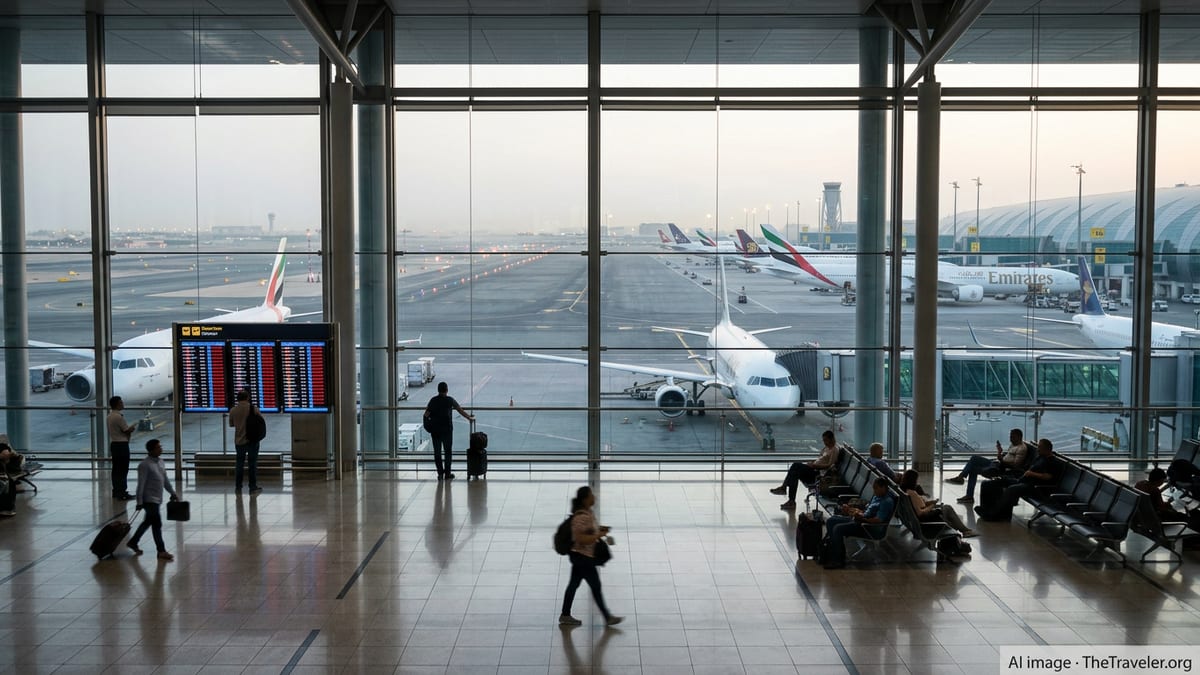
Conflict Fallout Reshapes Middle East Aviation Map
Publicly available information indicates that the latest wave of disruption was triggered in late February, when strikes linked to the Iran-Israel conflict prompted widespread airspace closures across the Gulf region. Coverage from international news agencies describes hundreds of thousands of travelers stranded as key hubs in Dubai, Abu Dhabi and Doha briefly shut to traffic, forcing mass cancellations and diversions on routes linking Europe, Africa and the Americas with Asia.
Dubai International Airport, normally one of the world’s busiest gateways for long-haul connections, saw scheduled services sharply curtailed as airlines reassessed flight paths around conflict zones. Analysts tracking aviation data report that more than 1,800 flights operated by major Middle Eastern carriers were cancelled in the initial days of the crisis, with knock-on effects lasting for weeks across global networks.
While operations in the Gulf have partially resumed, travel industry observers note that the combination of damaged infrastructure, restricted airspace and insurance concerns has left the region’s aviation sector operating under constraints not seen since the height of the pandemic. The result is a patchwork of suspensions, reroutings and reduced schedules that continue to affect passengers planning to travel through Dubai deep into the northern spring.
Emirates and flydubai Run Reduced Schedules Through May
Emirates, the largest carrier at Dubai International, has progressively rebuilt its schedule since the late February shock, but traffic remains significantly below pre-crisis levels. Specialist aviation outlets tracking daily operations estimate that Emirates is currently running at around 70 percent of its typical capacity, with approximately 145 to 150 departures a day from Dubai, compared with more than 200 in normal times.
Budget sister airline flydubai, which concentrates on regional and medium-haul routes, is reported to be operating at roughly 40 percent of its previous schedule. Data compiled by independent flight tracking services suggests that the two airlines together are delivering around 60 percent of their combined pre-conflict capacity from Dubai, a level that has remained broadly unchanged since mid-March.
Travel advisories published in early April indicate that both carriers are maintaining flexible policies for affected passengers, including options to rebook or seek refunds when flights are cancelled or heavily rerouted. Industry commentary suggests these concessions are likely to remain in place for several more weeks, with some projections indicating a gradual return toward normal schedules only from the second half of May, contingent on regional security assessments.
Foreign Airlines Pull Back as Restrictions Hit Dubai Access
One of the most striking developments for international travelers has been the sharp pullback by non-Gulf carriers from the Dubai market. According to aviation analysis sites, a temporary ban on certain foreign airlines at Dubai International, introduced as part of broader security and traffic-management measures, has pushed several major brands to suspend or reroute services.
Reports indicate that Lufthansa Group carriers, SWISS, British Airways, Singapore Airlines and others have faced particular challenges maintaining their usual patterns of flights into Dubai. Many services that once funneled passengers directly into the emirate are being redirected through alternative hubs such as Abu Dhabi or Doha, or temporarily suspended, in what some commentators describe as a “de facto global halt” in direct connectivity on specific city pairs.
For travelers, the impact is most visible in reduced seat availability and longer, more circuitous routings. Itineraries that previously relied on a single stop through Dubai now often require additional connections or overnight layovers elsewhere in the region. Pricing data shared by online travel agencies points to higher average fares on remaining services into the UAE, particularly during peak travel periods in April and May.
Etihad, Air Arabia and Regional Networks Under Strain
The disruption is not confined to Dubai. Etihad Airways, based in Abu Dhabi, and low-cost operator Air Arabia, which serves multiple UAE airports, have also implemented schedule changes as they adjust to shifting demand and airspace constraints. Travel advisories show that Etihad is offering free rebooking or refunds on tickets issued for travel spanning late February into mid-April, with flexibility extended for journeys rebooked through mid-May.
Air Arabia, which connects secondary cities across the Middle East, North Africa and South Asia, has trimmed frequencies on several routes while keeping limited links open to key cities in India, Pakistan, Saudi Arabia and Egypt. Industry observers say these pared-back services are helping to maintain essential connectivity for workers and families, even as discretionary and business travel falls sharply.
Neighboring hubs such as Doha and Riyadh are also seeing altered traffic flows as airlines redistribute capacity. Some carriers are adding temporary flights to these airports to compensate for reduced access to Dubai, while others are using them as staging points for rerouted services around restricted airspace. The overall effect is a fragmented regional network that remains vulnerable to further changes in the security environment.
Passenger Experience: Longer Journeys and Lingering Uncertainty
For passengers, the current situation translates into a more unpredictable travel experience to and through Dubai. Travelers report longer journey times as flights detour around closed corridors and as connections shift from Dubai to other regional hubs. Even when flights operate as scheduled, tighter capacity means that last-minute availability is limited and economy cabins are frequently full.
Consumer advocacy groups and travel agents are advising passengers to build in additional buffers for transit through the Gulf, recommending longer connection windows and, where possible, fully flexible tickets. Publicly available commentary from the sector highlights the importance of checking flight status multiple times before departure, as last-minute cancellations and equipment changes remain more common than usual.
With airlines, airports and regulators signaling that current patterns may persist until at least the end of May, the expectation is that Dubai’s role as a seamless global super-hub will remain constrained in the near term. Industry analysts suggest that a full restoration of the intricate web of routes linking Emirates, flydubai, Etihad, Air Arabia and major foreign partners will depend not only on operational readiness, but also on a sustained reduction in geopolitical risk across the wider region.