

More news on this day
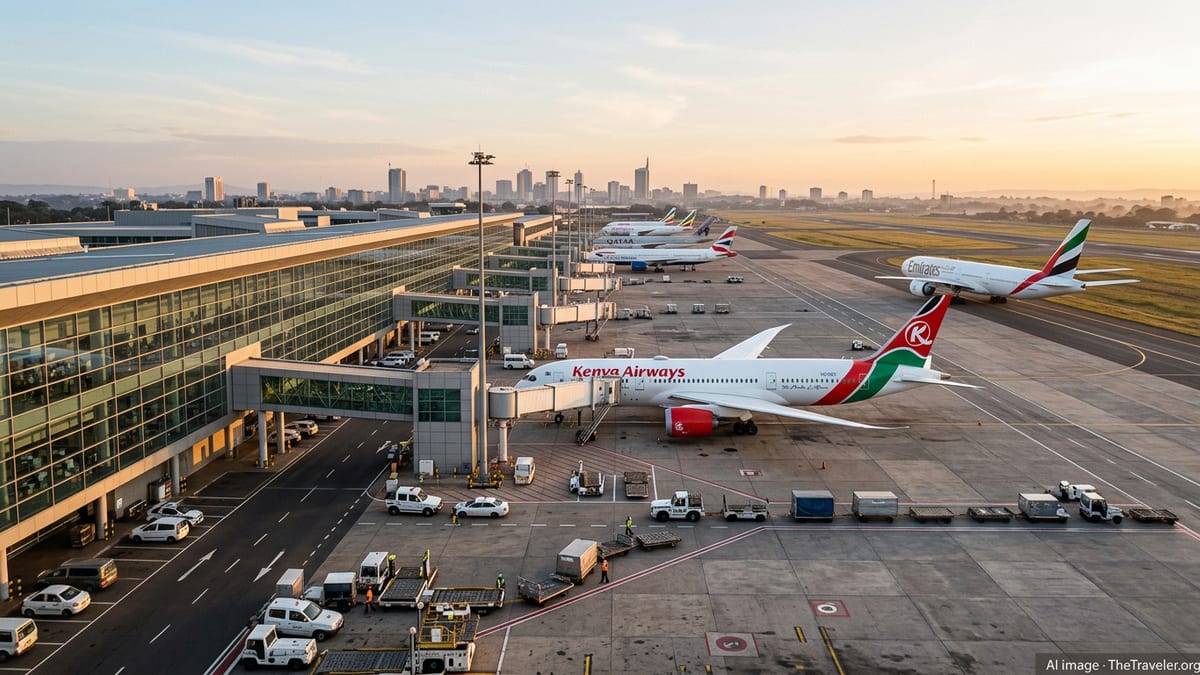
Nairobi’s Jomo Kenyatta International Airport is emerging as one of Africa’s most hotly contested hubs, as Emirates joins Kenya Airways, Lufthansa, Qatar Airways and Ethiopian Airlines in expanding services into the Kenyan capital just as the airport rolls out a new generation of self-service and digital passenger systems.
Get the latest news straight to your inbox!
Major Airlines Boost Capacity into Nairobi
The competitive landscape on routes into Nairobi is intensifying as global and regional carriers add frequencies, adjust schedules and deepen partnerships. Publicly available schedules and airline statements show Emirates maintaining regular Dubai–Nairobi services while rivals including Qatar Airways, Lufthansa and Ethiopian Airlines continue to build their networks into Kenya’s main gateway.
Kenya Airways is also reshaping its long-haul portfolio from its Nairobi base, including new and adjusted services to London and key Asian destinations. Industry route reports indicate that additional capacity into Nairobi is being deployed to capture growing demand from business travelers, leisure tourists and diaspora communities across Europe, the Middle East and Asia.
For passengers, the result is a wider choice of one-stop connections between Nairobi and major global hubs such as Dubai, Doha, Frankfurt and Addis Ababa. Aviation analysts note that this cluster of major carriers on overlapping corridors is turning Nairobi into one of the most competitive markets for East Africa–global traffic.
Partnerships and Network Strategies Reshape Connectivity
The latest moves into Nairobi are not limited to standalone route launches. Kenya Airways and Qatar Airways have strengthened their codeshare cooperation in recent months, broadening access to destinations beyond both Nairobi and Doha. Published information on the partnership shows expanded options for travelers heading from East Africa into the Gulf, Asia and parts of Europe via Qatar Airways’ network, while Qatar passengers gain easier access to secondary African cities via Kenya Airways services.
Star Alliance member Lufthansa, which already serves Nairobi from its Frankfurt hub, is using Nairobi as part of a broader Africa strategy that positions the German carrier to tap premium corporate and leisure demand. Ethiopian Airlines, meanwhile, continues to channel traffic between East, West and Southern Africa through Addis Ababa, linking onward to Nairobi as part of a dense intra-African network that feeds long-haul flights.
Emirates’ continued presence on the Dubai–Nairobi route keeps competitive pressure high on fares and schedules between the Gulf and Kenya. Together with other Gulf and African network carriers, the airline is helping to transform Nairobi from a predominantly point-to-point market into a more complex transfer hub, where passengers mix local origin-and-destination traffic with regional and intercontinental connections.
JKIA’s Push for Self-Service and Digital Processing
At the same time that airlines intensify their operations, Jomo Kenyatta International Airport is undergoing a significant modernization of its passenger processing systems. Government announcements and airport planning documents describe a shift toward self-service check-in, automated bag-drop facilities and greater use of biometric technologies at security and immigration checkpoints.
Authorities have outlined plans to digitize passenger flows from curb to gate, reducing paperwork and enabling more processes to be handled via kiosks and mobile devices. These measures are intended to cut queues, reduce manual document checks and improve on-time departures, addressing longstanding complaints about congestion and bottlenecks during peak travel periods.
Investment is also being directed toward baggage handling upgrades and the reconfiguration of terminal spaces to handle higher passenger volumes more efficiently. Industry observers note that these improvements are critical as traffic through JKIA edges closer to existing capacity limits and as Kenya pursues its ambition to position Nairobi as a top-tier African aviation hub.
Game-Changing Impact for Passengers and Airlines
The combination of new airline capacity and self-service infrastructure is expected to reshape the travel experience through Nairobi in the coming years. With more flights operated by Emirates, Kenya Airways, Lufthansa, Qatar Airways and Ethiopian Airlines, passengers gain additional departure times, increased seat availability and more competitive pricing across cabins.
As self-service kiosks and automated systems scale up at JKIA, the airport aims to shorten check-in and boarding times, enabling travelers to spend less time in queues and more time in airside facilities. For airlines, faster processing can support tighter connection windows, better aircraft utilization and more reliable schedules, all of which are key to attracting time-sensitive corporate traffic.
Aviation analysts point out that digitalization can also bolster security and regulatory compliance by standardizing identity checks and data capture. When combined with enhanced coordination between airport agencies and ground handlers, these systems can reduce the risk of operational disruption during peak seasons or irregular operations.
Nairobi’s Rising Role in Africa’s Aviation Network
The latest wave of route adjustments and infrastructure upgrades underscores Nairobi’s evolving role within Africa’s aviation map. The city already benefits from strong regional road links and dedicated highway infrastructure connecting JKIA to central Nairobi, and it sits at the crossroads of key north–south and east–west air corridors across the continent.
With Emirates, Qatar Airways, Lufthansa, Ethiopian Airlines and a revitalizing Kenya Airways all investing in services to Nairobi, the Kenyan capital is becoming more deeply integrated into global traffic flows. This positions JKIA as both a gateway for inbound tourism to Kenya’s safari, beach and business destinations and as a strategic transfer point for itineraries that connect different parts of Africa to the wider world.
Industry watchers will be tracking how quickly JKIA’s self-service and digital systems scale up, and how airlines adjust schedules and capacity in response to passenger demand. If current plans are fully realized, Nairobi could emerge from the current expansion cycle as one of Africa’s most efficient and competitive hubs, supported by a broad lineup of global and regional carriers and a more seamless airport experience.