

More news on this day
Major international and regional airlines serving Nigeria are reworking capacity and fares on key UK, US, Saudi Arabia and Ghana routes as naira volatility, high operating costs and shifting demand patterns turn the country into one of aviation’s most complex investment markets.
Naira Volatility Reshapes Airline Profitability Calculus
The sharp depreciation of the naira over the last two years and its subsequent fragile stabilisation have fundamentally altered the economics of flying to and from Nigeria. While the Central Bank of Nigeria’s currency reforms and improved foreign exchange liquidity in 2025 have eased some pressure, airlines still price tickets and settle major costs in dollars, magnifying the impact of any exchange rate movement on local passengers and on carrier balance sheets.
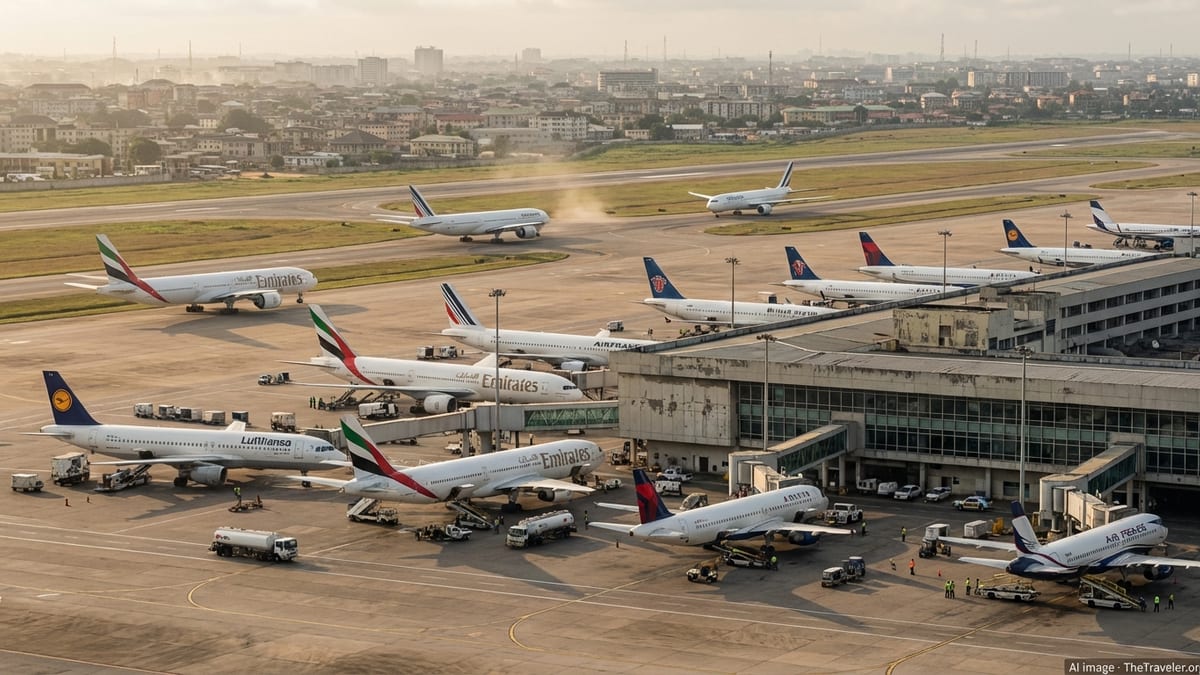
For global players such as Emirates, British Airways, Delta Air Lines, Qatar Airways, United Airlines and Lufthansa, Nigeria remains a strategically important but high risk market. Revenue earned in naira must be converted back into hard currency at uncertain rates, complicating yield management and long term planning. Airlines and aviation analysts say the investment case now hinges less on raw demand and more on how consistently they can repatriate funds and hedge currency exposure over multiple seasons.
The picture is further clouded by Nigeria’s broader macroeconomic headwinds. Persistent inflation and higher borrowing costs are squeezing household and corporate travel budgets, reducing the pool of passengers able to absorb record high international fares. Carriers are increasingly forced to balance schedule presence and brand visibility against thin margins on some long haul sectors, particularly to London, New York, Atlanta and key Middle Eastern hubs.
Industry executives argue that while recent policy moves have reduced the risk of a new backlog of trapped funds, volatility remains a structural concern. Many airlines are therefore retaining flexibility in their Nigeria strategies, keeping aircraft deployment, schedules and fare structures under constant review instead of locking in multi year growth plans.
UK and US Routes Under Pricing and Capacity Pressure
Routes linking Lagos and Abuja with London, New York, Atlanta, Washington and other transatlantic gateways illustrate the new tension between demand and affordability. Fares on Nigeria to UK services have risen sharply in dollar and naira terms, partly reflecting higher fuel and leasing costs but also airlines’ need to protect yields against currency risk. Travel agents report that some economy return tickets from Lagos to London now cost significantly more than comparable itineraries from neighbouring West African capitals, pushing price sensitive travellers to route via Cotonou or Accra when visas and schedules allow.
British Airways, Virgin Atlantic and other UK bound carriers have focused on revenue quality rather than volume, concentrating capacity on peak travel periods while trimming less profitable shoulder season flights. US carriers, led by Delta Air Lines and United Airlines, have taken a similarly cautious approach on Nigeria services to Atlanta, New York and other hubs, upgauging or downgauging aircraft and adjusting frequencies to match a market where corporate demand is uneven and leisure traffic has been dented by economic hardship and tighter visa regimes.
Local officials and tourism stakeholders worry that sustained high fares and reduced seat availability could erode Nigeria’s connectivity to two of its most important trade and diaspora markets. However, airlines point to persistently elevated operating costs at Nigerian airports, limited overnight parking and maintenance facilities and exposure to foreign exchange swings as reasons why aggressive expansion on UK and US routes is unlikely in the near term.
Some carriers are quietly betting on a gradual recovery in outbound business travel if macroeconomic stability holds and reforms deepen. Yet few are willing to add significant new long haul capacity until they see stronger evidence that consumer purchasing power and corporate travel budgets are recovering from the shock of the last two years.
Gulf and Saudi Markets Weigh Pilgrimage, Labour and Investment Flows
For Emirates and Qatar Airways, Nigeria is both a point to point market and a critical spoke feeding their global networks through Dubai and Doha. Currency turbulence has raised the bar for profitability, but strong flows to Asia, the Middle East and North America via Gulf hubs continue to underpin demand. These carriers have leaned on sophisticated revenue management and flexible aircraft deployment to keep Nigerian operations viable while navigating foreign exchange constraints and shifting passenger preferences.
Saudi Arabia routes add a further layer of complexity. Traffic from Nigeria to Jeddah and Medina is highly seasonal, driven by Hajj and Umrah pilgrimages, as well as labour migration and religious tourism. Airlines rely on intensive peak season flying to balance weaker off peak performance, making them acutely sensitive to any policy or exchange rate changes that alter package prices for Nigerian pilgrims.
Operators serving Saudi destinations, including regional carriers and charter specialists, have had to reprice packages several times in response to naira movements and rises in aviation fuel. Nigerian authorities, under pressure to keep pilgrimage costs manageable, have engaged airlines and tour operators in negotiations aimed at smoothing extreme price swings, but outcomes vary season by season.
Against this backdrop, Gulf carriers are closely watching Nigeria’s reform trajectory. A more predictable currency regime and improved airport infrastructure could support a return to pre crisis capacity levels and even new routes. If volatility persists, however, they are expected to prioritise flexibility, keeping spare aircraft deployable across more stable markets while retaining only the most profitable Nigerian frequencies.
Regional Competition Intensifies on Ghana and West Africa Links
Nigeria’s aviation turbulence is also reshaping competition on short haul West African routes, particularly links to Ghana. Air Peace, which has positioned itself as a leading Nigerian and regional carrier, has been steadily building its presence on Lagos to Accra and other regional sectors even as it pushes into longer haul markets such as London. Ghana’s relative macroeconomic stability and growing role as a hub for multinational firms give airlines an incentive to link Nigerian cities with Accra, but price sensitivity on these routes is acute.
International carriers like Ethiopian Airlines and Qatar Airways, which use West African points as feed into their global networks, are also recalibrating their strategies. Some have maintained or even expanded frequencies to Nigeria, betting that connecting traffic from across the region can offset domestic headwinds. Others are subtly shifting capacity to alternative West African gateways where yields are more predictable and local currencies less volatile.
Competition with Ghanaian and other regional airlines is heating up as they attempt to capture travellers deterred by higher Nigerian international fares. Travel consultants say some passengers now originate itineraries in Accra for long haul flights, taking advantage of more stable pricing and sometimes lower taxes, even if it means an additional short haul leg.
This dynamic risks eroding Nigeria’s position as a natural aviation hub for West Africa. Unless its cost environment and currency risk profile improve, more traffic could be intermediated through neighbouring countries, diluting the value proposition for global airlines that have historically treated Lagos and Abuja as anchor points for their regional strategies.
Policy Uncertainty Keeps Long Term Investment Plans on Hold
Behind the tactical schedule changes and fare adjustments, airlines are wrestling with a deeper question: whether Nigeria offers a reliable long term platform for investment. Plans for new routes, larger aircraft and joint ventures typically rely on a clear view of future foreign exchange rules, aviation taxes, regulatory stability and infrastructure development. In Nigeria, many of these variables remain in flux.
Executives at several international airlines privately describe a cautious wait and see stance. They welcome signs that foreign exchange backlogs have eased and that the naira has traded within a narrower band this year, but they are wary of potential policy reversals or further devaluations that could erode hard won gains. Some are therefore prioritising asset light strategies, such as code shares and interline agreements with Nigerian and regional partners, over direct capital intensive expansion.
For Nigerian carriers like Air Peace, the environment is equally challenging. While currency depreciation can make their services more price competitive in dollar terms on certain routes, they still face heavy dollar obligations for aircraft leases, maintenance and insurance. This narrows the room for error as they attempt to scale up international operations to the UK, US, Saudi Arabia and Ghana against a backdrop of weak consumer purchasing power at home.
Industry analysts say Nigeria’s ability to retain and attract airline investment will depend on a combination of sustained macroeconomic stability, transparent foreign exchange policies and a concerted push to tackle structural cost drivers such as aviation fuel pricing and airport charges. Without that, Emirates, British Airways, Delta, Ethiopian Airlines, Qatar Airways, United Airlines, Lufthansa and their regional counterparts are likely to continue treating Nigeria as a volatile but unavoidable market, managed with caution rather than embraced as a growth engine.