

More news on this day
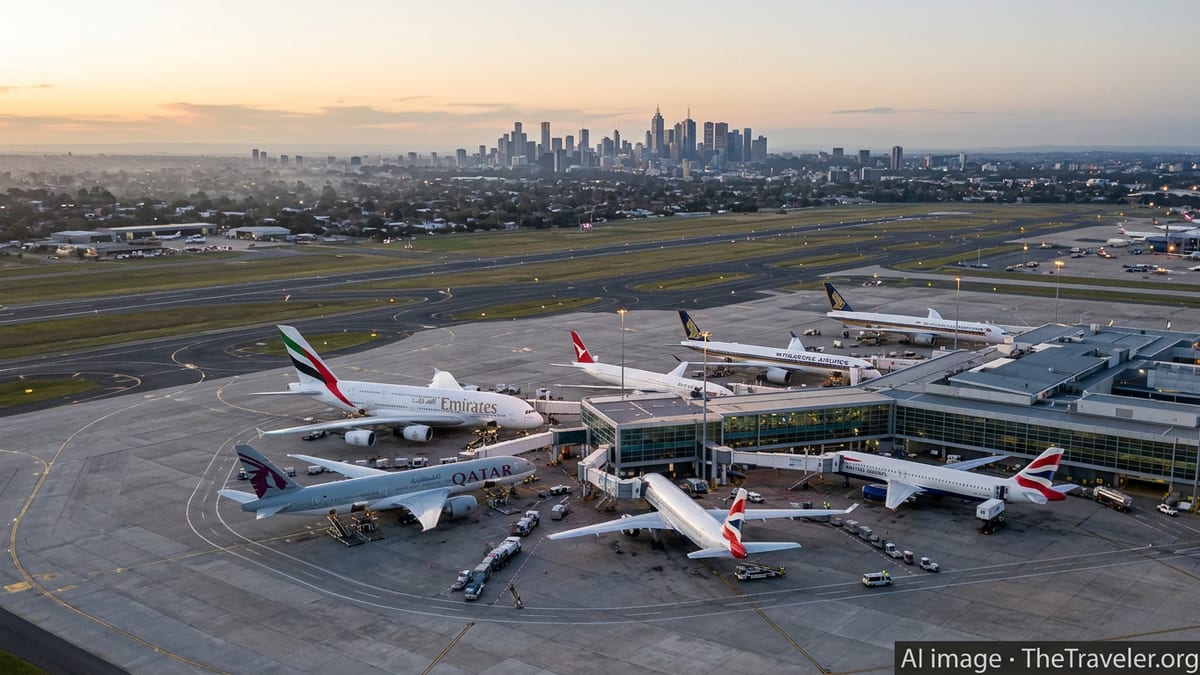
Fresh capacity moves by British Airways, Emirates, Qatar Airways and Singapore Airlines are sharpening global focus on Melbourne, setting up Australia’s cultural capital for a pronounced surge in international tourism and hotel demand through 2025 and 2026.
Get the latest news straight to your inbox!
Middle East and Asian Hubs Tighten Connectivity Into Melbourne
Publicly available airline schedules and industry analyses show that long-haul hubs in Dubai, Doha, Singapore and London are steadily restoring and, in some cases, expanding connectivity to Melbourne. Emirates has rebuilt its Australian operations to near pre-pandemic levels and has shifted capacity to nonstop Dubai–Melbourne services, including a third daily flight in place of its former Singapore–Melbourne tag, increasing the number of direct seats into Victoria’s capital.
Qatar Airways is also deepening its footprint in the Australian market. After a period of constrained growth, the carrier has focused on strengthening access via partnerships rather than solely through its own metal. A new phase begins as Qatar Airways and Virgin Australia coordinate daily Melbourne–Doha services, creating more one-stop options from Europe, the Middle East and Africa into Melbourne through the Doha hub.
Singapore Airlines, already one of the largest foreign carriers in Australia, continues to treat Melbourne as a core long-haul gateway. The airline has progressively rebuilt frequencies between Singapore and major Australian cities, with public financial and network updates indicating sustained demand on Melbourne routes and the use of larger widebody aircraft during peak seasons. More direct and flexible routings across Southeast Asia and the Pacific are trimming flying times, making Melbourne more attractive for stopover and multi-destination itineraries.
Across the network, these developments mean Melbourne is increasingly embedded in a global web of high-frequency trunk routes. For international travelers, particularly from Europe, India and Southeast Asia, it is becoming simpler to reach Melbourne on a single ticket with competitive connection times and growing premium-cabin availability.
British Airways Taps Long-Haul Demand Into Australia
While British Airways does not currently operate nonstop flights to Melbourne, publicly available booking data and industry commentary suggest the carrier is leveraging partner networks and one-stop links through hubs such as Singapore and Doha to feed traffic into Victoria. British Airways Holidays’ latest travel trend reporting points to strong UK interest in long-haul journeys combining urban culture, food and nature, a profile that closely matches Melbourne and wider Victoria.
Melbourne benefits from its position on popular round-the-world and multi-stop itineraries used by British and European travelers. As British Airways rebuilds and refines capacity to key Asian and Middle Eastern hubs served by Emirates, Qatar Airways and Singapore Airlines, the practical effect for Melbourne is a thicker pipeline of connecting passengers. Travel packages sold in the UK increasingly pair city stays with coastal drives or wine regions, and Melbourne’s easy access to the Great Ocean Road, Yarra Valley and Mornington Peninsula aligns with these patterns.
Tourism forecasters note that pent-up demand among UK travelers for extended, experience-led trips is flowing into Australia as air connectivity improves and visa processes remain relatively straightforward. With more seamless through-ticketing across alliances and partnerships, British Airways can route a greater share of these high-yield passengers into Melbourne on codeshare services operated by its Gulf and Asian partners.
This indirect presence still has tangible consequences for Melbourne’s visitor economy. Higher-spending long-haul guests, staying longer and booking premium rooms, are particularly valuable for hotels, fine-dining venues and cultural attractions seeking to diversify beyond domestic demand.
Melbourne Airport Expansion and Capacity Surge Support Tourism Growth
Recent specialist travel trade coverage highlights that Melbourne Airport is in the midst of a multi-billion-dollar expansion designed to accommodate rising international traffic. Industry reports reference a pipeline of terminal, runway and ground-transport upgrades intended to increase capacity and improve connectivity between international and domestic operations.
Carriers such as Emirates, Qatar Airways and Singapore Airlines are among the primary beneficiaries of this infrastructure growth, as they concentrate widebody operations and schedule banks around peak connection waves. Additional gates for large aircraft, improved baggage systems and more efficient security and border processing are expected to reduce turnaround times and support higher frequencies.
For tourism operators, these changes translate into more predictable arrival patterns and larger cohorts of visitors landing during the same time windows, which can be crucial for tour departures, event scheduling and cruise turnarounds. Increased capacity also provides state and city marketing bodies with a stronger platform to negotiate cooperative campaigns with airlines, as there are more seats to fill and more inventory to package with hotels and experiences.
Analysts point out that Melbourne’s growing role as a secondary hub for travel across the Tasman Sea, to other Australian cities and into the Pacific also multiplies the impact of new long-haul capacity. International visitors arriving on British Airways, Emirates, Qatar Airways or Singapore Airlines tickets may use Melbourne as a base, radiating out to regional Victoria and beyond before returning for city stays.
Hotels, Restaurants and Events Prepare for Higher International Spend
The hospitality sector in Melbourne and across Victoria is already reacting to the prospect of sustained international growth. Industry publications and local market reports describe an active hotel investment pipeline, with new-build properties, branded conversions and luxury refurbishments concentrated around the central business district, Docklands and key precincts near the airport and convention center.
Higher airline capacity from global carriers typically correlates with increased demand for upscale and luxury accommodation, as long-haul travelers often prioritize comfort and convenience. Market analysts expect city-center hotels to benefit from corporate and conference traffic channeled through these carriers’ global sales networks, while boutique properties in inner suburbs anticipate more leisure guests drawn by Melbourne’s food, coffee and arts scenes.
Restaurants and bar operators are also positioning for a busier international calendar. Melbourne’s reputation as a culinary capital means that inbound visitors frequently seek local dining experiences soon after arrival. As load factors rise on premium cabins operated by Emirates, Qatar Airways, Singapore Airlines and codeshare partners of British Airways, hospitality businesses expect a greater share of customers willing to spend on chef-led tasting menus, regional wine lists and experiential dining.
Major events, from sporting tournaments to arts festivals, stand to gain from the enhanced air access. Improved connectivity and schedule choice make it easier for overseas visitors to align travel dates with marquee events, extending average length of stay. Tourism analysts suggest that successful coordination between airlines, event organizers and hotel groups could help spread demand beyond traditional peaks, smoothing occupancy patterns and strengthening year-round employment.
Competitive Fares and Changing Passenger Behaviour Shape the Outlook
Competition among British Airways, Emirates, Qatar Airways, Singapore Airlines and other long-haul carriers funnelling traffic into Melbourne is also influencing airfare dynamics and traveler behaviour. Economic and government research cited by Australian media has previously indicated that the entry or expansion of an additional airline on a route can bring measurable downward pressure on fares, which in turn stimulates demand.
As capacity grows across key Europe–Australia and Asia–Australia corridors, travel platforms report improved availability of one-stop options to Melbourne and a broader mix of fare types, from basic economy to fully flexible premium products. This variety is encouraging more visitors to bolt leisure days onto business trips and to consider return visits focused on regional exploration rather than single-city stays.
Corporate travel surveys in Australia for 2025 show a pronounced rise in so-called “bleisure” trips, where travelers extend work journeys for holidays. With Qatar Airways and Emirates both emphasizing connectivity to global corporate centers, and Singapore Airlines and British Airways serving major financial hubs, Melbourne’s conference and meetings market appears well placed to benefit from this trend.
Looking ahead to 2026, publicly available forecasts across the aviation and tourism sectors anticipate that global capacity restoration, coupled with airline partnerships and Melbourne Airport’s expansion program, will keep pushing the city up the shortlist for long-haul travelers. For Australia’s hospitality industry, the combined influence of British Airways, Emirates, Qatar Airways and Singapore Airlines on Melbourne-bound traffic is shaping up as a powerful driver of revenue, investment and jobs in the years ahead.