

More news on this day
Indonesia has joined a widening circle of tourism-dependent countries facing fresh setbacks as wars in the Middle East, Red Sea shipping threats, and airspace closures disrupt some of the world’s most important travel hubs and routes.
Get the latest news straight to your inbox!
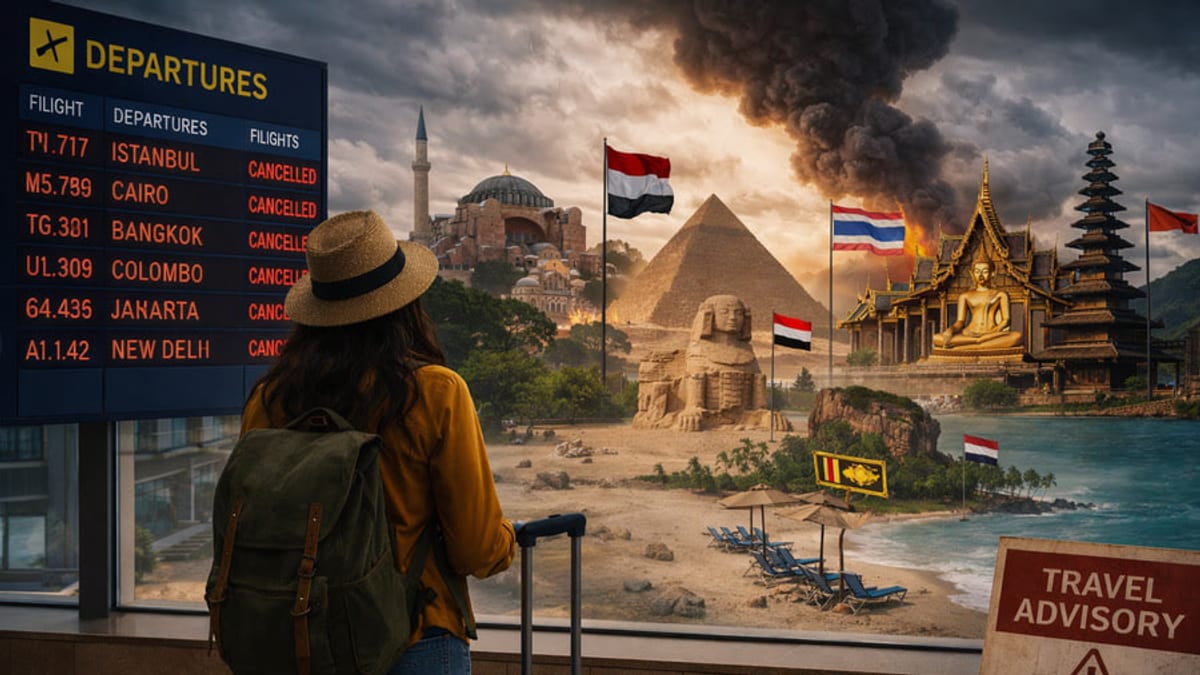
Image by Latest International / Global Travel News, Breaking World Travel News
How Global Conflict Is Reshaping Air and Sea Corridors
War and instability across the Middle East and surrounding waters are increasingly dictating how and where people travel. Airspace closures linked to the 2026 Iran war and related missile exchanges have forced airlines to redraw flight paths between Europe, Asia, and Africa, complicating itineraries and pushing up operating costs. Reports indicate that thousands of flights have been cancelled or rerouted in recent months as carriers avoid conflict zones and critical chokepoints.
At sea, recurring attacks on commercial vessels in the Red Sea and Bab el-Mandeb Strait have sharply reduced traffic through the Suez Canal, sending many ships on longer journeys around the Cape of Good Hope. Industry analyses show that voyages between Asia and Europe can lengthen by one to two weeks on these alternative routes, significantly raising fuel, crew, and insurance expenses. While cargo is the primary target, these disruptions reverberate into passenger travel as cruise lines alter itineraries and tour operators face higher costs on imported goods and aviation fuel.
These shifts have turned once-stable hubs such as the Gulf, the eastern Mediterranean, and the Red Sea into perceived high-risk transit points. Even where airports and ports remain open, traveler confidence has weakened in markets that depend on seamless long-haul connectivity, from resort towns in Egypt and Turkey to city breaks in Istanbul, Dubai, and beyond.
The broader effect is a more fragmented global tourism map. Routes that previously relied on smooth overflight across Iran, Iraq, Israel, and neighboring states now zigzag to avoid no-fly zones, complicating connections to destinations across South and Southeast Asia, including Indonesia. Higher fares and longer travel times are encouraging price-sensitive travelers to stay closer to home or postpone long-haul trips altogether.
Indonesia’s Tourism Engine Faces New Headwinds
Indonesia entered 2026 with considerable momentum after a strong rebound in 2024 and 2025, particularly in Bali, which welcomed well over six million international visitors in 2024 according to publicly available tourism data. Yet this recovery is running into new friction from global conflict. Many of Indonesia’s most valuable long-haul markets depend on flight corridors that now intersect with contested or congested airspace, adding complexity for airlines and unpredictability for travelers.
European and Middle Eastern carriers have traditionally served Bali, Jakarta, and secondary Indonesian gateways via hubs in the Gulf, Turkey, and Southeast Asia. With some of these hubs now grappling with security concerns, rerouting pressures, and fluctuating capacity, the onward flow into Indonesia is more vulnerable to shocks. Travel industry commentary points to growing caution among long-haul tourists weighing multi-stop itineraries that pass near conflict-affected regions, even when Indonesia itself remains peaceful.
Indonesia is simultaneously confronting structural strains that make it harder to absorb external shocks. Recent coverage from regional outlets has highlighted mounting worries around overtourism, infrastructure bottlenecks, and social tensions in Bali, where crowding and environmental pressures were already testing the island’s carrying capacity. When global demand softens or shifts, highly concentrated tourism economies can see volatility amplified, with small businesses, informal workers, and local communities bearing the brunt.
In response, planners and industry groups in Indonesia are increasingly focused on diversifying both source markets and domestic destinations. Campaigns promoting lesser-known islands and secondary cities, alongside efforts to attract more visitors from within Asia and from the domestic market, aim to reduce reliance on a narrow band of long-haul travelers whose journeys are most affected by conflict-related route disruptions.
Turkey, Egypt, Thailand and Sri Lanka Confront Softening Demand
Indonesia’s challenges echo those facing a string of other tourism powerhouses along the wider conflict belt. Turkey, which in recent years has climbed into the top tier of global destinations by arrivals, has seen periods of weaker forward bookings tied to regional crises. Analysts tracking the sector report that resorts along the Turkish Riviera have recently encountered slower-than-expected demand growth, as some European travelers take a wait-and-see attitude toward trips near sensitive airspace and political flashpoints.
Egypt’s exposure is even more direct. The country relies heavily on Red Sea resorts such as Hurghada and Sharm el-Sheikh, as well as the Suez Canal for foreign-exchange earnings. Publicly available figures show that Suez Canal revenues plunged in 2024 as Red Sea attacks deterred shipping, creating additional fiscal pressure. Tour operators report that Egypt’s beach destinations have faced repeated booking swings linked to security headlines, maritime incidents, and high-profile accidents in local waters.
Further east, Thailand and Sri Lanka are grappling with a more indirect but still significant impact. Both destinations depend heavily on long-haul visitors from Europe and on regional connectivity through Gulf and South Asian hubs. When air routes lengthen and fares climb, beach holidays in Phuket, Krabi, the Maldives, or Sri Lanka’s southern coast can become less competitive against closer, cheaper options. Industry commentary from Asia-based tour operators indicates that some travelers are trading intercontinental trips for regional breaks, a trend that can quickly dent revenues in far-flung island and beach economies.
Although none of these destinations sit at the center of the current conflicts, the perception of regional instability often matters as much as the underlying risk. Historical booking data following earlier regional crises suggest that even short-lived flare-ups can cast a shadow over at least one or two travel seasons, erasing billions in potential visitor spending.
Key Hubs Under Strain: From Gulf Gateways to the Red Sea
Global conflicts are hitting not only end destinations, but also the hubs that knit the tourism economy together. Gulf airports and carriers play an outsize role in connecting Europe to Asia and Africa, while Istanbul functions as a major transfer point for traffic into the eastern Mediterranean, the Caucasus, and Southeast Asia. Reports from aviation and logistics providers describe a patchwork of route changes and capacity adjustments as airlines respond to evolving risk assessments and government restrictions.
In maritime transport, the Red Sea and Suez Canal remain central to cruise and ferry itineraries serving Egypt, Jordan, Saudi Arabia, and beyond. Episodes of vessel attacks, combined with elevated war-risk insurance premiums, have prompted some cruise operators to alter or shorten seasons, reassign ships, or pivot to more stable regions. Each adjustment can ripple out to tour guides, hotels, restaurants, and souvenir sellers who have little cushion against sudden drops in visitor numbers.
Secondary hubs have absorbed some of this pressure. Carriers are leaning more heavily on routings via Central Asia, the Indian Ocean, and Southeast Asian gateways to maintain global connectivity. However, longer flying times and more complicated network planning raise costs that ultimately filter down to leisure travelers. This trend reinforces a two-speed travel market, where higher-spending tourists continue to fly despite prices, while more price-sensitive segments cut back first on long-haul holidays.
As a result, destinations that rely on volume rather than high yield feel the pinch most acutely. Mass-market sun-and-sea destinations in Turkey, Egypt, Thailand, Sri Lanka, and parts of Indonesia are especially exposed, because small changes in perceived risk or price can result in large swings in package tour demand.
What Travelers and Destinations Should Watch Next
For travelers planning trips in 2026 and 2027, the new geography of conflict means paying closer attention to routings, transit points, and insurance policies. Travel advisors recommend checking whether flights avoid the most volatile airspace, allowing extra time for connections through busy hubs, and monitoring airline and government advisories for last-minute schedule changes. Flexible tickets and comprehensive coverage for disruption have shifted from nice-to-have to near-essential for long-haul itineraries.
Destinations, meanwhile, are being pushed to adapt. Governments and tourism boards across Indonesia, Turkey, Egypt, Thailand, and Sri Lanka are sharpening campaigns that emphasize safety, diversified access routes, and off-peak travel. There is also a growing focus on spreading visitors beyond single flagship locations, in part to reduce the risk that a shock to one gateway or resort cluster will derail the wider national tourism economy.
Industry analysts note that previous crises suggest a path to recovery once tensions ease and airspace fully reopens, but they also stress that lost seasons cannot be recaptured. For highly tourism-dependent economies, each cancelled charter season or weak winter of long-haul arrivals represents foregone income for millions of workers and small businesses.
For now, Indonesia’s move into the same risk conversation as Turkey, Egypt, Thailand, Sri Lanka, and other tourism-reliant nations underscores a new reality. Even destinations far from the front lines are being reshaped by conflict-driven disruptions to the world’s key travel hubs and routes, and both travelers and policymakers will need to stay nimble as the map continues to shift.