

More news on this day
From Dubai to Doha and Frankfurt to Istanbul, a wave of airspace closures, strikes, and emergency schedule changes is colliding just as travelers lock in their 2026 vacation plans, raising urgent questions about how safe future itineraries really are.
Get the latest news straight to your inbox!
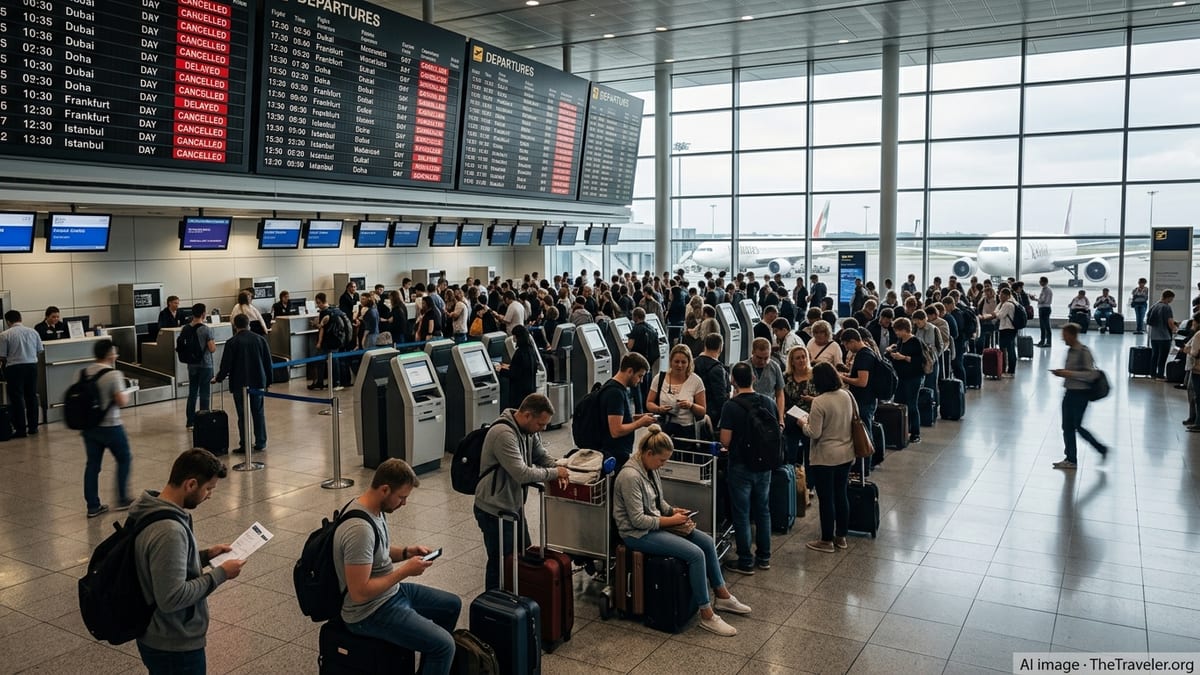
Middle East Conflict Triggers Cascading Airspace Closures
Ongoing hostilities involving Iran and regional powers have reshaped the aviation map across the Gulf and beyond. Airspace restrictions and security advisories affecting parts of Iran and neighboring states have forced carriers to suspend routes, lengthen flight times, and concentrate traffic through a shrinking number of safe corridors. Published coverage of evacuations and airspace shutdowns indicates that hundreds of thousands of travelers have faced cancelled or heavily rerouted flights in recent weeks.
Emirates, one of the world’s largest long haul operators, has been operating a rolling program of limited repatriation and recovery flights while maintaining a disruption waiver that now covers journeys through mid April 2026. Publicly available advisories show that passengers with travel dates falling inside the waiver window are being offered broad options to rebook, reroute via partner airlines, or request refunds, reflecting the scale and uncertainty of the situation.
Qatar Airways, normally a key transit player via Doha, has also been forced into a drastically reduced interim schedule following missile threats and airspace constraints around Qatar. Flight tracking data and traveler reports point to multiple rounds of cancellations, last minute timing changes, and a gradually expanding list of restored routes as the airline tests what can safely operate through Hamad International Airport.
Schedule volatility is not confined to the Gulf. Carriers across Asia, Europe, and Africa that rely on overflying affected regions have been diverting around closed airspace. That adds hours to some journeys and increases fuel burn, with knock-on effects including missed connections, crew scheduling challenges, and rolling delays that can ripple through entire networks for days.
European Networks Strained by Strikes and Winter Weather
While geopolitical risks dominate headlines in the Middle East, Europe has been battling its own brand of disruption. In Germany, Lufthansa pilots and cabin crew have staged a series of walkouts over pay and working conditions in March 2026. Airline statements and aviation industry analysis indicate that on some strike days the carrier has had to cancel the majority of its mainline and cargo services, particularly through its hubs in Frankfurt and Munich.
Lufthansa has emphasized that it can still maintain more than half of its overall schedule on targeted strike days, but the cancellations and consolidations are significant enough to upend travel plans for tens of thousands of passengers. Travelers connecting from intercontinental flights to shorter European legs have been particularly exposed to missed onward journeys and forced overnight stays.
At the same time, a powerful winter storm system in late January 2026 caused one of the worst weather-related aviation disruptions in recent North American history, with more than ten thousand cancellations recorded in a single day at the height of the storm. Many of those flights served or connected to European routes, contributing to knock-on delays, aircraft rotations arriving out of position, and crew schedules that took days to fully reset.
Separate industry statistics compiled for late 2025 and updated in March 2026 also show elevated rates of delays and cancellations across multiple European carriers, including Lufthansa and several regional and low cost operators. Together, these pressures suggest that European hubs are entering the 2026 peak travel season with less operational buffer than usual, leaving them more vulnerable to additional shocks.
Turkish Airlines and Gulf Carriers Navigate Shifting Risk Maps
Turkish Airlines, which promotes itself as flying to more countries than any other airline, sits at the crossroads of Europe, Asia, and the Middle East and has been directly exposed to shifting risk assessments. Turkish authorities extended suspensions of flights to several Middle Eastern destinations in early March 2026 as security concerns around the Iran conflict escalated, and Turkish Airlines cancelled services to affected cities during that period according to local news coverage.
Operational data from late 2025 into early 2026 shows that Turkish Airlines has been managing rising cancellation rates during peak periods, with weather, congestion, and regional instability all cited as contributing factors. More recently, traveler accounts also describe scattered advance cancellations on certain long haul routes months ahead of departure, labeled as force majeure or operational reasons, underscoring how quickly route planning can change in response to demand or risk.
In the Gulf, Emirates has been operating in a highly constrained environment, balancing its role as a global connector with evolving flight permissions and route restrictions. Daily schedule bulletins in early March 2026 listed specific flights into and out of Dubai that could operate, while others were removed from timetables or repurposed as repatriation services. For many travelers, the practical effect has been a series of rolling rebookings as the airline adjusts to each new airspace update.
Other regional and international carriers, including those based in Asia and Europe, have also reduced or suspended flights to certain Gulf destinations or rerouted services to avoid conflict zones. This has further tightened available capacity through alternative hubs, making it harder for stranded passengers to secure last minute seats even when they are willing to reroute through entirely different regions.
What This Means for 2026 Vacation Plans
For travelers looking ahead to summer and year end holidays in 2026, the immediate disruptions may feel distant, but the implications are significant. Airlines are rewriting schedules around new risk maps, rebalancing capacity away from certain routes, and building in additional time buffers for long haul journeys that must skirt closed airspace. That process can lead to earlier departure times, added technical stops, or reduced frequencies on routes that once operated daily.
Published guidance from consumer advocates and travel industry analysts suggests that the traditional assumption of a stable, fixed schedule months in advance is less reliable than it was even a few years ago. The combination of geopolitical instability, labor actions, and climate driven weather extremes is pushing airlines to maintain more flexible networks, sometimes at the expense of previously advertised timetables.
For passengers, that means any 2026 vacation involving connections through the Gulf, major European hubs, or winter sensitive regions in North America carries a higher risk of significant change after booking. Longer layovers, the use of multiple carriers on a single journey, and itineraries that rely on tightly timed domestic links after long haul arrivals all require closer scrutiny than in the past.
Travelers planning milestone trips, such as honeymoons or multi country tours, may also need to factor in the possibility of last minute rerouting that bypasses preferred stopover cities entirely. With certain hubs currently operating on emergency or interim schedules, there is no guarantee that a favored connection point will still be practical or available by the time departure day arrives.
How Travelers Can Reduce Their Exposure to Disruption
Amid this turbulence, experts in publicly available travel guidance broadly recommend building resilience into any 2026 itinerary. That starts with choosing tickets that allow date or routing changes without heavy penalties, particularly for journeys that transit regions currently affected by airspace restrictions or labor disputes. Many major airlines, including Emirates and Qatar Airways, have already introduced temporary waivers that make such flexibility easier for affected travel windows.
Direct flights, where available, generally reduce the number of weak points in a trip. When a connection is unavoidable, opting for longer layovers can provide a buffer against late arrivals from disrupted regions. Travelers are also being encouraged to monitor airline apps and official channels closely in the weeks leading up to departure, as schedule changes are increasingly being pushed out via digital notifications rather than traditional travel agents alone.
Another emerging recommendation is to think in terms of backup hubs. For example, a traveler originally planning to connect through Doha or Dubai might identify alternative routings via European or Asian gateways that could be used if local conditions deteriorate again. While booking multiple parallel itineraries can quickly become expensive, having a clear alternative plan and understanding refund or credit rules in advance can make it easier to act quickly if cancellations occur.
Ultimately, while it is too early to declare 2026 vacation plans unsafe across the board, the current wave of cancellations, reroutes, and delays shows that global air travel is operating with far thinner margins. Travelers who build in flexibility, keep a close eye on evolving advisories, and remain prepared to adjust their routes may be best positioned to keep their long awaited trips on track.