

More news on this day
Virgin Atlantic is cutting back flights between London and Dubai as renewed airspace warnings over the widening Iran war trigger fresh disruption across key Middle East corridors, sending shockwaves through already fragile global aviation networks.
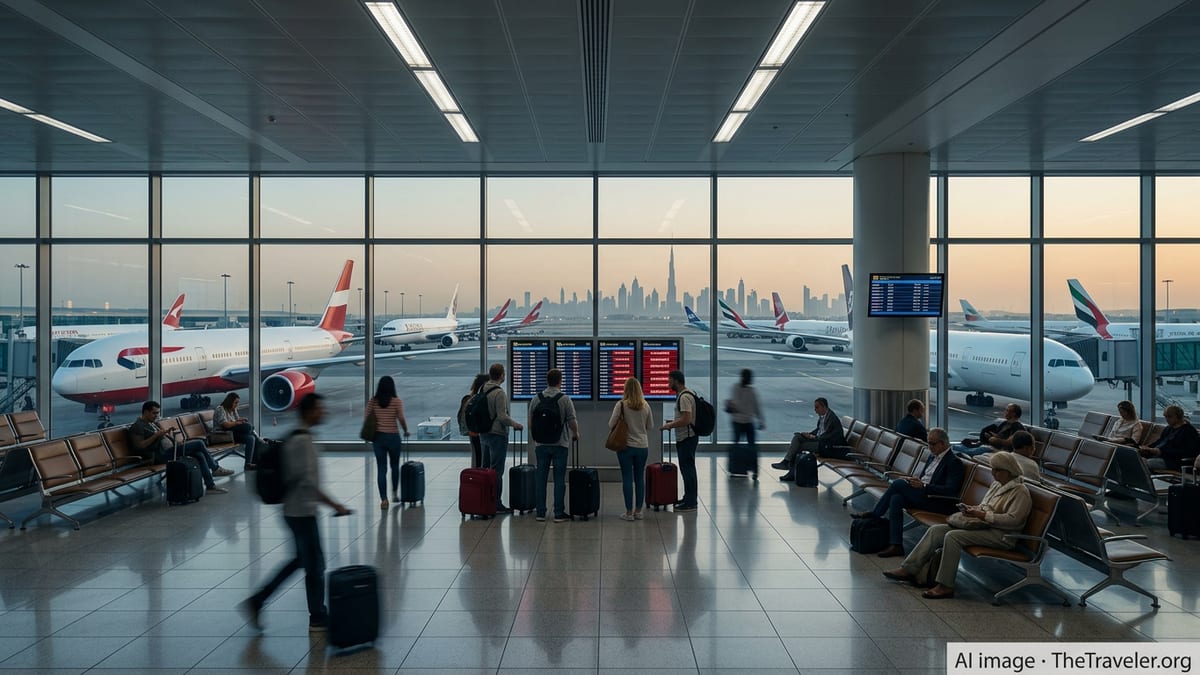
Virgin Atlantic Scales Back as Conflict Reignites Middle East Risks
Virgin Atlantic has reduced its London Heathrow to Dubai schedule after security reviews concluded that operating a full program through the embattled region is no longer viable in the short term. The carrier had briefly restored services following initial closures at the end of February, but worsening military activity and evolving guidance from international regulators have prompted a renewed pullback.
In an advisory to passengers, the airline cited airport and airspace closures in Dubai and surrounding states, explaining that its security and operations teams are reassessing each rotation in real time. Flights on certain days have been removed from the timetable or consolidated, with Virgin prioritizing departures that can be operated on routings deemed safe and operationally sustainable.
The move illustrates how quickly conditions are shifting for airlines attempting to reconnect the Gulf after the latest phase of the conflict between the United States, Israel and Iran. Even as limited services restart, the prospect of sudden closures, last minute reroutes and elongated flight times continues to hang over any carrier using the Gulf as a hub.
Virgin Atlantic is offering rebooking options for customers whose flights are canceled, but warns that alternative routings are constrained by the same airspace restrictions and intense demand. Passengers are being urged to monitor flight status tools and ensure contact details are up to date so that schedule changes can be communicated at short notice.
Airspace Warnings Spread Across the Middle East and Persian Gulf
The airline’s decision comes as European and international regulators extend conflict-zone bulletins for Middle Eastern skies. The European Union Aviation Safety Agency has prolonged its advisory covering key portions of the Middle East and Persian Gulf, reflecting continued uncertainty over the safety of overflying territories affected by missile launches, drone incursions and air defense activity.
Across Iran, Iraq, Israel, Jordan, Kuwait, Qatar, Bahrain, the United Arab Emirates, Oman and Saudi Arabia, airspace remains partially closed or heavily restricted. Some flight levels and corridors are being kept clear for military operations, while commercial aviation is pushed onto narrow bands of airspace at the margins of the region. The result is a patchwork of temporary routes that can change from one day to the next.
The heightened risk environment follows a series of high-profile incidents, including friendly fire losses, drone strikes near strategic bases and attacks on energy infrastructure. Each episode adds new pressure on civil aviation authorities to keep airliners away from potential conflict trajectories, even if that means wholesale closures of busy flight corridors with minimal warning.
Industry analysts note that conflict-zone advisories are deliberately conservative, designed to keep commercial jets well clear of any area where anti-aircraft systems or long-range missiles might be active. For airlines, that caution translates into longer diversions, higher fuel burn and, in some cases, a decision to suspend routes altogether rather than operate through a rapidly changing risk map.
Ripple Effects for Europe Asia Traffic and Global Flight Times
While Virgin Atlantic’s cutbacks focus attention on Dubai, the impact of the crisis extends far beyond the Gulf. For more than a decade, Middle Eastern hubs have been pivotal waypoints on Europe Asia and Africa Asia routes. With direct transits over Iran, Iraq and nearby states now constrained, many long haul flights are being pushed north through limited Caucasus corridors or south along routes that hug the Red Sea and the Arabian Sea.
These diversions are adding two to five hours to typical sector times on some Europe Asia services, according to independent air travel trackers and schedule analysis. Additional fuel loads are required to complete the longer journeys, which in turn can restrict payload and reduce the number of seats or the amount of cargo an aircraft can carry. For passengers, that means longer overnight flights, missed connections and fewer options when disruptions occur.
Global knock-on effects are already visible. Aircraft and crew are returning late to their home bases, creating rotation challenges that cascade through airline networks. Slots at busy European and Asian airports are being missed, leading to further delays or cancellations on unrelated routes. For travelers who never intended to transit the Middle East, the result can still be a last minute schedule change as carriers reshuffle fleets to cope with extended flying times in other parts of their system.
Travel booking platforms are reporting increased interest in itineraries that avoid the region entirely, even at the cost of additional connections. Some travelers are opting for polar or transatlantic plus transpacific combinations to link Europe and Asia, a pattern last seen at scale during earlier crises when parts of Eastern European or Russian airspace were restricted.
Stranded Passengers, Patchy Reopenings and Confusing Timetables
The shutdowns that began in late February left hundreds of thousands of travelers stranded in or around major Gulf hubs. Dubai International, Hamad International in Doha, and Zayed International in Abu Dhabi all saw mass cancellations in the opening days of the conflict, with flight tracker data showing well over ten thousand flights scrubbed in less than a week.
As limited operations resume, the picture on the ground remains fluid. Some carriers, including regional giants, have restarted selective services on shorter routings within relatively calm parts of the Gulf, while keeping long haul or night time flights on hold. Others have chosen to push their suspension dates further into March as they wait for more stable security conditions and a clearer picture from regulators.
For travelers, that mixed landscape can be deeply confusing. Two airlines serving the same city pair may take very different views on risk, leaving one flight operating and another canceled. Airport departure boards now show a patchwork of green and red, with last minute gate changes as airlines secure revised routings or await updated clearances from air traffic control centers.
Consular authorities, including the United States and several European governments, have advised citizens to leave the region while commercial options still exist, warning that further deterioration in security could lead to renewed blanket closures. Those advisories, in turn, have created surges in demand on the few flights that are operating, even as schedules for the days ahead remain tentative.
What Travelers Should Do Now
With flight plans changing daily, travel specialists stress that flexibility is essential for anyone booked to fly into, out of, or over the Middle East in the coming weeks. Passengers on Virgin Atlantic’s curtailed Dubai service, or on other airlines affected by the airspace warnings, are being urged to treat their itineraries as provisional and to monitor them closely up to the moment of departure.
Experts recommend booking directly with airlines where possible, as this can simplify rebooking in the event of cancellations or major delays. Travelers already in the region are advised to keep at least one additional day of buffer time before critical onward connections, such as cruises, tours or long haul returns. Where reroutings involve lengthy detours, travelers should also be prepared for fuel stops or technical holds at unscheduled airports.
Insurance is another potential pressure point. Many standard travel policies exclude disruptions linked to declared conflicts, leaving passengers to rely on airline goodwill policies or statutory compensation schemes in specific jurisdictions. Travelers are being encouraged to read the small print of their coverage and to keep receipts for any unexpected hotel nights and meals in case partial reimbursement is possible.
For now, there is no clear timeline for when Middle East airspace will fully normalize. Virgin Atlantic’s decision to cut Dubai flights underscores how fragile the recovery remains: even limited reopenings can be reversed quickly if the conflict escalates or if new safety intelligence emerges. Until the geopolitical picture stabilizes, global aviation is likely to remain locked in a pattern of rolling disruption, with the Gulf at its troubled center.