

More news on this day
From cyber outages and airspace closures to flooded runways and strained control towers, a string of recent crises has exposed how quickly disruptions in one corner of the world can ripple through the global aviation system.
Get the latest news straight to your inbox!
Tech Outages Reveal Hidden Single Points of Failure
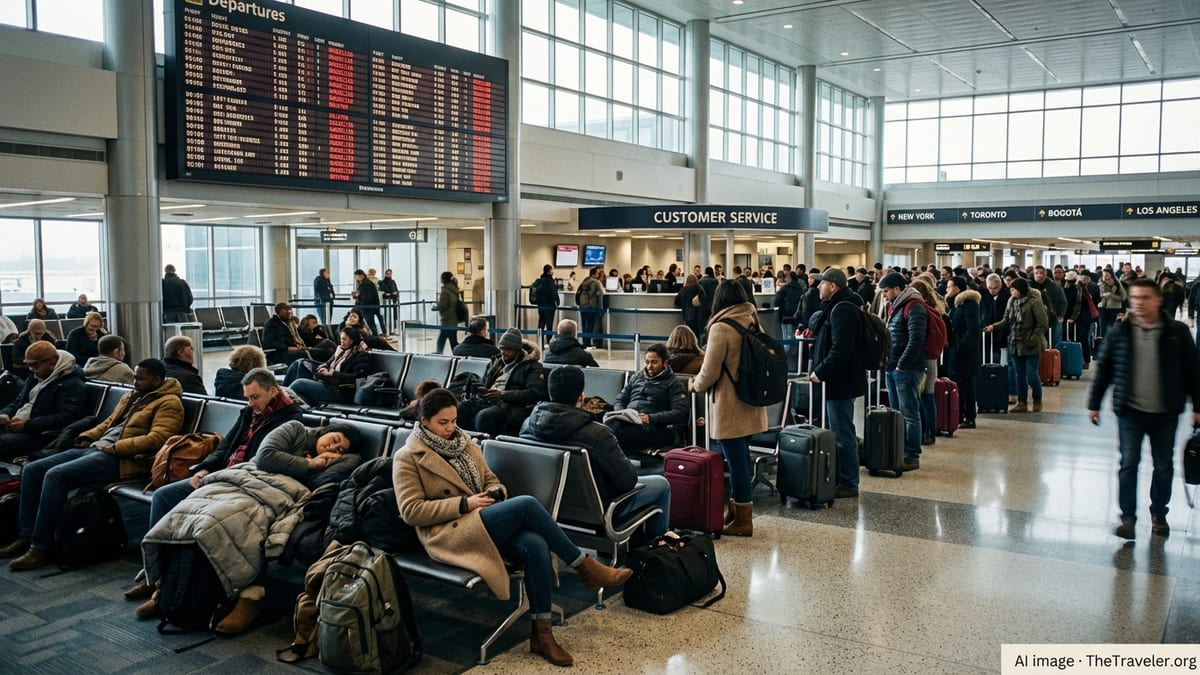
The most striking illustration of systemic fragility came with the global CrowdStrike-related IT outage on July 19, 2024, which crashed millions of Microsoft Windows systems and disrupted critical services worldwide. Aviation was hit particularly hard. Flight tracking data and industry reports indicate that more than 5,000 flights, nearly 5 percent of those scheduled that day, were cancelled globally as airlines, airports and ticketing systems struggled to reboot key infrastructure.
Delta Air Lines was among the most heavily affected carriers, cancelling thousands of flights over several days as its operations center, crew-management tools and airport systems struggled to recover. Publicly available financial disclosures indicate the airline expects hundreds of millions of dollars in costs tied to the meltdown, even as legal disputes continue over who should bear the losses. Other major carriers also reported multi-day impacts as residual glitches and manual workarounds slowed recovery.
Travel management companies and risk consultancies describe the outage as a textbook example of how deeply digitized aviation has become, and how concentration around a few technology providers can amplify risk. A configuration error in a widely used cybersecurity platform cascaded through airline departure control systems, airport check-in kiosks, ground handling software and even hotel and event platforms that travelers rely on, extending the disruption beyond a single day.
Subsequent incidents have reinforced those concerns. In 2025, Alaska Airlines temporarily grounded all flights for several hours after a critical hardware component failed at a data center, leading to more than 150 cancellations and widespread delays. While the interruption was shorter, analysts note that it again showed how the failure of one device in a complex, centralized architecture can ripple across an entire route network.
Geopolitics and War Redraw the Global Route Map
Network fragility is not limited to software. Conflicts and airspace closures are forcing airlines to redraw route maps on short notice, adding flying time, fuel burn and operational complexity. Russian airspace restrictions since 2022 have already pushed many Europe to Asia flights onto longer detours, increasing costs for carriers and testing the limits of crew scheduling and aircraft availability.
The impact has intensified in 2026 with the widening war involving Iran. According to coverage from major wire services and aviation analytics firms, airspace closures over Iran, Iraq, Syria, Kuwait, Bahrain and at times parts of the Gulf have triggered mass cancellations and diversions across the Middle East and beyond. Hub airports in Dubai, Abu Dhabi and Doha, normally handling tens of thousands of long-haul transfer passengers each day, have faced waves of disruption as flights are delayed, rerouted or scrubbed entirely.
Industry observers describe the crisis as the most severe geopolitical shock to global air travel since the early months of the pandemic. Gulf carriers, which depend on unfettered access to regional skies to funnel traffic between Europe, Africa and Asia, have been forced to juggle complex rerouting while coping with surging fuel costs. Longer routings reduce aircraft and crew productivity, leaving less slack in already stretched schedules and making networks more vulnerable to even minor operational hiccups.
These pressures build on a longer list of geopolitical constraints, from sanctions and no-fly zones to sudden airport closures. Analysts point out that although airlines increasingly use sophisticated network models to hedge against such risks, the interdependence of hubs means that a closure in one region can still snarl connections across multiple continents within hours.
Extreme Weather and Climate Risks Strain Airport Infrastructure
Climate-related disruption is adding another layer of stress. Recent analysis from international aviation and climate bodies highlights a rise in extreme weather events affecting airports, including flooding, heatwaves, storms and low-visibility conditions. In 2024, for example, Brazil’s Salgado Filho International Airport in Porto Alegre remained closed for about five months after unprecedented flooding damaged runways and terminal infrastructure, forcing airlines to reroute or cancel services for an extended period.
Operational statistics from European network managers show that winter weather has recently become a leading cause of delay, with some hubs experiencing a sharp increase in weather-related airport disruptions compared with the previous year. Similar patterns are emerging in North America and Asia, where intense storms and prolonged heat can quickly overwhelm de-icing capacity, runway drainage systems and ground handling operations.
Experts warn that existing resilience planning at many airports still assumes relatively short, localized events, while climate projections point toward more frequent, compounding shocks. When infrastructure is taken offline for weeks or months, airlines must reconfigure networks, shift capacity to secondary airports and renegotiate slots. These adjustments are expensive and complex, and they often leave passengers facing longer journeys and fewer backup options when something goes wrong.
Industry initiatives are starting to address these vulnerabilities. New simulation tools promoted by multilateral groups are being used to stress-test airport operations under future climate scenarios, including simultaneous flooding and heat events. However, these efforts require significant investment at a time when margins remain thin, raising questions about how quickly hardening and adaptation measures can keep pace with the changing risk profile.
Air Traffic Control and Staffing Gaps Undermine Resilience
Even when aircraft and airports are functioning, disruptions in air traffic control and staffing can cause rapid network slowdowns. In the United States, recent reports from the Federal Aviation Administration and independent watchdogs point to chronic controller shortages at key facilities. During the 2025 federal government shutdown, several towers operated with reduced staff, and at least one major Southern California airport reported a temporary closure of its tower due to staffing, forcing pilots to self-coordinate movements.
Separate technical failures have added to concerns. In 2025, investigations were launched into a radio outage affecting Denver’s air traffic control operations and a loss of radar and communications affecting traffic into Newark. Although both incidents were resolved without accidents, they prompted renewed scrutiny of aging systems and the limited redundancy at some high-volume control centers.
Academic research on U.S. flight networks has underscored these vulnerabilities. A recent network analysis found that while the system is highly efficient under normal conditions, it is also susceptible to cascading delays when a few central nodes are disrupted. In practical terms, a staffing shortage or technology problem at a handful of large hubs can create knock-on delays throughout the network, especially during peak travel periods when there is little spare capacity.
Controller unions and industry groups argue that sustained investment in staffing, training and modernization is needed to prevent minor outages turning into multi-day disruptions. Without that, routine weather events or minor system glitches can quickly escalate into widespread cancellations and missed connections.
Signs of Improvement, But Vulnerabilities Remain
Despite headline-grabbing crises, some metrics suggest that airlines are slowly improving their ability to manage disruption. A recent global operations report found that flight cancellations decreased by around 12 percent in 2025 compared with the previous year, a sign that carriers and airports are stabilizing schedules and refining contingency planning as demand normalizes after the pandemic.
Leading hubs have invested in more robust backup power and IT systems, as well as expanded data sharing between airlines, airports and ground handlers to speed recovery when problems arise. Some carriers are also diversifying key technology suppliers, adding redundancy for critical applications like crew scheduling and departure control in an effort to avoid a repeat of the CrowdStrike-related outage.
Yet observers caution against reading too much into a single year’s improvement. The same reports note that delays and cancellations remain a persistent challenge in many regions, and that even modest shocks can still leave passengers stranded when networks are tightly scheduled and aircraft utilization is high. Low-cost carriers with lean operations and limited spare aircraft can be particularly exposed to disruption.
With geopolitical tensions, climate risks and digital dependencies all trending upward, analysts argue that the central lesson from recent disruptions is the need to treat aviation as a tightly coupled global network rather than a collection of standalone flights. Investments in redundancy, diversified routing, climate-resilient infrastructure and modernized air traffic control, they say, will determine whether future shocks are contained locally or once again cascade around the world.