

More news on this day
Passengers traveling through major global hubs including Paris, Amsterdam, London, New York, and Tokyo are facing a fresh wave of disruption, with 21 cancellations and 136 delays reported across Air France, KLM, and British Airways services, stranding travelers across Europe, North America, and Asia.
Get the latest news straight to your inbox!
Operational Strain Spreads Across European Hubs
Current disruption data indicates that European hubs such as Paris Charles de Gaulle, Amsterdam Schiphol, and London Heathrow are bearing the brunt of the latest round of delays and cancellations. Recent industry reporting points to a cluster of 21 canceled flights and more than 130 delayed departures and arrivals for Air France, KLM, and British Airways services over a short time window, compounding an already difficult start to the spring travel period.
Amsterdam Schiphol and Paris Charles de Gaulle have been repeatedly highlighted in passenger-rights tracking reports for elevated disruption levels since early 2026, with earlier weather and staffing pressures continuing to ripple through schedules. Analysts note that even modest schedule changes at these tightly coordinated hubs can trigger missed connections and extended rebooking queues as aircraft and crews fall out of position.
London Heathrow is also experiencing knock-on effects. While some of the disruption there is linked to broader European congestion and airspace rerouting, the current figures show British Airways services shouldering a notable share of delays, particularly on short-haul European routes that connect into long-haul transatlantic and Asian services.
Industry observers say this pattern is consistent with recent months, when monitoring platforms tracked triple-digit daily delays across leading European airports following adverse weather, air traffic control restrictions, or route suspensions in neighboring regions. Even as the number of outright cancellations has declined from previous winter peaks, the high volume of late departures continues to cause missed onward flights for connecting passengers.
Transatlantic Routes Disrupted From New York
The current disruption is not limited to Europe. Transatlantic routes linking hubs such as New York to Paris, Amsterdam, and London are again under pressure, with data showing delays on key services used by both business and leisure travelers. New York airports have experienced an elevated number of late departures in recent days, complicating connections for European-bound passengers relying on overnight services.
Publicly available airport statistics from New York show recurring congestion and weather-related slowdowns feeding into airline schedules. These conditions, combined with aircraft that arrive late from Europe due to earlier disruptions, have contributed to departures slipping behind schedule. For travelers booked on Air France, KLM, and British Airways, even small delays can mean missed onward flights to destinations across the Middle East, Africa, and Asia.
Passenger advocacy platforms report that, in several recent disruption events, travelers have been forced into overnight stays in New York when missed connections left no viable same-day options back to Europe. With cabins on peak transatlantic services often fully booked in early April, reaccommodating stranded passengers is proving challenging and can mean rerouting via secondary hubs or alternative carriers.
Travel data specialists note that transatlantic reliability is particularly important during this period, as airlines attempt to rebuild capacity on long-haul routes affected by earlier route suspensions and changing demand patterns. The latest wave of delays and cancellations underscores how fragile that recovery remains when several major carriers encounter operational strain at the same time.
Asian and Middle Eastern Connections From Tokyo and Beyond
Reports from flight-status trackers show knock-on effects reaching into Asia, including Tokyo, where connections on joint and codeshare routes with European airlines remain vulnerable to schedule disruption in Europe and North America. When aircraft depart late from hubs such as Paris, Amsterdam, or London, arriving services into Tokyo and other Asian gateways often miss their scheduled onward slots, resulting in extended waits or rebookings for passengers.
In parallel, ongoing airspace restrictions and route adjustments in parts of the Middle East continue to complicate long-haul planning. Publicly available summaries of recent schedule changes show that European carriers, including Air France, KLM, and British Airways, have periodically trimmed or rerouted services in the region, which leaves fewer alternative paths when irregular operations occur elsewhere in the network.
Travel-industry analysts point out that long-haul flights between Europe and Asia typically run with tight aircraft utilization, meaning that one heavily delayed rotation can cascade through subsequent days. If a widebody aircraft reaches Tokyo several hours behind schedule, it may force airlines to delay the return sector or swap equipment, both of which can push disruption back into the European morning peak.
This interconnected pattern is visible in current data, where a limited number of cancellations and a concentrated group of delays translate into widespread inconvenience as passengers on multi-leg journeys through Tokyo, the Gulf, or other Asian hubs struggle to maintain their planned itineraries.
Passenger Experience: Long Queues, Missed Connections, Limited Options
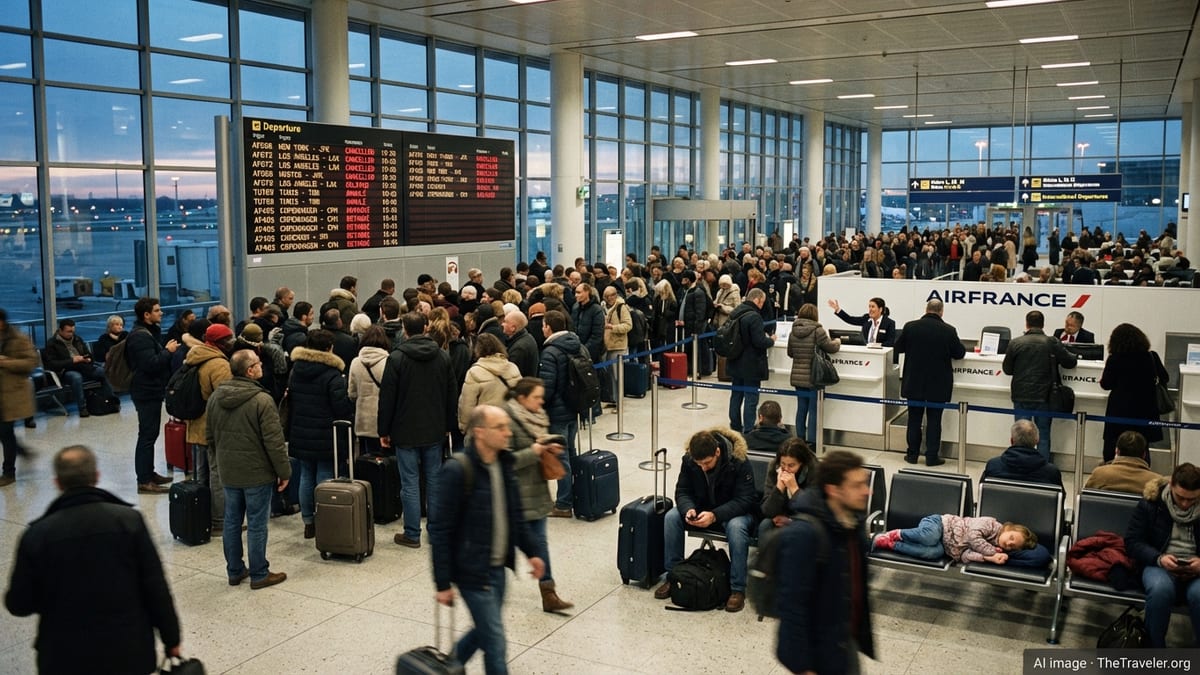
For travelers caught in the latest disruption, the lived experience is familiar: long queues at check-in and transfer desks, congested customer-service phone lines, and difficulty securing clear information about rebooking options. Posts on public forums and social media in recent weeks already describe passengers stranded for extended periods in Amsterdam and Paris after weather and operational problems, and the current figures on cancellations and delays suggest a renewed wave of similar incidents.
Passenger-rights organizations emphasize that even when only a few dozen flights are canceled, the impact can be severe for those on tight schedules or traveling with families. Missed connections can mean lost hotel nights, missed events, or having to rebook at short notice from expensive hubs. With 136 delays concentrated among three major carriers, the number of travelers experiencing knock-on disruption is likely in the thousands.
Observers note that, as with previous disruption episodes, the burden often falls hardest on connecting passengers who are already en route when problems escalate. A delay leaving New York or London may look minor on paper, but if it erases a short connection window in Amsterdam or Paris, the traveler may be forced to wait many hours for the next available seat or accept an indirect routing through a different continent.
In addition, reports indicate that some airports are struggling to provide sufficient staffing at transfer desks during peaks of irregular operations, leading to longer waits for assistance. This can be particularly challenging for passengers unfamiliar with their rights or with complex itineraries that involve multiple carriers under codeshare agreements.
What Travelers Can Do as Disruptions Continue
Given the ongoing pattern of irregular operations, travel experts recommend that passengers build additional buffer time into itineraries involving major hubs such as Paris, Amsterdam, London, New York, and Tokyo. Recent disruption data illustrates that even when headline figures show fewer cancellations than during winter storms or strike days, the cumulative effect of delays can still derail tight connections.
Publicly available guidance from passenger-rights platforms advises travelers to monitor flight status frequently through official airline channels and airport information screens, and to keep digital copies of boarding passes and receipts. These documents can be important later when seeking refunds, compensation where applicable, or reimbursement for incidentals such as meals and accommodation.
Analysts also highlight the value of understanding local and regional passenger protections. On routes touching the European Union or the United Kingdom, established compensation frameworks may apply when delays or cancellations are within the airline’s control. For flights originating outside these regions, policies vary by jurisdiction and by carrier, so passengers are encouraged to review the conditions of carriage for Air France, KLM, British Airways, and any partner airlines involved in their itinerary.
With the current set of 21 cancellations and 136 delays showing how quickly disruption can spread across continents, travelers are being urged by industry commentators to plan conservatively, stay informed in real time, and remain prepared for last-minute schedule changes as the busy spring travel season gathers pace.