

More news on this day
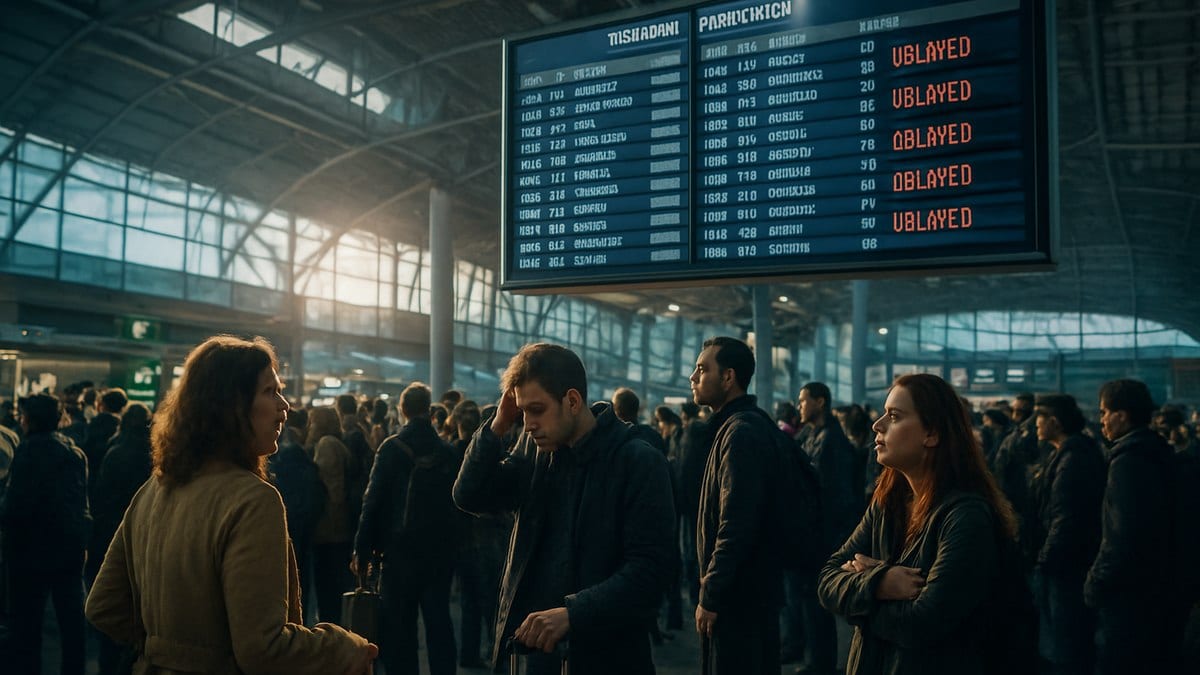
A cascade of weather emergencies, technology failures, staffing constraints and geopolitical tensions turned March 2026 into one of the most turbulent months for global air travel in recent years, highlighting how quickly modern aviation networks can unravel when multiple weak points are hit at once.
Get the latest news straight to your inbox!
Storm Systems Turn Key Travel Corridors Into Bottlenecks
Across North America, a sequence of powerful storm systems repeatedly disrupted major hubs in March, creating bottlenecks that rippled through airline schedules for days. Data compiled by flight-tracking and travel-industry outlets shows that severe thunderstorms, snow and high winds triggered thousands of cancellations and delays at airports in Chicago, Denver, New York and Atlanta, often on consecutive days.
On March 7, 2026, coverage from aviation news platforms reported nearly 500 cancellations and more than 5,000 delays across the United States as thunderstorms, snow and low cloud ceilings prompted ground stops at Chicago O’Hare and Atlanta, affecting both mainline and regional carriers. A separate blizzard and severe-weather outbreak from March 13 to 17 compounded the strain, forcing widespread schedule changes while airlines attempted to reposition aircraft and crews.
The weather impact was not limited to storms moving across the continent. Reports on a major March blizzard indicated that Denver alone saw more than a thousand flights delayed or canceled over several days, underscoring the vulnerability of inland hubs that serve as crucial connection points. Each localized disruption translated into missed onward connections and aircraft out of position across the wider network.
Spring weather also destabilized operations along the busy U.S. East Coast. Travel-industry analysis described strong winds and fast-moving systems as drivers of rolling ground delays at New York airports, with ripple effects stretching into secondary markets as airlines prioritized scarce aircraft and crew resources for trunk routes.
Europe’s Congested Skies Struggle With Capacity and Control
European air travel faced its own series of shocks in March, as already crowded airspace encountered a mix of operational constraints, air traffic management pressures and localized weather challenges. Passenger-advocacy and travel-intelligence firms reported that on March 5, 2026, more than 1,000 flights across key airports in England, France, Germany, the Netherlands and Switzerland were either canceled or significantly delayed, leaving terminals packed and crews out of sequence.
Later in the month, additional disruption waves hit Europe’s largest hubs. Reports from travel-news outlets detailed hundreds of delays on March 21 and March 24, affecting airports from London Heathrow and Paris Charles de Gaulle to Frankfurt and Istanbul. The causes cited ranged from staffing and scheduling strains in air traffic control to weather-related safety advisories that reduced capacity on already saturated routes.
Network overviews from European aviation bodies show that overall flight volumes in early 2026 were slightly higher than a year earlier, even as air traffic control delays have been trending upward over the past decade. Industry assessments point to a persistent gap between traffic growth and investment in control capacity, which leaves the system sensitive to any shock, whether a thunderstorm over a key sector or an unplanned route restriction tied to regional security considerations.
The result for travelers in March was a pattern of cascading disruption: a relatively contained trigger in one part of the network quickly translated into rolling delays and missed connections across the continent. For airlines, each event added pressure to already tight rosters and aircraft rotations, limiting their ability to absorb further shocks.
Middle East and Asia Highlight Geopolitical and Environmental Risk
In the Middle East, March 2026 travel patterns were shaped by a combination of regional security tensions and severe weather. Corporate risk advisories and travel-management bulletins noted that rerouted traffic around closed or restricted airspace funneled additional flights through remaining open corridors, including key hubs in the Gulf. That concentration, combined with dust storms and visibility issues affecting airports in the United Arab Emirates, Qatar and Oman, produced congestion and extended delays.
Travel-industry coverage described hundreds of flights affected across Dubai, Abu Dhabi, Doha and Muscat around the third week of March, including an extended closure at Muscat International Airport as dust and wind reduced operational windows. Even after formal airspace restrictions were eased or adjusted, the accumulated backlog kept regional networks under strain.
Asia experienced its own acute shock as the month closed. On March 31, reporting from aviation-focused outlets tracked nearly 400 cancellations and more than 5,000 delays across major airports in China, Japan, Thailand and the Gulf region, with Guangzhou, Shenzhen, Shanghai and Tokyo among the hardest hit. The disruption affected a broad mix of carriers, from China Southern and regional low-cost airlines to long-haul operators linking Asia with Europe and North America.
Analysts cited the scale of these disruptions as evidence of how interdependent Asian and Middle Eastern traffic flows have become. When weather, airspace restrictions or operational issues affect a few key hubs, connections spanning three continents can quickly unravel, stranding passengers far from the original point of failure.
Technology Outages and Staffing Strains Expose Hidden Weak Points
Beyond weather and geopolitics, March brought renewed attention to the technological and staffing underpinnings of airline operations. In the United States, publicly available information shows that a brief technology outage at JetBlue on March 10 led the Federal Aviation Administration to impose a short-lived nationwide ground stop for the carrier, halting departures until systems were restored and highlighting the extent to which a single airline’s digital tools are intertwined with broader traffic management.
Localized technology issues also surfaced at individual airports. Passenger reports and local media described computer outages at Pittsburgh International Airport toward the end of March, with check-in and baggage systems temporarily affected. While the incident was relatively contained in duration and scale, it illustrated how quickly normal flows can be disrupted when airport systems go offline, even if runways and airspace remain fully available.
Staffing pressures introduced yet another layer of fragility. In the U.S., a partial federal government shutdown that began in mid-February strained security screening capacity through March, according to national news coverage and transportation briefings. Longer lines and sporadic staffing shortages compounded the impact of weather delays at large hubs, as travelers struggled to clear checkpoints in time for already-disrupted departures.
Similar challenges exist behind the scenes in air traffic control. Industry associations and performance reports have flagged chronic staffing shortfalls and rising controller workloads in both North America and Europe. March’s disruptions underscored how these structural issues reduce the margin for error: when storms or system failures occur, there is limited spare capacity to reroute traffic or extend operating hours without pushing personnel to their limits.
Systemic Fragility Prompts Calls for Resilience Overhaul
The string of events in March 2026 prompted analysts, travel advocates and industry observers to frame the disruptions not as a series of isolated crises, but as evidence of systemic fragility in global aviation. Weather extremes, geopolitical shocks and occasional technology failures are not new, but the clustering of multiple stressors within a single month showed how thin the buffer has become across many parts of the network.
Risk and infrastructure assessments published in March highlighted several areas of concern. These included exposure to regional fuel and energy supply disruptions, limited redundancy in critical airport and airline IT systems, and dependence on a small number of mega-hubs for intercontinental connections. When one or more of these elements is compromised, the knock-on effects can extend well beyond the geographic area directly affected.
Policy and industry discussions are increasingly focused on resilience rather than solely on efficiency. Proposals under debate range from greater investment in air traffic control modernization and staffing, to hardening of airport infrastructure against extreme weather, to clearer passenger-protection frameworks that account for multi-day, multi-region disruption events. Some analysts argue that diversifying routings and strengthening secondary hubs could reduce the risk of single points of failure, even if it adds cost in the short term.
For travelers, March’s turmoil offers a preview of what future peak seasons could look like if these vulnerabilities are not addressed. As climate variability increases, geopolitical fault lines shift and airlines rely ever more heavily on complex digital systems, the aviation network that underpins global tourism and business travel may face more frequent tests of its resilience.