

More news on this day
Hundreds of flights have been cancelled, thousands more delayed and key Middle Eastern hubs partially shut as the escalating conflict involving Iran, the United States and Israel triggers the most serious disruption to global aviation since the early days of the pandemic.
Airspace Closures Ripple Across the Middle East
A wave of US and Israeli strikes on targets in Iran, followed by Iranian retaliation, has prompted at least eight countries in the region to close or heavily restrict their airspace. Iran, Israel, Iraq, Jordan, Qatar, Bahrain, Kuwait and the United Arab Emirates have all announced full or partial shutdowns, with Syria imposing temporary restrictions in its southern corridor. The result is a near blank space on flight-tracking maps over much of the Gulf and Levant.
These decisions are driven primarily by safety concerns. Military activity, the risk of miscalculation and the possibility of stray missiles or drones have made civilian overflights untenable for now. Aviation security specialists say both airlines and regulators are adhering to a conservative approach, assuming the worst-case scenario while the scale and duration of the confrontation remain unclear.
The closures are particularly disruptive because Middle Eastern airspace forms a crucial bridge between Europe and Asia at a time when large parts of Russian and Ukrainian skies are already off limits. With two major corridors effectively closed, carriers are being forced into lengthy detours through narrower southern routes over Egypt, Saudi Arabia and the eastern Mediterranean.
Industry analysts warn that even a short-lived shutdown could produce a backlog that takes days to clear. With many aircraft and crew stranded in the wrong locations, airlines face complex rescheduling challenges that extend far beyond the conflict zone itself.
Major Hubs Hit: Dubai, Doha and Abu Dhabi Under Strain
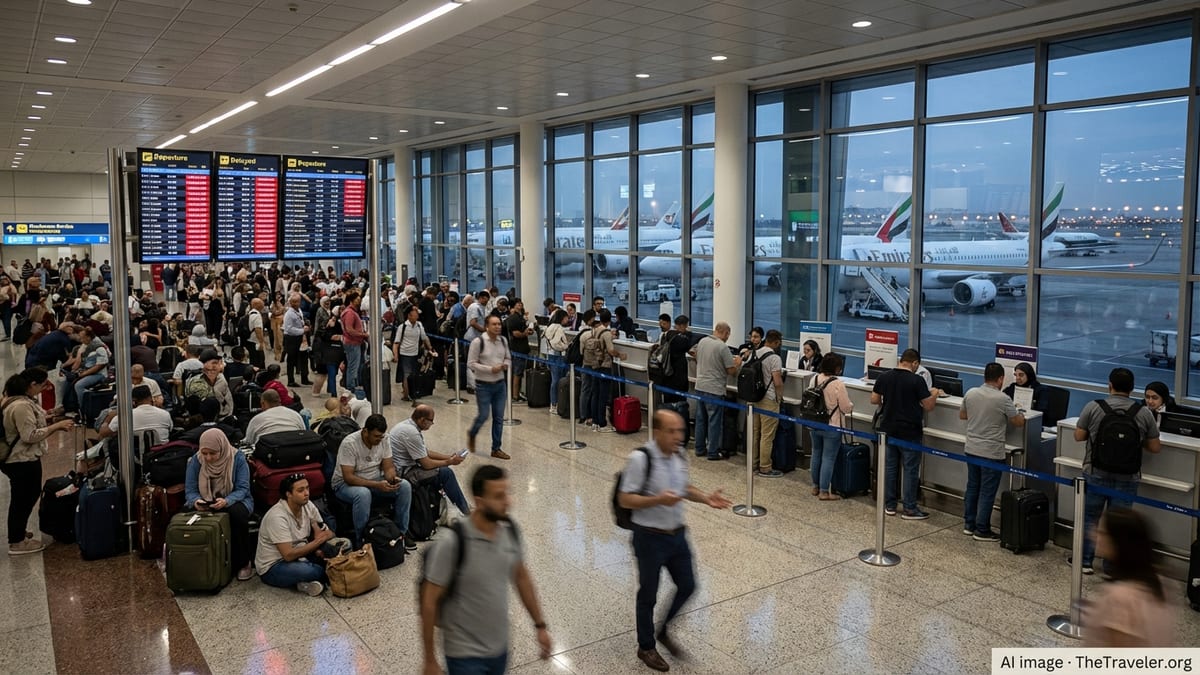
Nowhere is the disruption more visible than in the Gulf’s dominant transit hubs. Dubai International, Hamad International in Doha and Abu Dhabi’s Zayed International Airport all saw large portions of their operations halted over the weekend, throttling the flow of long-haul passengers between Europe, Africa and Asia.
Emirates, Etihad, Qatar Airways and flydubai collectively cancelled or suspended hundreds of flights as airspace restrictions took effect, with some carriers temporarily grounding all departures from their home bases. Although a limited number of services have resumed, schedules remain heavily curtailed and subject to last-minute changes as governments reassess the security situation hour by hour.
The shock is being felt well beyond the Middle East. Travellers transiting through Dubai or Doha on journeys between Europe, India, Southeast Asia and Australia have found themselves stranded, in some cases without immediate options to rebook. Aviation analytics firms estimate that more than a quarter of all flights to the wider Middle East region were cancelled on the first day of the crisis, with knock-on delays registered at airports from London and Frankfurt to Mumbai and Jakarta.
These hubs are also among the world’s largest cargo gateways, and any prolonged disruption risks affecting supply chains for everything from pharmaceuticals to high-value electronics. While freighter operators are exploring alternative routings, longer flight times and higher fuel burn are expected to push up costs.
Global Airlines Cancel, Divert and Reroute
Flag carriers and low-cost airlines across Europe, Asia and North America have announced sweeping schedule changes in response to the conflict. Lufthansa Group, Air France-KLM, British Airways, Finnair, Norwegian and several other European airlines have suspended flights to destinations such as Tel Aviv, Beirut, Amman and Tehran, while also avoiding Iranian, Iraqi and Israeli airspace on long-haul routes to Asia.
Indian carriers are among those hardest hit. Air India has extended the suspension of all flights to and from the United Arab Emirates, Saudi Arabia, Israel and Qatar until late on March 2, while cancelling a series of Europe-bound services and operating others on lengthier detours via Oman, southern Saudi Arabia and Egypt. Budget airlines IndiGo and Akasa Air have also announced one-day suspensions on routes to Abu Dhabi, Doha, Jeddah, Kuwait and Riyadh, affecting hundreds of additional flights.
Gulf-based low-cost carrier Wizz Air has halted services to Israel, Dubai, Abu Dhabi and Amman for several days, and Turkish Airlines has scrubbed flights to a broad list of Middle Eastern cities including in Iran, Iraq, Jordan, Kuwait and the United Arab Emirates. Russian, Asian and North American carriers have joined in, cancelling flights to the region and redesigning transcontinental routes to avoid closed skies.
The cumulative impact is stark. Aviation data providers report that well over a thousand flights have been cancelled across the Middle East and adjoining regions since the latest escalation began, while tens of thousands of flights worldwide have suffered delays due to rerouting, slot constraints and crew availability issues.
What Travellers Can Expect in the Coming Days
For passengers, the most immediate effects are cancellations, long delays and missed connections, particularly for those relying on Gulf hubs as transit points. Travellers booked on routes touching the Middle East should expect their itineraries to change at short notice, even if their final destination lies in Europe, Asia or Africa rather than in the conflict zone itself.
Most major airlines are offering free rebooking on affected routes and, in many cases, refunds for flights that can no longer operate. However, hotel accommodation and compensation rules vary by jurisdiction and carrier, and events linked to armed conflict are often exempt from standard payout regulations. Travellers are being urged to check airline apps frequently, keep contact details up to date and allow significantly more time for connections.
Even where flights are operating, journeys may be longer than usual. Detours around closed airspace can add 30 to 90 minutes to flight times, increasing the risk of missed onward connections and congestion during peak hours at Europe’s already crowded airports. Some long-haul services are planning technical stops for refuelling, turning normally nonstop segments into multi-leg journeys.
Travel insurers are closely scrutinising policy wording, and coverage for disruptions caused by war or military action may be limited. Experts advise passengers to document all expenses and communications with airlines in case partial reimbursement is possible under trip interruption or delay clauses.
How Long Could the Aviation Crisis Last?
The duration of the aviation turmoil will depend largely on how the Iran conflict evolves and whether regional airspace can be reopened in stages. Security analysts say regulators are likely to move cautiously, reopening high-altitude corridors for overflights before restoring full passenger services to some airports, and keeping other destinations off limits altogether until the risk of further strikes subsides.
Industry figures point out that the global network is still adjusting to earlier shocks, from the closure of Russian airspace to lingering operational strains after the pandemic. The loss of yet another major corridor further reduces flexibility, making the system more vulnerable to cascading delays each time weather or technical issues arise elsewhere.
For now, airlines are publishing rolling advisories rather than firm timelines, updating schedules in 24 to 72 hour increments as they receive new guidance from governments and air traffic control authorities. Travellers planning trips that involve the Middle East in the coming weeks are being advised to build in extra buffer time, consider alternative routings where available and stay prepared for rapid changes to flight plans.
What is clear is that the confrontation centred on Iran has rapidly become a global aviation story, underlining how heavily modern air travel depends on a few strategic corridors. Until skies over the region begin to reopen, passengers and airlines alike are likely to face an extended period of uncertainty.