

More news on this day
Dubai’s role as a global crossroads of air travel has been abruptly curtailed after sweeping Middle East airspace closures slashed movements at its normally packed airports to a fraction of usual levels, triggering a cascade of delays, diversions and cancellations for travelers around the world.
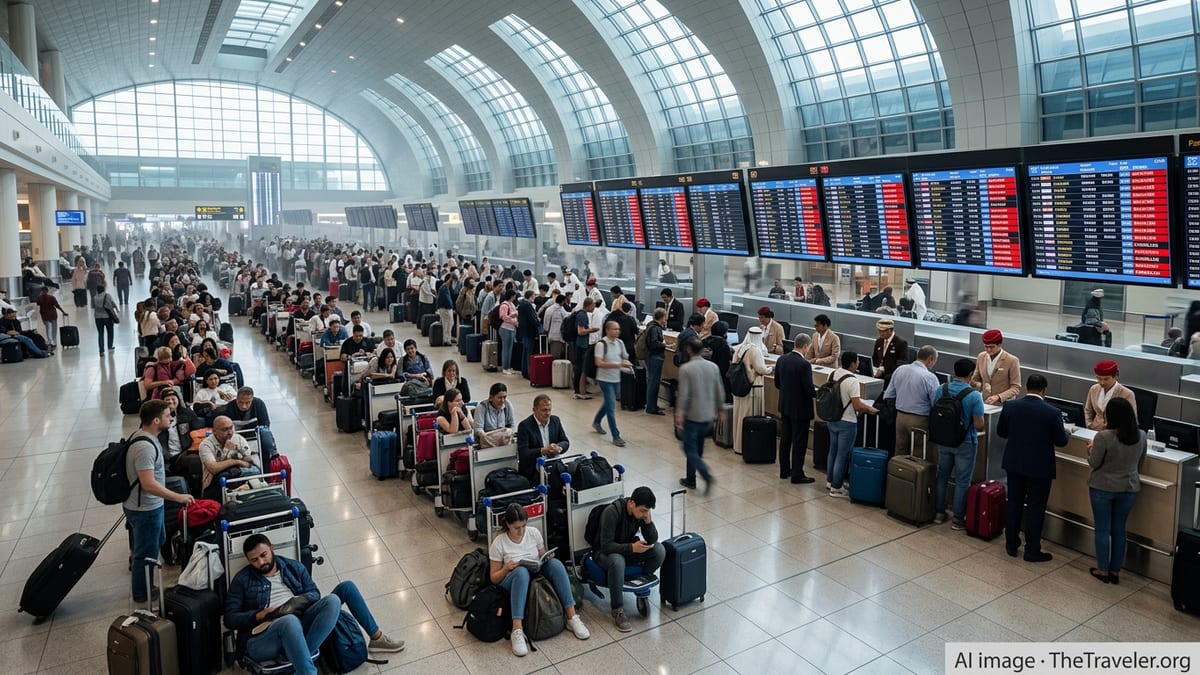
Dubai’s Mega-Hub Slows to a Near Standstill
Once one of the world’s busiest gateways, Dubai International Airport has seen its operations fall from around 1,200 daily aircraft movements to as few as 20 in recent days, according to aviation data shared by regional media. The slowdown follows a rapid escalation of conflict involving the United States, Israel and Iran that has transformed swathes of Middle Eastern airspace into conflict zones.
Authorities in the United Arab Emirates temporarily halted all civilian traffic at Dubai International (DXB) and Dubai World Central (DWC) as missiles and drones were tracked across the Gulf region. Airport officials confirmed that a concourse at DXB sustained minor damage during one incident, with emergency teams deployed and a small number of staff treated for injuries.
While limited operations have now resumed, Dubai’s status as a 24-hour transfer machine has been fundamentally disrupted. Aircraft and crews are out of position, connection banks have been broken and airlines are struggling to restore even skeleton schedules amid continuing overflight restrictions in neighboring states.
The disruption has rippled far beyond the Gulf. With Dubai at the heart of many itineraries between Europe, Asia, Africa and Australasia, flight maps have been redrawn almost overnight, forcing airlines on long, fuel-intensive detours or prompting outright cancellations.
Airspace Closures Reshape Global Routes
Since late February, airspace closures or severe restrictions have been imposed across multiple Middle Eastern countries, including Iran, Iraq, Qatar, Bahrain and Kuwait, with Israel’s skies also shut to civilian traffic. The UAE has allowed only limited, tightly controlled movements, while Saudi Arabia and Jordan have introduced partial or time-bound controls that change from day to day.
For long-haul carriers, this has created a complex patchwork of no-go zones, narrow corridors and shifting security advisories. Routes that once cut across the Gulf and Iran in a straight line now bend north toward Turkey and the Caucasus, or south over the Arabian Sea, adding hours to flight times and pushing aircraft close to their performance limits on certain city pairs.
Aviation safety regulators in Europe and elsewhere have warned of a high risk to civil aviation in affected airspace, advising airlines to avoid the region until further notice. Many carriers have responded by suspending flights entirely to Gulf hubs or by operating only a handful of essential services while they reassess routing options and insurance coverage.
With Russian airspace still largely closed to many Western airlines because of the conflict in Ukraine, the loss of key Middle Eastern corridors has left long-haul planners with few efficient alternatives. Analysts say the combination of detours, higher fuel burn and increased war-risk premiums could weigh on airline finances even if the crisis proves relatively short-lived.
Major Carriers Slash Schedules and Reroute
Dubai-based Emirates, one of the world’s largest long-haul airlines, has suspended the majority of flights to and from its home hub, extending its halt on regular operations while airspace conditions remain volatile. The carrier is running only a small number of services, prioritising passengers with earlier confirmed bookings and those on repatriation or essential travel.
Etihad Airways in Abu Dhabi and Flydubai have enacted similar cuts, cancelling large portions of their schedules and diverting aircraft to alternate airports such as Muscat when last-minute airspace changes make planned routings impossible. Qatar Airways and other Gulf carriers have also been forced into widespread cancellations as their home skies and key overflight routes have closed.
Beyond the region, global airlines from Europe and Asia have pulled back from the Gulf or rerouted flights to avoid conflict zones. Carriers such as British Airways, Lufthansa, Air France, Air India and IndiGo have curtailed services to Dubai and other Middle Eastern destinations, while also reconfiguring Asia-bound routes that once relied heavily on Middle Eastern overflights.
The effect has been stark for travellers who had no intention of visiting the Gulf but were scheduled to change planes there. Itineraries linking cities like London and Sydney, New York and Johannesburg, or Paris and Bangkok via Dubai, Abu Dhabi or Doha have been among the hardest hit.
Stranded Passengers and Airport Contingency Measures
The sudden shutdown of key hubs left tens of thousands of passengers stranded in the UAE and neighbouring states over the weekend. Dubai authorities said more than 20,000 transit travellers were accommodated in temporary shelters and hotels, as airlines raced to provide meals, beds and rebooking options amid fast-changing security conditions.
Inside terminals, scenes of crowded departure halls and long customer-service queues have been reported as travellers sought clarity on when they might move again. Those who had already started multi-leg journeys have been particularly affected, with missed connections leading to complex re-ticketing and lengthy waits for available seats on the few flights still operating.
Airports and airlines have urged passengers not to travel to the airport unless they have a confirmed seat on a flight that is scheduled to operate. Instead, they are advising customers to rely on official airline notifications and to expect that departure times may shift repeatedly as airspace restrictions are updated.
Consular staff from multiple countries have been deployed to UAE airports to assist affected citizens, while some governments are preparing charter operations or alternative routings via safer hubs in Saudi Arabia, Oman, Cyprus and beyond. Travel insurers are fielding a surge in claims and queries as passengers seek refunds or compensation for abandoned trips.
What the Crisis Means for Future Travel Through Dubai
Aviation analysts say the final impact of the Middle East airspace crisis will depend largely on its duration. If airspace closures ease within days, carriers may be able to restore many routes quickly, accepting a short-term financial hit in exchange for preserving their network structures and hub strategies.
If the conflict and closures drag into weeks, however, the consequences could be more profound. Airlines could be forced to permanently reconfigure route maps, shifting connecting traffic to alternative hubs seen as lower risk or more resilient to geopolitical shocks. That could erode some of the competitive advantage Dubai and other Gulf hubs have built over decades.
For now, would-be visitors and transit passengers are being urged to build flexibility into their plans. Industry experts recommend checking flight status and government advisories frequently, travelling with carry-on essentials in case of unscheduled overnight stops, and considering routing options that avoid the most heavily restricted airspace where possible.
Despite the present turmoil, few in the industry expect Dubai’s strategic role in global aviation to disappear. Its geographic location, infrastructure and established airline partnerships mean that once the skies reopen and risk levels subside, traffic is likely to return. How quickly that happens, and whether travellers retain confidence in using the Gulf as a primary corridor between continents, will be the key questions in the weeks ahead.