

More news on this day
Rapidly widening airspace closures across the Middle East are rippling through global aviation networks, forcing airlines into costly detours, shrinking capacity and undermining fragile tourism recoveries from Europe to Asia-Pacific.
Get the latest news straight to your inbox!
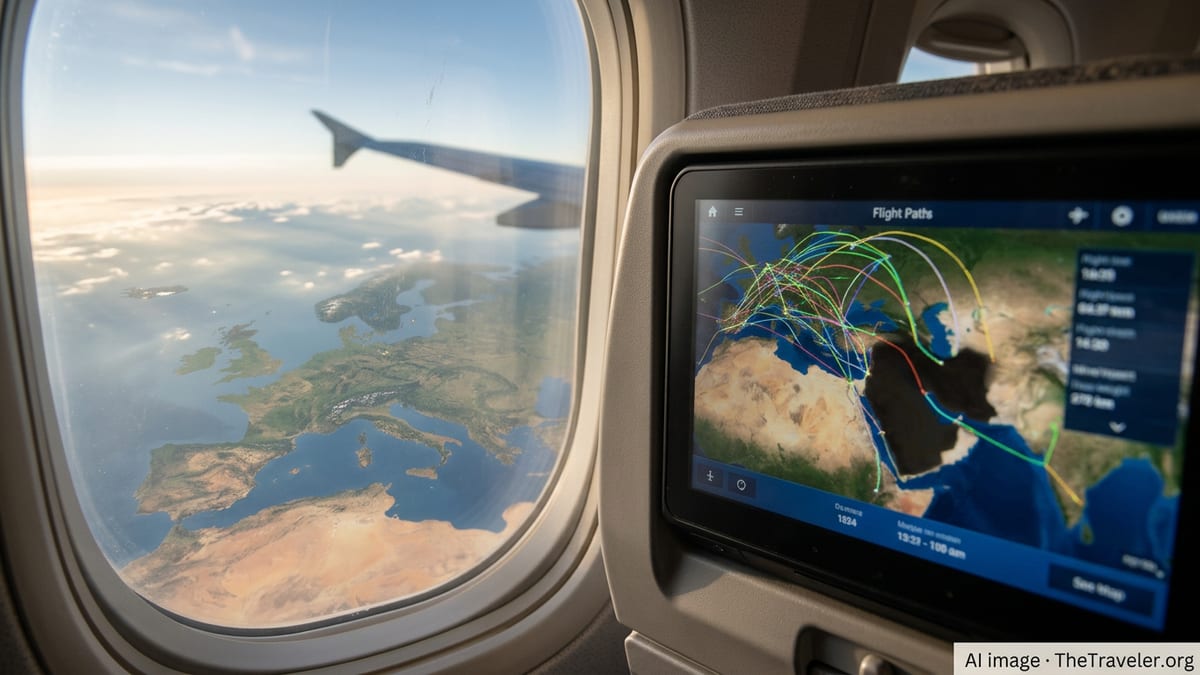
A Core Global Corridor Suddenly Constricts
Publicly available flight tracking and advisory data show that since late February 2026, large parts of the Middle East’s skies have shifted from busy arterial routes to either complete no-go zones or tightly controlled corridors. Airspace over Israel, Iraq, Qatar and Bahrain has been effectively shut to most commercial carriers, while operations in the United Arab Emirates, Saudi Arabia and Oman are constrained by temporary security zones and redefined waypoints.
According to recent travel industry briefings, these restrictions came on top of existing conflict-related warnings over Syria, Yemen and portions of Lebanon and Egypt, further squeezing an already narrow east–west trunk route. Analysts note that many of the flight information regions that connect Europe with South and Southeast Asia now operate with sharply reduced capacity or sudden, short-notice closures.
As a result, airlines have been diverting traffic far to the north over Turkey and the Caucasus or south over the Arabian Sea and the Horn of Africa. Aviation consultancies estimate that some Europe–Asia journeys are adding two to three hours of flying time, a shift that multiplies fuel burn, crew costs and aircraft utilisation challenges on each affected sector.
Industry commentary in outlets such as Condé Nast Traveler and The National highlights how these restrictions are not limited to regional point-to-point services. Long-haul connections that never touch a Middle Eastern airport are being re-routed to avoid closed or high-risk airspace, creating a global knock-on effect in delays and missed connections.
Airlines Slash Schedules and Redraw Routes
Major Gulf and European carriers have moved quickly to cut or consolidate flights while they redesign their networks around the fast-changing map of safe corridors. Travel advisories compiled by cargo and logistics operators show that Qatar Airways temporarily suspended most passenger and cargo services when Qatari airspace closed, while Etihad Airways and other UAE-based airlines shifted to reduced schedules focused on repatriation and essential connections.
In parallel, several global passenger carriers including KLM and Finnair have publicly stated that they are avoiding the airspace of Iran, Iraq, Israel and parts of the Gulf region. This decision pushes more traffic onto longer northerly or southerly routes, raising block times and reducing the number of rotations an aircraft can complete in a 24-hour period.
Financially, the impact is immediate. Industry experts quoted in business media estimate that detours of two to three hours on a wide-body aircraft can add thousands of dollars in operating costs per flight hour. For airlines already grappling with higher fuel prices and intense competition, that translates into rapid pressure to either raise fares, trim frequencies or redeploy capacity to less affected markets.
Operationally, schedule reliability has suffered. Flight status boards across major hubs show clusters of delays linked to crews and aircraft arriving late from rerouted sectors, with some carriers advising passengers not to travel to the airport without confirmed rebookings. Aviation risk briefings warn that this pattern could persist as long as restrictions remain dynamic and conflict risks elevated.
Tourism Hotspots Face Sudden Demand Shocks
The airspace turmoil is radiating far beyond the conflict zone, unsettling tourism flows in destinations that depend heavily on convenient hub connections through the Gulf and Levant. Reports from regional tourism bodies and travel trade media indicate that leisure bookings to Middle Eastern city-break favourites such as Dubai, Abu Dhabi and Muscat have softened as travelers confront uncertainty around flights and potential diversions.
At the same time, detours around the region are reshaping demand into alternative gateways. Mediterranean and Southern European airports that offer connections skirting the affected airspace are seeing increased interest from long-haul travelers trying to keep itineraries intact. Travel agencies in Asia and Europe report that customers planning trips to Africa or the Indian Ocean are being steered through longer, more complex routings that avoid the most constrained corridors.
Tour operators focused on religious tourism and multi-country itineraries in the Middle East are particularly exposed. Public advisories show widespread suspensions of flights into parts of Iraq, Jordan and Lebanon, cutting key access points for pilgrimage traffic and cultural tours. Some operators have pivoted to last-minute alternatives in Turkey, Cyprus and North Africa, but many departures are being postponed outright.
Insurance considerations are also reshaping choices. With several governments updating travel advisories for countries across the region, insurers are tightening coverage conditions for trips that rely on volatile airspace. Travel risk firms note that corporate travel managers are under pressure to demonstrate that routings avoid elevated-risk zones, further reducing demand for itineraries that once relied on Middle Eastern hubs.
Global Networks, Cargo Flows and Prices Under Strain
The disruption is not confined to holidaymakers. Air cargo, express shipments and time-critical supply chains are also feeling the strain as closures and reroutes reduce lift and complicate schedules. Market updates from freight forwarders show that integrators and cargo operators have suspended or diverted flights serving Bahrain, Iran, Iraq, Israel, Jordan, Kuwait, Lebanon, Oman, Qatar, the United Arab Emirates and Saudi Arabia.
With many of the world’s key east–west cargo lanes funneled through the same skyways now subject to closures, shippers report lengthening transit times and tightening capacity. Some logistics providers are experimenting with hybrid air–sea or air–road solutions that route freight via alternative ports and secondary airports farther from the conflict zone, but these workarounds often add days to delivery windows.
The pressure comes on top of existing maritime disruption in the Red Sea and Suez region, forcing more ships around the Cape of Good Hope and crowding ocean lanes. Combined with higher aviation costs, the result is a broad-based rise in logistics expenses that can filter through into consumer prices worldwide, from fashion and electronics to pharmaceuticals and perishables.
Analysts caution that while airlines and logistics companies are practised at crisis rerouting after years of geopolitical shocks, the sheer concentration of no-go airspace across such a vital crossroads makes this episode unusually far-reaching. The longer closures persist, the more permanent some of the network changes are likely to become.
Travelers Confront Longer Journeys and Shifting Advice
For individual travelers, the practical effect of the airspace crisis is a mix of longer travel times, more complex routes and a heightened need to monitor advisories in real time. Recent coverage by consumer travel outlets underlines how fast conditions are changing, with airlines updating schedules day by day and rerouting flights mid-season as risk assessments evolve.
Passengers flying between Europe and Asia are among the most affected. Many now face overnight connections instead of single-hop flights, additional technical stops for refuelling, or significant time added to itineraries as aircraft thread through remaining safe corridors. In some cases, travellers who had booked transits through Gulf hubs are being rebooked through entirely different regions, including northern Europe or southern Africa.
Travel risk consultancies recommend that passengers check both airline travel alerts and government advisories repeatedly in the days leading up to departure, and avoid booking tight connections on routes that skirt restricted airspace. Flexible tickets and comprehensive travel insurance with disruption cover have become more valuable, as sudden airspace closures can trigger sweeping cancellations with limited on-the-spot alternatives.
With no clear timeline for a full reopening of Middle Eastern skies, the crisis is reinforcing a lesson learned during past geopolitical shocks: aviation and tourism are deeply exposed to regional conflict, and a shutdown in one strategic air corridor can send tremors through travel plans and tourism revenues across the globe.