

More news on this day
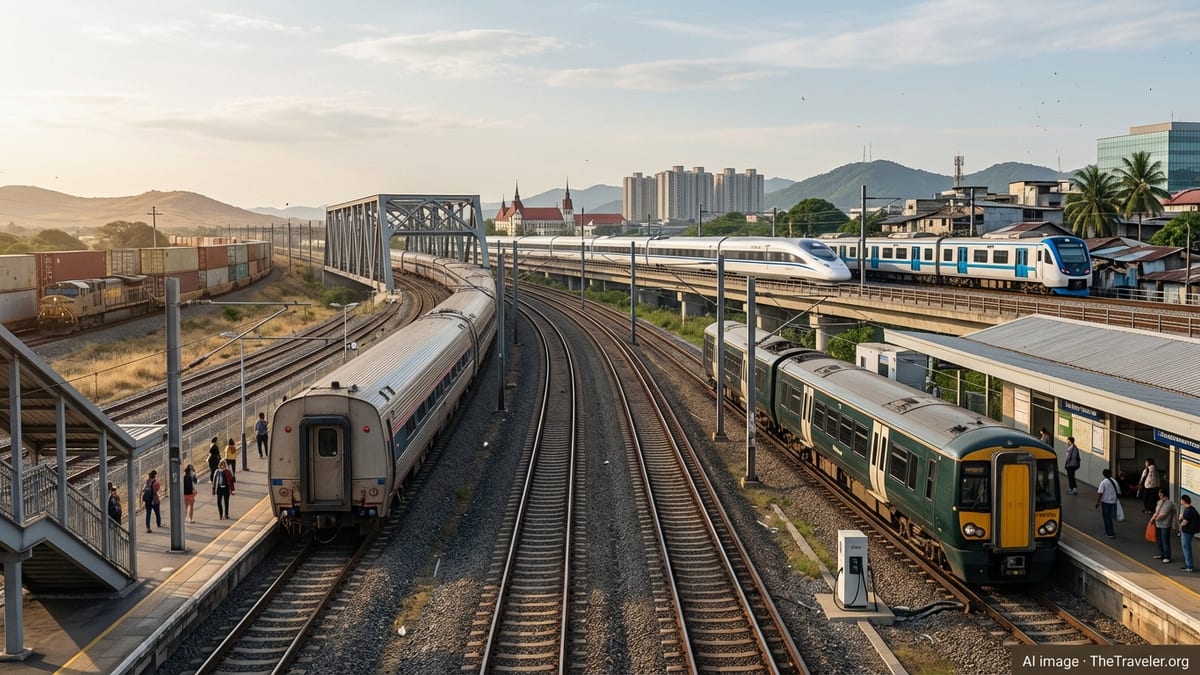
Across the world’s rail networks, governments are treating new tracks, cleaner trains and smarter timetables as strategic infrastructure. In early 2026, the United States, United Kingdom, Australia, the Philippines, China, the Czech Republic and India are all pushing ahead with major changes that promise tighter route connectivity and lower-carbon rail travel.
While each country is moving at its own pace, together they point to a broad shift toward rail as the backbone of more sustainable mobility and freight.
More News
- Caribbean Travel to U.S. Upended by New Visa Freezes and Expanded Bans
- Mexico Restores E-Visas for Brazilians, Paving the Way for Borderless Tourism
- Philippine Airlines Joins Regional Carriers Powering Southeast Asia’s Tourism Boom
United States: Corridor Upgrades and a Slow March to High-Speed Rail
In the United States, where car and air travel still dominate, rail investment is increasingly framed as both a climate and competitiveness priority. Federal funding packages adopted over the past several years are now filtering into concrete projects, particularly along the dense Northeast Corridor and a handful of emerging high-speed routes in the South and West. State and regional agencies are using federal grants to straighten curves, replace aging bridges and add passing tracks, all of which allow more trains to run more reliably on existing rights of way.
Improved connectivity is most visible in efforts to stitch together growing city pairs with higher frequencies rather than single flagship trains. New or upgraded intercity services linking hubs such as Dallas and Houston, Las Vegas and Southern California, and corridors in North Carolina and Virginia are designed to offer journey times that compete with flying when security queues and transfers are taken into account. The focus is on predictable, clockface timetables and easier transfers to local transit, positioning rail as a realistic alternative for medium-distance trips that are currently made by car.
Sustainability is emerging both through cleaner rolling stock and better operations. Several U.S. regional railroads are trialling battery-electric and hydrogen-powered trains on shorter corridors where full electrification is not yet justified, seeking to cut diesel emissions while long-term infrastructure decisions are made. At the same time, dispatching systems are being modernised so that freight and passenger services can share lines more efficiently, reducing congestion-induced idling and associated fuel burn. While the U.S. still lags behind rail-heavy countries, the policy direction now clearly leans toward rail as a central plank of climate strategy.
United Kingdom: Battery Trains and a Rewired Rail Governance Model
The United Kingdom is moving on two parallel tracks: decarbonising its rolling stock and reshaping how the network is run. At the end of January 2026, Great Western Railway introduced the UK’s first rapid-charging battery train into passenger service on a short commuter branch in west London. The converted train operates solely on battery power and can recharge in around three and a half minutes via a high-capacity charging system embedded in the track at West Ealing station. This trial is being closely watched as a template for hundreds of lightly used diesel-operated routes where full overhead electrification would be prohibitively expensive.
Elsewhere, operator LNER has unveiled a new “Serenza” long-distance fleet designed to improve the passenger experience while encouraging a shift from short-haul flights. The trains offer upgraded seating, power and USB-C at every seat, redesigned bike storage, and enhanced accessibility, as well as amenities such as free water refill points. Together with incremental speed and reliability gains on the East Coast Main Line, the goal is to make rail the preferred way to travel between London and major cities such as Leeds and York, reducing aviation emissions on domestic routes.
Structural reform is just as significant as technological change. By early 2026, the majority of major rail operators in Great Britain have moved into public ownership under a phased nationalisation programme. A new coordinating body, widely referred to as Great British Railways, is being established to integrate infrastructure and service planning. Supporters argue that unified control will allow timetables to be better meshed across operators, making transfers smoother and boosting overall connectivity, particularly in regional areas that have historically seen fragmented service patterns.
From a sustainability perspective, the UK government is betting that better-integrated rail operations, together with targeted electrification and the rollout of battery trains, will sharply cut diesel use. The combination of technology pilots and a more centralized governance structure positions the UK as a testbed for how legacy rail systems can transition toward net-zero operations without pausing day-to-day service.
Australia: Inland Rail and the Rise of Low-Carbon Freight Corridors
Australia’s most consequential rail project is unfolding not in its big coastal cities, but along a 1,600 kilometre inland spine. The multibillion-dollar Inland Rail scheme, now well into its construction phase, will link Brisbane and Melbourne with a freight route designed for long, double-stacked trains. Project leaders report that, as of late 2025, the line has generated more than 7,600 jobs and channelled hundreds of millions of dollars in contracts to regional businesses, underlining its economic as well as logistical significance.
Connectivity gains from Inland Rail will be structural. By bypassing congested coastal bottlenecks and ports, the new line is expected to shorten freight journeys between Queensland, New South Wales and Victoria by several hundred kilometres. That, in turn, can reduce heavy truck traffic on highways, easing congestion and road maintenance costs. The project is being carefully integrated with existing freight hubs so that agricultural and mining regions across the interior can plug into faster, more predictable rail services to ports and markets.
Sustainability has been written into the project from the outset. Routing more freight from trucks onto trains sharply cuts emissions per tonne-kilometre, even when locomotives remain diesel-powered in the near term. The project proponent has highlighted environmental measures such as careful water and biodiversity management along the corridor, together with an emphasis on local sourcing and Indigenous participation in the supply chain. Over the longer term, Inland Rail is expected to be compatible with emerging low- and zero-emission locomotive technologies, allowing Australia’s freight backbone to become steadily cleaner over its operating life.
Beyond Inland Rail, Australian state governments are continuing to electrify and upgrade commuter and regional lines, particularly around Sydney, Melbourne and Brisbane. New intercity fleets and track upgrades are aimed at better linking fast-growing outer suburbs with central business districts, reducing car dependence and helping cities meet their emissions targets.
Philippines: Building a Modern Rail Backbone for Metro Manila and Beyond
The Philippines is in the midst of a rail-building phase unlike anything in its recent history, driven by the need to relieve chronic road congestion and cut urban air pollution. At the heart of this transformation is the North South Commuter Railway, a multi-section project intended to connect Clark in the north, central Manila and Calamba in the south with modern electric trains. Portions of the line are already under construction, with test runs and phased openings expected to begin in the second half of the decade.
The new line will dramatically improve connectivity across the sprawling Greater Manila area. Designed for frequent, high-capacity operations, it will allow commuters from outlying provinces to reach central business districts and airports in a fraction of current journey times. By co-locating stations with bus terminals and future metro lines, planners are attempting to create genuinely multimodal hubs, encouraging travellers to shift away from informal minibuses and private cars.
Sustainability is integral to the project’s design. The North South Commuter Railway is being built as an electrified corridor, enabling the use of modern rolling stock that produces no tailpipe emissions in operation. It is also being financed and developed with climate resilience in mind, incorporating elevated sections and flood-resistant infrastructure in low-lying areas. Multilateral development banks monitoring the project have positioned it as a showcase for how emerging economies can leapfrog to lower-carbon urban mobility while still expanding capacity at scale.
Additional schemes, including the Metro Manila Subway and extensions of existing commuter rail lines, are being coordinated with the North South Commuter Railway to create a more coherent network. For the Philippines, which has historically underinvested in rail, these projects together represent a decisive pivot toward rail-based connectivity as a foundation for more sustainable urban growth.
China: High-Speed Expansion and Next-Generation Low-Carbon Technology
China continues to set the global pace on high-speed rail expansion, with new lines opening and more under construction as the country targets a long-term national network that can move most intercity trips from planes and cars onto trains. At the start of 2025, China’s rail operator indicated that total high-speed mileage would surpass 50,000 kilometres by the end of the year, with plans to reach around 60,000 kilometres by 2030. This expansion is bolstered by new routes linking secondary cities into the national grid and high-speed loops that improve intra-provincial connectivity.
Recent openings and upgrades underscore how the network is pushing deeper into regional interiors and tourist areas. In Hubei province, the Wuhan–Yichang high-speed railway began operations at the end of 2025, creating a faster link across the Yangtze corridor and easing pressure on older conventional lines. The Xiangyang–Jingmen high-speed railway also opened in September 2025, helping to complete a high-speed ring within the province. In northeast China, the Shenyang–Baihe line, fully opened in late 2025, connects major cities with the Changbai Mountain region, a significant step in using high-speed rail to support sustainable tourism.
China is pairing physical expansion with technological advances aimed at cutting travel times and emissions. The state-backed CR450 trainset, designed for commercial speeds around 400 kilometres per hour, is undergoing intensive testing. Officials have signalled that once it enters service, it will be the fastest conventional high-speed train in operation, further narrowing the gap between rail and air on core routes. In parallel, a 600 kilometre per hour maglev prototype has been unveiled, with the government positioning it as a long-term option for ultra-fast, high-capacity, low-emission travel between major metropolitan clusters.
Policy makers present these developments as central to a “1-2-3” mobility vision under which trips within metropolitan areas take one hour, between city clusters two hours, and between major national hubs three hours. Achieving this framework would significantly reduce the climate impact of China’s rapidly growing middle-class travel demand. Electricity for the rail network is increasingly sourced from renewables, meaning that every passenger shifting from short-haul flights or private cars to high-speed trains amplifies the emissions savings.
Czech Republic: Planning a New High-Speed Spine for Central Europe
The Czech Republic, a country long served by conventional intercity rail, is preparing for its first generation of true high-speed lines. The government has laid out plans for around 800 kilometres of high-speed corridors to be in place by mid-century, forming a network that will link Prague, Brno, Ostrava and key border crossings to Germany, Austria and Poland. In early 2026, officials confirmed that the first line capable of speeds above 300 kilometres per hour, known as the Moravská brána corridor, is targeted to open around 2035.
Work is already advancing on prerequisites such as upgrading and electrifying the line between Přerov and Brno to allow higher speeds of up to 200 kilometres per hour. Parallel efforts include the Prague–Světlá nad Sázavou route toward Brno and the Prague–Dresden corridor, both of which are at relatively advanced stages of planning and approval. These projects are supported by European Union funding instruments, which see improved Czech connectivity as a linchpin for more efficient north–south and east–west rail flows across the continent.
Recent agreements with the European Investment Bank signal that the country intends to use public-private partnerships for some segments, particularly the airport rail link between central Prague and Václav Havel Airport. The aim is to create a modern, electrified route that not only slashes journey times for air passengers but also frees up capacity on existing lines for regional commuter and freight services. By shifting long-distance passengers onto dedicated fast tracks, conventional lines can be optimised for more frequent stopping services and freight paths, enhancing overall connectivity without compromising punctuality.
Environmental considerations sit at the heart of the Czech high-speed programme. Officials have emphasised that, in a country where road transport has steadily grown, a compelling high-speed rail alternative is critical for meeting climate targets. By offering reliable, rapid journeys between major cities and connecting seamlessly to neighbouring countries’ high-speed networks, the Czech Republic hopes to make rail the default for trips that might otherwise be taken by car or plane.
India: Vande Bharat Rollout and Network Modernisation for a Greener Future
India is pursuing one of the world’s most ambitious passenger rail modernisation drives as it seeks to carry hundreds of millions of additional travellers while curbing transport emissions. A flagship element is the expansion of the semi-high-speed Vande Bharat train family. In early 2026, the government confirmed plans to manufacture around 260 Vande Bharat sleeper train sets, adding to an existing fleet of daytime services that already connect key city pairs at up to 160 kilometres per hour.
The new sleeper variants are designed to transform overnight rail travel by combining higher speeds with improved onboard comfort and safety features. They will be deployed on long-distance trunk routes, enabling faster links between metros and major regional centres without the need to build entirely new high-speed lines everywhere. The rollout is part of a broader “railway modernisation” agenda that includes upgraded signalling, track renewals and the adoption of advanced safety systems across the network.
Connectivity improvements are also playing out on suburban and regional scales. In the Mumbai region, for example, work is progressing on the Virar–Dahanu Road corridor quadrupling project, which includes large new bridges such as the Vaitarna crossings designed to carry four broad-gauge tracks with higher axle loads. The goal is to physically separate suburban and long-distance services, easing chronic congestion and improving punctuality on one of the world’s busiest commuter networks. Similar capacity expansions are under way around Delhi, Chennai and other metropolitan areas.
On sustainability, India is pursuing multiple strategies at once. The railways have committed to net-zero operational emissions within the coming decade, backed by large-scale solar power installations on railway land and station rooftops, as well as energy-efficiency measures in stations and depots. Electrification of key routes is accelerating so that new trains like Vande Bharat can run under electric power across more of the country, reducing reliance on diesel locomotives. For a nation experiencing rapid growth in both population and mobility demand, these steps position rail as a relatively low-carbon backbone of national connectivity.
FAQ
Q1: How are these railway changes improving international connectivity between the featured countries?
Most of the current projects focus on domestic corridors, but they indirectly enhance international connectivity by feeding passengers and freight into cross-border routes and airports more efficiently. High-speed links in China and the Czech Republic, for example, plug into wider European and Asian rail corridors, while better U.S. and UK services connect to major international airports, smoothing long-distance, multi-modal journeys.
Q2: Which country is moving fastest toward a fully high-speed passenger network?
China remains the clear frontrunner, both in terms of existing high-speed track length and the pace of ongoing expansion. With tens of thousands of kilometres already in operation and more under construction, it has a scale and speed of rollout that far exceeds that of the UK, Czech Republic or India, where high-speed and semi-high-speed corridors are still in earlier stages.
Q3: How do these projects contribute to lower greenhouse gas emissions?
Rail generally emits far less carbon per passenger or per tonne of freight than road or air travel, especially when powered by low-carbon electricity. Electrification in the Philippines, China, the Czech Republic and India, along with battery-powered trains in the UK and freight shifts in Australia, all reduce reliance on diesel and help displace higher-emission modes such as cars, buses and trucks.
Q4: Are passengers already experiencing shorter journey times as a result of these changes?
In several countries, yes. Newly opened lines in China, upgraded services in India and pilot battery train operations in the UK are already shaving minutes or even hours off conventional travel times. In other cases, such as the Czech high-speed corridors or some U.S. intercity projects, the biggest time savings will materialise later in the decade as construction progresses and new timetables are introduced.
Q5: How are governments ensuring that rail expansions benefit regional and rural areas, not just big cities?
Many projects explicitly include regional connectivity as a core aim. Australia’s Inland Rail is routed through inland communities rather than coastal metros, India is adding capacity on suburban lines that serve outlying districts, and the Philippines’ commuter rail upgrades extend beyond central Manila. Even in high-speed-focused countries like China and the Czech Republic, planners are pairing fast intercity tracks with improved regional services on existing lines.
Q6: What role does new train technology play compared with traditional electrification?
New technologies such as battery and hydrogen trains complement classic overhead electrification rather than replace it outright. In the UK and, potentially, parts of the U.S. and Australia, they allow operators to decarbonise shorter or lightly used branches where installing wires would be costly. At the same time, countries like China and India continue to rely on large-scale electrification for their busiest main lines, using advanced trainsets to maximise performance on those routes.
Q7: How are these projects being financed, given their high upfront costs?
Funding models vary by country, but most blend public investment with loans, sometimes supplemented by public-private partnerships. The Czech Republic, for example, is drawing on European Union support and European Investment Bank advisory services. Australia and India are relying heavily on national budgets, while some U.S. schemes combine federal grants with state funding and private capital. Multilateral development banks are particularly active in the Philippines, supporting sustainable urban rail with concessional finance.
Q8: Will ticket prices rise as networks modernise and new trains are introduced?
Authorities generally aim to keep rail fares competitive with road and air travel, especially where they are seeking to shift travellers to lower-carbon modes. While premium high-speed or upgraded services can carry higher fares, many governments, including those in India and parts of Europe, continue to provide subsidies or regulated fare structures to maintain affordability, particularly for commuter and regional passengers.
Q9: How are environmental and community concerns addressed during construction?
Large rail projects increasingly undergo extensive environmental impact assessments and community consultations. Australia’s Inland Rail and various bridge and corridor upgrades in India, for example, have incorporated measures to manage water, noise, and biodiversity impacts, as well as efforts to work with local and Indigenous communities. Similar processes are in place in the Czech Republic and the Philippines, where land acquisition and resettlement are sensitive issues.
Q10: When will travellers see the full impact of these connectivity and sustainability initiatives?
Timelines differ. Some benefits, such as reduced emissions from new battery trains or incremental speed increases on upgraded lines, are already visible. However, the most transformative changes, like the completion of Inland Rail in Australia, full high-speed corridors in the Czech Republic, or widespread deployment of new Vande Bharat sleeper trains in India, will unfold gradually over the next five to fifteen years as construction concludes, networks are integrated and travel habits adapt.