

More news on this day
Americans heading into the 2026 spring travel season are being urged to rethink itineraries as Middle East conflict, airspace closures and a U.S. government funding lapse combine to disrupt global flight paths and trigger hours-long security lines at home.
Get the latest news straight to your inbox!
Heightened Middle East Tensions Reshape Global Flight Routes
Escalating conflict involving the United States, Iran and regional allies is rapidly reshaping the map for long-haul travel between North America, Europe and Asia. Publicly available aviation tracking data and media reports point to widespread airspace closures across much of the Gulf region after late February strikes in Iran, forcing airlines to divert or suspend routes that typically pass over the Middle East.
Airspace restrictions over Bahrain, Iraq, Kuwait, Qatar, Syria, the United Arab Emirates and Israel have removed key corridors for flights linking Europe and Asia, with some carriers rerouting via longer paths over the Caucasus, Central Asia or Africa. These diversions add time, fuel costs and complexity, which can translate into higher fares, missed connections and tighter aircraft rotations for travelers originating in the United States.
Maritime disruption in the Strait of Hormuz and continued risk to shipping in the Red Sea are adding further strain to an already fragile transport network. Shipping advisories describe reduced traffic through the Gulf and caution that any renewed attacks on tankers or infrastructure could deepen volatility in the region’s logistics, with knock-on effects for cargo capacity in passenger aircraft and supply chains that support airline operations.
Travel risk firms are advising clients to expect short-notice schedule changes, extended journey times and additional technical stops for refueling on routes that previously overflew affected areas. For U.S. passengers booked on spring trips to or through the Middle East, this means itineraries that looked straightforward when purchased earlier in the year may now involve unplanned overnights or last-minute rebookings.
U.S. Issues Stronger Warnings for Travel Across the Region
The evolving security picture has prompted a flurry of updated government advisories for American citizens in parts of the Middle East. Recent public guidance from U.S. diplomatic missions in the region highlights elevated risks tied to protests, missile and drone activity and potential attacks near government installations, airports and western-linked sites.
In Iraq, a security message from the U.S. Embassy in Baghdad in early March urged American citizens to shelter in place during large demonstrations around the city’s fortified Green Zone, underscoring concerns that political unrest could spill into areas frequented by foreigners. Similar alerts have referenced road closures and intermittent disruption around diplomatic compounds and critical infrastructure.
Regional travel bulletins prepared by private security consultancies describe a patchwork of airport statuses, with some major hubs operating limited commercial flights and others suspending services entirely due to security conditions or airspace bans. Travelers are being cautioned that formal airport closures may come with little notice if tensions intensify, particularly near military facilities or key energy terminals.
For U.S. leisure travelers contemplating spring break trips to Gulf destinations or onward connections through regional hubs, these advisories collectively amount to a strong signal to reassess risk tolerance. Insurance policies, routing flexibility and the ability to change plans at short notice are becoming central considerations, even for itineraries that do not directly enter declared conflict zones.
TSA Delays Mount Amid Partial Government Shutdown
While international headlines focus on missile launches and airspace maps, many U.S. travelers are feeling a more immediate impact at the airport checkpoint. A partial federal government shutdown affecting the Department of Homeland Security has left Transportation Security Administration screening officers working without pay, a dynamic that aviation and travel groups long warned could strain the system during peak demand.
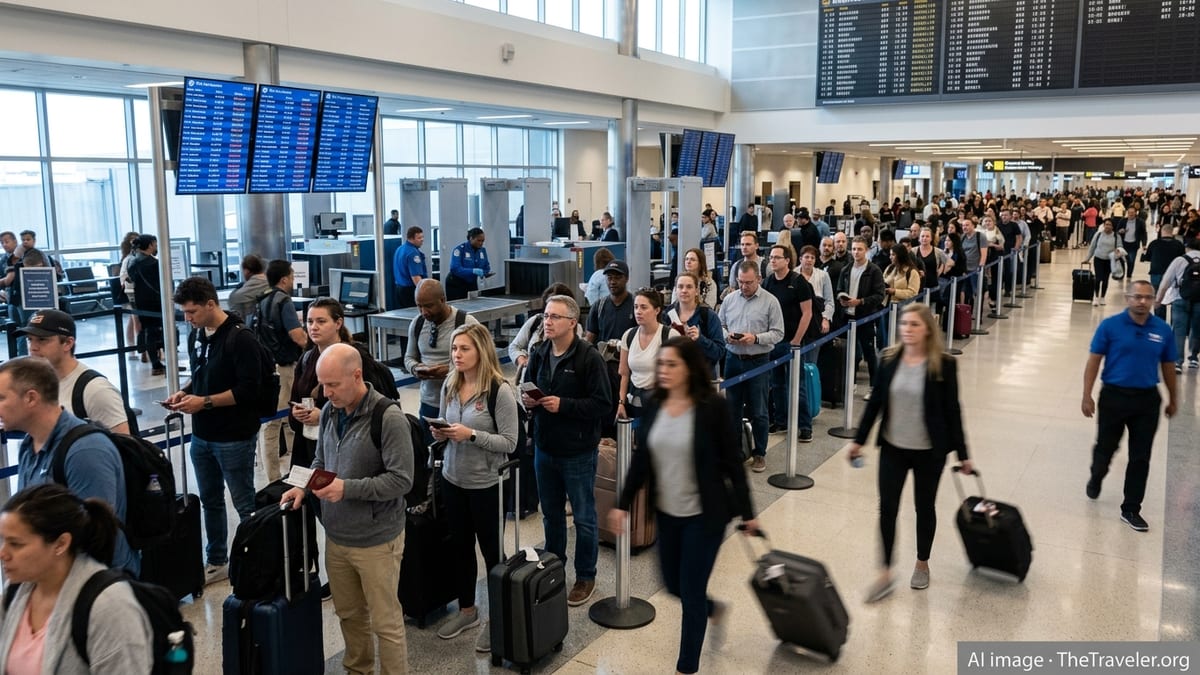
In early March, consumer travel coverage and local news outlets documented three-hour or longer security lines at several major airports, particularly during morning rush periods and spring break weekends. Reports from cities such as Houston described temporary queues stretching through terminals when staffing levels dipped, before additional officers were shifted in and wait times eased.
Nationally, the combination of unpaid shifts, unscheduled absences and record passenger volumes has forced airports and airlines to urge travelers to arrive much earlier than normal. Some carriers and airport operators are recommending passengers build in three to four hours for check-in and security on busy days, especially if they do not have TSA PreCheck or CLEAR and are departing from hub airports with heavy connecting traffic.
Industry analysts note that the current shutdown follows previous funding lapses that already tested the resilience of the TSA workforce. A recent aviation-focused analysis projected that, if prolonged, the present disruption could push security-related delays from a manageable nuisance into a visible driver of missed flights and rolling knock-on delays across the network.
System Outages and Weather Add Another Layer of Uncertainty
The pressure on travelers is being compounded by technical and weather-related turbulence elsewhere in the system. Earlier in March, a failure in a key Federal Aviation Administration notification platform triggered widespread delays and forced at least one major U.S. airline to temporarily halt departures, adding to passenger frustration already heightened by security bottlenecks.
Recent winter storms and severe weather events have also led to hundreds of cancellations and thousands of delays on multiple days across the United States, hitting large hubs in the Midwest and Pacific Northwest particularly hard. These disruptions ripple quickly when security lines are already stretched, since rebooked passengers must pass through screening again and flights depart with tighter turnaround margins.
A growing body of academic work on aviation reliability suggests that security delays now play a more visible role in propagating disruption through hub-and-spoke networks than they did a decade ago. Researchers analyzing U.S. on-time performance data between 2010 and 2024 found that as airports operate closer to capacity, even relatively small slowdowns at checkpoints can tip complex schedules into broader waves of missed connections and late arrivals.
The result for spring 2026 is a travel environment where small operational hiccups interact with larger geopolitical and funding shocks. Travelers may find that a localized storm, brief technology outage or staffing gap at one airport develops into a full-day cascade of inconvenience if it coincides with constrained airspace or already stressed security operations.
What Spring Travelers Should Expect in the Weeks Ahead
With the Iran conflict ongoing, airspace still restricted over parts of the Middle East and the U.S. government shutdown unresolved as of late March, travel planners warn that volatility is likely to persist at least through the core spring break period. Airlines are continuing to adjust schedules on short notice, swapping aircraft types, rerouting long-haul flights and, in some cases, suspending specific city pairs that depend on Gulf overflight rights.
Travelers with tickets to or through the region are being urged by consumer advocates to monitor airline notifications closely and to confirm that contact details in reservations are current, so that rebooking offers or schedule changes arrive promptly. Experts also note that seemingly indirect knock-on effects, such as tighter aircraft availability or crew scheduling challenges, can affect flights with no direct link to the Middle East or Washington politics.
Within the United States, spring break crowds will continue to test airport checkpoints as long as TSA staffing remains under pressure. Smaller regional airports that usually see modest lines may experience occasional surges if a single checkpoint lane closes or if one or two officers call out, while large hubs face sustained stress during morning and evening peaks.
For now, publicly available information points to a season defined less by a single disruptive event and more by the convergence of several: a widening conflict along critical global flight corridors, a domestic funding stalemate affecting front-line screeners and a backdrop of severe weather and technical glitches. The combined effect is that even well-planned spring trips may require an extra margin of time, flexibility and patience in 2026.