

More news on this day
Hundreds of thousands of travelers were left stranded or diverted around the world on Sunday after a sudden shutdown of large swathes of Middle East airspace forced airlines to cancel or reroute thousands of flights, plunging the global aviation system into its worst crisis since the pandemic.
Gulf Super-Hubs Grind to a Halt
The abrupt closure of skies over Iran, Iraq, Israel, Syria, Kuwait, Bahrain, Qatar and the United Arab Emirates triggered an immediate standstill at the Gulf’s three powerhouse transit hubs: Dubai, Abu Dhabi and Doha. Flight tracking services showed traffic vanishing from the regional map within hours as aviation authorities issued emergency notices and airports suspended operations.
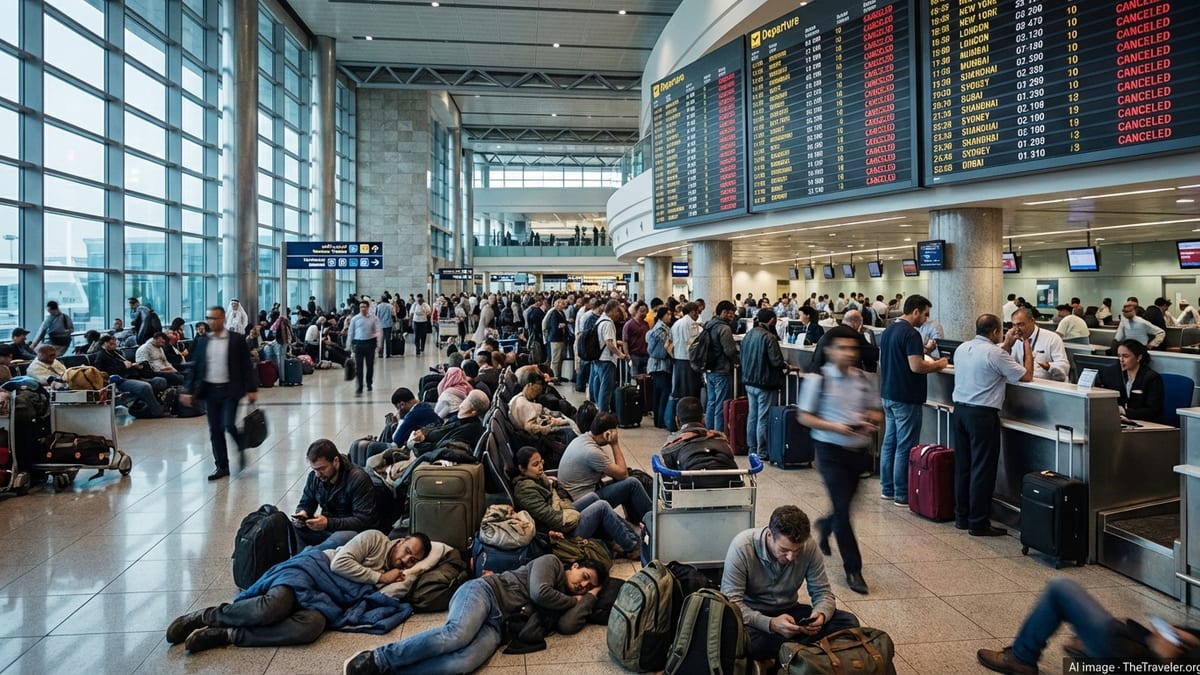
Emirates, Qatar Airways and Etihad, which together funnel roughly 90,000 passengers a day through their hubs in normal times, canceled or halted the majority of their services as jets already en route were diverted to secondary airports or forced to turn back. Terminal departure boards in Dubai and Doha filled with red cancellation notices while airport public address systems repeatedly urged passengers not to proceed to the terminals unless specifically instructed by their airline.
In Dubai, one of the world’s busiest international gateways, operations were further complicated by damage from incoming missiles and drones, with officials reporting injuries to passengers and staff. Abu Dhabi’s main airport also recorded casualties after a drone strike, deepening safety concerns and reinforcing the decision to keep much of the region’s airspace closed to civilian traffic.
Aviation analysts warned that these simultaneous shutdowns at the very crossroads of East–West travel represent a structural shock to the global route network, with even brief closures translating into days of disruption for passengers trying to reach Europe, Asia, Africa and Australasia.
Ripple Effects From Europe to Asia-Pacific
The airspace lockdown rapidly spread chaos far beyond the immediate conflict zone. Airlines in Europe, Asia-Pacific and North America scrambled to adjust long-haul services that normally overfly the Middle East en route between continents, confronting a complex puzzle of diversions, crew duty limits and fuel constraints.
Preliminary analytics indicated that roughly a quarter of all scheduled flights to the broader Middle East were canceled within hours of the first strikes, with even higher cancellation rates into Israel, Qatar and Kuwait. Globally, tracking firms logged many thousands of delays and several thousand outright cancellations as carriers tore up timetables and sought alternative routings over Saudi Arabia, North Africa and Central Asia.
For passengers, the impact has been immediate and deeply disruptive. Travelers bound from Australia and Southeast Asia to Europe have been forced into last-minute detours via Singapore, Bangkok or Istanbul, often requiring unplanned overnight stays. In major European hubs, lines have snaked through departure halls as airlines attempt to reaccommodate stranded customers whose itineraries relied on Gulf connections.
Industry experts say the knock-on effects will be felt for days even if some airspace begins to reopen, likening the current situation to the early days of the Russia–Ukraine airspace closures, which permanently reshaped many long-haul routes and pushed up operating costs.
Airlines Cut Routes and Brace for Prolonged Disruption
Major carriers across multiple regions announced sweeping suspensions of services to Middle Eastern destinations and key transit points. In addition to the Gulf giants, airlines such as Lufthansa, Air France, British Airways, Turkish Airlines and leading Indian carriers halted or sharply curtailed flights to cities including Tel Aviv, Dubai, Doha, Beirut, Amman and Tehran.
Several operators introduced flexible rebooking policies and fare waivers for affected passengers, but warned that limited spare capacity on alternative routes and aircraft already tightly deployed for the northern spring travel season would constrain options. Some airlines indicated that suspensions could last several days or longer, depending on how quickly security conditions stabilize and how regional regulators coordinate potential reopening.
Rerouting around closed airspace adds hours to some long-haul journeys and significantly increases fuel burn, costs that carriers are likely to pass on to customers if the disruption continues. Analysts note that airlines were already contending with higher operating expenses tied to previous detours around Russian and Ukrainian airspace, leaving little buffer to absorb yet another shock.
Behind the scenes, airline operations centers have moved to round-the-clock crisis footing, with dispatchers, pilots and ground teams working to reposition aircraft and crews stranded out of place. The resulting imbalance of equipment and staff will complicate efforts to restore normal schedules even after flight permissions are gradually restored.
Stranded Travelers Face Long Waits and Limited Information
For passengers caught mid-journey, the sudden shutdown has left many facing long waits, rapidly changing plans and sparse information. At Dubai, Abu Dhabi and Doha, travelers described crowded terminals where airport seating and nearby hotels quickly filled, forcing some families to sleep on the floor or in check-in areas as they awaited updates.
In Europe and Asia, transit passengers have found themselves unexpectedly stuck in connecting hubs as downstream flights to the Middle East vanished from departure boards. Some reported being handed meal vouchers and hotel slips, while others said they received only generic text messages advising them to await further communication from their carrier, with new departure times still uncertain.
Travel agents and online booking platforms have been inundated with calls from customers seeking clarity on whether upcoming trips will go ahead. Many have been advised not to head to the airport until they have a confirmed rebooking, and to expect that itineraries involving the Gulf or overflying the Middle East may need to be rebuilt entirely.
Consumer advocates are urging travelers to document all expenses incurred during the disruption and to familiarize themselves with their rights to refunds or rerouting under the rules that apply in their departure country. However, they caution that compensation rules vary widely and may not cover events categorized as security-related or force majeure.
What Travelers Should Do Now
With no clear timeline for a full reopening of Middle Eastern airspace, travel planners recommend that anyone due to transit through Dubai, Abu Dhabi, Doha or nearby hubs in the coming days check their booking status frequently and prepare for significant itinerary changes. Airlines are prioritizing passengers who were already en route when the shutdown began, which may delay rebooking for those with departures later in the week.
Experts advise travelers to ensure that airlines and booking platforms have up-to-date contact details and to monitor official airline apps, which are typically updated faster than airport screens or third-party tracking tools during fast-moving disruptions. Where possible, passengers may want to explore routings that avoid the Middle East altogether, even if that means longer journey times via secondary hubs.
Travel insurers are also under pressure, with policyholders asking whether missed connections, extended layovers and last-minute hotel stays will be covered. Specialists stress that coverage will depend on the policy wording and whether conflict-related events are excluded, urging travelers to review documentation carefully and to file claims promptly with detailed receipts.
For now, the only certainty for the global aviation industry is uncertainty. As military tensions remain high and regulators keep large swathes of the region’s skies closed to civilian traffic, airlines and passengers alike are bracing for a prolonged period of disrupted journeys and shifting flight paths across one of the world’s most important air corridors.