

More news on this day
Global travel has been thrown into fresh uncertainty as the war centered on Iran closes airspace across the Middle East, prompting the World Travel & Tourism Council (WTTC) and the International Air Transport Association (IATA) to intensify calls for governments and industry to work together to protect vital routes and traveler confidence.
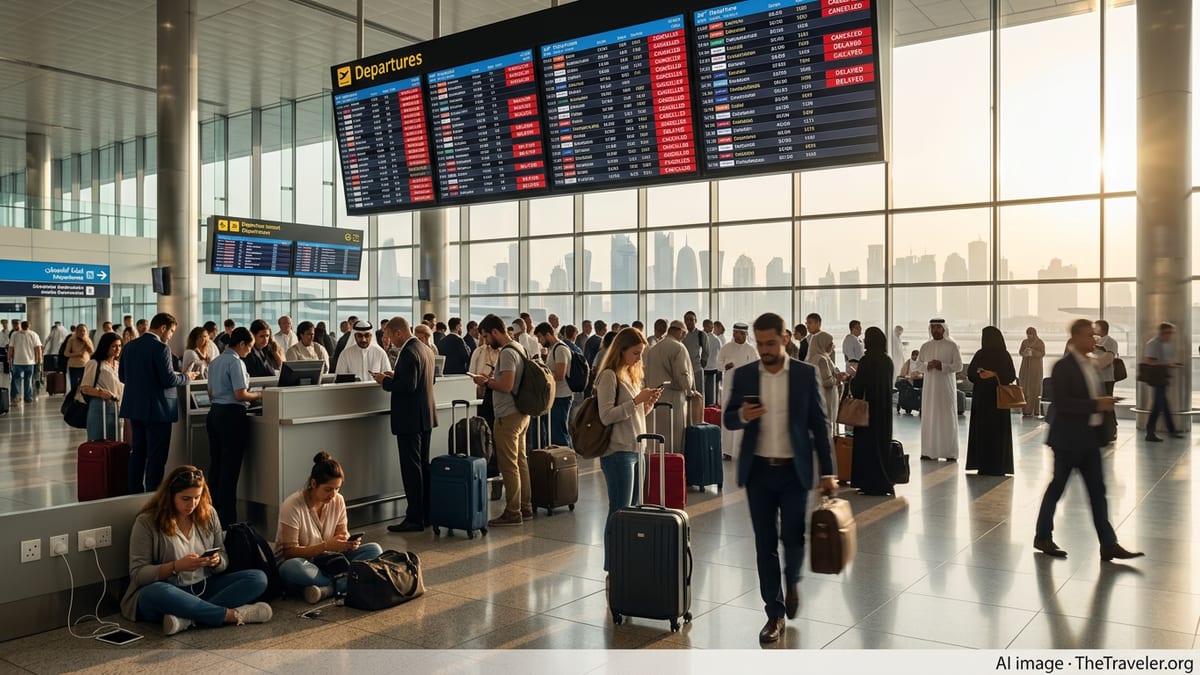
Middle East Conflict Ripples Through Global Flight Networks
The latest round of hostilities involving Iran, Israel and allied states has upended flight schedules across the Middle East and beyond, turning key aviation hubs into chokepoints and leaving hundreds of thousands of passengers stranded or rerouted. Airspace closures over Iran, Iraq, Israel, parts of the Gulf and neighboring states have forced airlines to cancel services outright or send aircraft on long detours that add hours to flying times and significantly raise fuel costs.
Major connecting hubs in Dubai, Abu Dhabi and Doha, normally among the busiest transit points linking Europe, Africa and Asia, have experienced waves of cancellations and temporary shutdowns as governments respond to missile and drone strikes. According to aviation data providers, thousands of flights have been disrupted since large-scale attacks began in late February, with knock-on effects reaching far beyond the region as aircraft and crew are left out of position.
Travelers heading for destinations as far apart as Bangkok, Johannesburg, London and Sydney have seen itineraries unravel with little warning. Some governments have issued urgent advisories urging citizens to leave parts of the Middle East, while others are organizing special evacuation flights out of Gulf airports. Industry analysts warn that as long as airspace remains restricted and security risks remain elevated, global networks will operate on a fragile, day-by-day basis.
At the same time, tour operators and cruise lines that rely on Gulf turnarounds or regional shore excursions are scrambling to redesign itineraries and find alternative ports and gateways. The sharp reduction in capacity through the Middle East’s biggest hubs is beginning to impact corporate travel, cargo flows and migrant worker movements as well as holiday traffic.
WTTC Warns of Economic Shock Without Public-Private Coordination
Against this backdrop, the World Travel & Tourism Council is stepping up its warnings about the economic shock that prolonged instability could inflict on a sector that has only recently surpassed its pre-pandemic size. WTTC’s latest research shows travel and tourism contributed around a tenth of global GDP last year, with record investment and tax revenues. That momentum is now at risk in parts of the Middle East, where tourism had been one of the fastest-growing segments of the economy before the current conflict.
In a recent statement on the situation, WTTC leadership said it is closely tracking the impact of the tensions on travelers, businesses and communities across the region and beyond, underscoring that the conflict threatens jobs and livelihoods far outside the immediate war zone. Early forecasts for 2026 already point to a possible double-digit decline in international arrivals to the Middle East compared with earlier growth expectations, as cancellations mount and safety perceptions deteriorate.
The council is urging governments to maintain open channels with the private sector to coordinate security protocols, share real-time risk information and prioritize resources for the most affected destinations. It argues that rapid, transparent cooperation can limit long-term damage by preserving essential connectivity, supporting small and medium-sized tourism businesses and protecting workers who are most exposed to sudden drops in demand.
WTTC also stresses that history shows tourism can recover quickly when travelers perceive that conditions are stabilizing and when routes and services are restored in an orderly manner. To reach that point, however, the body says authorities must avoid unilateral decisions that fragment regulations, confuse passengers and complicate the work of airlines, airports, hotels and tour operators trying to plan even a few weeks ahead.
IATA Presses for Consistent, Safety-Led Airspace Decisions
For airlines, the immediate priority is safe routing through a region now laced with conflict zones, military activity and electronic interference. IATA, which represents the majority of the world’s carriers, has been vocal in urging governments to base airspace closures and restrictions strictly on objective safety criteria and international aviation rules, rather than on political or symbolic gestures.
In recent briefings, IATA’s operations and safety leaders have highlighted the growing risks posed by conflict zones, from missile strikes to GPS jamming and other forms of signal disruption. The association notes that in the past two years airlines have already had to navigate multiple war-related airspace shut-offs, and that sudden, poorly coordinated closures create systemic vulnerabilities by forcing jets into congested corridors or onto lengthy diversions at short notice.
IATA is calling for more timely sharing of threat assessments between defense and civil aviation authorities, as well as clearer guidance on safe overflight levels and contingency routes around hotspots. It wants to see regional coordination mechanisms strengthened so that carriers are not left to interpret conflicting national notices to air missions at the last minute, when aircraft are already airborne and options are limited.
The trade body has also reiterated that safety performance in commercial aviation remains strong by historical standards, but warns that rising geopolitical tensions are eroding some of the gains made in risk management. Its message to governments is that keeping skies predictably open where it is safe to do so is essential not only for tourism, but for global supply chains and humanitarian operations that also rely on air transport.
Travelers Confront Rising Costs, Complicated Journeys
For passengers, the consequences of the Middle East conflict are increasingly visible in higher fares, longer journeys and a sense that even well-planned trips can change overnight. Airlines forced to avoid large swathes of airspace burn more fuel and tie up aircraft and crews for extra hours, costs that are already filtering through to ticket prices on some long-haul routes between Europe, Asia and Africa.
Uncertainty is now a defining feature of travel planning for itineraries that cross or connect through the region. Some travelers are opting to reroute via secondary hubs in Europe or Asia, accepting extra stops to avoid perceived risks. Others are postponing or cancelling trips altogether, particularly for discretionary leisure travel and religious tourism that can be rescheduled.
Consumer groups are reporting confusion over passengers’ rights as airlines adjust schedules day by day in response to changing security assessments and government advisories. While many carriers are offering free rebooking or refunds for flights directly affected by airspace closures, policies can vary widely by airline and destination, and hotel or tour cancellation terms often lag behind aviation decisions.
For the wider industry, sustained volatility threatens to complicate crew scheduling, aircraft maintenance planning and fleet deployment, particularly for carriers based in or heavily reliant on the Gulf hubs. Smaller regional airlines and inbound tour operators, which lack the balance sheets of global groups, are especially vulnerable if demand remains depressed into the key summer season.
Industry Looks to Past Crises for a Recovery Blueprint
Despite the immediate disruption, both WTTC and IATA note that the travel sector has repeatedly demonstrated resilience after shocks ranging from terrorism and natural disasters to health emergencies. Industry leaders say that experience provides a blueprint for recovery, but only if policymakers and private operators act in concert to restore confidence and connectivity once conditions allow.
That blueprint includes clear and consistent communication with travelers, rapid restoration of point-to-point links where security permits, and targeted marketing campaigns to rebuild demand for affected destinations when the situation stabilizes. It also involves financial support for small businesses in tourism-dependent communities, which may face months of reduced income even after flights resume.
In the current conflict, there is an added urgency given the central role of Middle Eastern hubs in global aviation networks. Prolonged instability could accelerate a structural shift in travel patterns as airlines and passengers reorient toward alternative gateways viewed as safer or more reliable. Industry groups argue that coordinated action now could help avoid permanent loss of market share for some destinations.
For now, the message from both WTTC and IATA is that cooperation is no longer optional but essential. With geopolitical risks rising and skies more contested, they insist that only a tightly coordinated approach between governments, aviation regulators and the private sector can keep global travel functioning, protect millions of jobs and ensure that the connective power of tourism is not another casualty of war.